Saturday, March 24, 2012

Els: Keep the Box!

Probably one of the best bits of golf swing advice I've ever seen or heard comes from the great touring professional Ernie Els; touring pros aren't usually the best golf teachers, but this small tip from Els has become one of my top swing thoughts.

I've referred to this before in other posts (sequenced passivity and golf's triangles), but it also ties closely into other posts and fundamentals that did not mention Els, including the right hip-right elbow relationship and arms falling to start the downswing (as Shawn Clement's "arm-club unit falling down the plane").

Simply stated it's this: the right elbow, right forearm, and right wrist (and thus the club) form a box shape (actually more of a rectangle with 2 90-degree angles) at the top of the swing. During transition, one simply allows this box shape to remain intact and fall down in front (right elbow coming close to the right hip while the shoulders REMAIN turned) and then release it past the ball. As Ernie so simply puts it, "Keep the box and give it a lash!"

I believe it's probably best to focus on the right arm only in the backswing, because doing this properly will keep the left arm straighter and help set the wrists earlier. And thinking of the box shape in the downswing is a given; maintaining it as long as possible gets 2 crucial levers working in the swing: the right elbow and right wrist straightening in the right sequence and at the right times. This adds tremendous, effortless power to the swing (for all shots…include bunkers and pitch shots).

This is Els' way of describing what TGM'ers call the use of Pressure Point #3: "Keeping the box" as Els describes will place pressure in the base knuckle of the first digit on the right hand from the start of the downswing until past impact. This is often referred to as "lag pressure," and it's maintained all the way down into the ball. As a matter of fact, one can think of the base knuckle or first phalanx of the right finger as analogous to the club face; it's often called the "trigger finger," though most of the finger should do NOTHING during the swing.

By using this "box" method, you will notice that the left and right wrists can cock up and down WHILE the right wrist remains hinged backwards, and it's this backwards hinged right wrist that creates a flat left wrist at impact, maintains lag pressure in PP #3, gets the hands leading the club head, compresses the ball, and creates a forward leaning shaft. A key is to start down or transition slowly; the greatest speed is added at the bottom, not the top.

In reality, Ernie could have called this "Avoid the cast!" instead of "Keep the box!" Casters apply an active pushing force, unhinging force, and/or uncocking force (either consciously or unconsciously) at the top (and thus have to flip the wrists at the bottom), while laggers (i.e., good players) form the angles at the top and then drop that arm-club "power package" intact from the top (the right wrist remains hinged backwards through impact). Thus, the angles formed in the right arm during the backswing are retained late into the downswing. Casting is often associated with an early shoulder rotation; the arm-club power package should ideally begin dropping in response to the lower body BEFORE the shoulders open up.

Many instructors will tell you that maintaining lag pressure is not something you can do actively, but that poses the question: Is consciously fighting the urge to cast considered an active attempt to maintain lag? One could argue that "keeping the box" as Els describes is a means of actively keeping the angles and lag pressure in PP #3. Martin Hall's take on this is to "keep the thumbs pointing up in the air as long as possible," which also implies an active effort to maintain lag. As with all things in golf, let your results be the arbitrator.

A good way to practice this move is using the Pump Drill (see videos below); Hogan doesn't refer to it as the Pump Drill, but you can see him demonstrating it in his video. Another drill advocated by Hogan and Brian Manzella is to simply remove the right thumb from the shaft and hit some balls (Sam Snead used to remove his right thumb and right index finger entirely to practice). There are also drills that advocate holding a wet mop like a club (or using a club with a towel on the end) and dragging it across the ground. An impact bag is also used to instill the correct feeling at impact.

My take on the Pump Drill is to completely remove the right hand thumb and index finger from the handle to accentuate the pressure feeling in the base phalanx of my right index finger. From the top of the backswing, use the left hip motion to cause the arm-club unit to pump up and down a few times. The end of a "pumping action" gets the hands over the ball with the club shaft still parallel to the ground. After one or two "pumps," let it go at the bottom.

What happens when lag is taken too far? Skull shots (not really thin shots) because the club bottoms out late and balls that fly off to the right because the club face doesn't close in time. Rejoice if you see these occasionally instead of weak fat or thin shots that come from casting and flipping.

It's very crucial to keep your head behind the ball (i.e., maintain a tilted spine angle); just get the feel that once you get over the right leg in the backswing that the head stays there while the lower body weight shifts to the left. Keeping the head back assists with shallowing out the swing and with hitting inside-out.

Even cooler, if you "shake hands" with your right hand towards the target, you can coax a draw or straight-ish ball flight (the toe of the club overtakes the heel), or you if you hold off the right hand somewhat (toe and heel come through more together) you can get a fade.

As Ben Hogan rotates his lower body towards the target, the "straight left arm + bent right arm" act as a single unitary structure and they are both passively pulled down towards waist level as a single unit. Homer Kelley refers to this unitary structure of the left arm and bent right arm as the power package assembly [6]. In other words, Ben Hogan does nothing actively with his hands/arms/club during the early downswing - he simply allows them to respond reactively/passively to the shift-rotational movement of the lower body, and he simply allows the entire power package assembly to be passively pulled down to waist level.

How to maximize wrist lag

[Drill for learning the feel of lag pressure.]

BM: "Grip the club normally. Take the right thumb off of the club and point it at the target. Hit it."

[Why does this work?]

Forum Member: "...when most of us begin to lose the lag, we compensate by feeling/adding pressure from the right thumb to try and stop the throwaway....without the right thumb on the club, we must store and hold the lag or be ready for the club to flop around coming into impact (especially if there is throwaway or if we lose the lag on PP#3)."

BM: "Helps Slicers too!

...but why???"

Forum Member: "Without the right thumb exerting pressure on the club, one can drag the sweetspot onplane via the right index finger, thus closing the clubface by impact."

Best Drill for maintaining lag

In the Golf swing there are 4 distinct pressure points (more on that in another article) but again, for simplicity stakes, we will focus on the easiest and more convenient to feel: the meaty part of your index (the "trigger finger") of your trailing hand where it touches the club.

Here is the trick: Are you able to perform a Golf stroke while feeling pressure in this index from start down to both arms straight (the end of the follow-through and before the finish)???

Even better: if you can feel this pressure not decreasing (unrelentless pressure), I bet my shirt you must be a 1 digit handicap as you must have Lag in your swing with all the good things that come with it!

A player who casts the club (club head throwaway) does exactly that: he feels a lot of pressure in the start of the downswing (by accelerating the club very hard and convulsively). Such a sudden accelartion thows the club away with no chance to catch it up before impact.

Needless to say, that player feels no pressure at all in the index finger when the club head arrives at the ball.

The correct way to do it is to push your cart evenly with no over-acceleration.

Golf Lag Tips » Focus on pressure points to feel Lag


One-Plane vs Two-Plane

Saw something interesting from Martin Hall on Golf Channel recently discussing variations in swing planes, specifically one- and two-plane swings. This is a concept championed by Jim Hardy.

Martin said that a one-plane swing has the shoulders pointing more downward with the angle of arms matching the shoulder angle in the backswing, while a two-plane swing has the shoulders turning on a flatter plane with the arms moving more vertically during the swing (what I do currently).

He went on to say that the two-plane swing relies more on timing with the arms on the downswing, while the one-plane's swing relies less on timing because of the pivot used to square the face.

Chuck Quinton's Rotary Swing would be an example of a one-plane swing.

Wednesday, March 21, 2012

Low Trajectory with the Driver

UPDATE: Can now confirm that this is a MUST, especially with longer irons! Definitely gained yards and height by keeping the head back, but the bend in the right elbow (or keeping the box) needs to be kept as long as possible to prevent hitting fat. Another way to think of keeping the head back is to simply widen the stance, which automatically pre-positions the head behind the ball and more weight to the right side. Also, one of my old habits is to unconsciously try to lift the ball (a yip or flinch), because we've all been told to hit up on the ball with the driver, but this actually will cause thin and fat shots. It's more important to envision swinging level to the ground; pretend you're trying to drive a nail directly in the back off the ball with the driver and woods.

This is something that has plagued me. So I'm intrigued to try some of these strategies to correct it and give me a higher ball flight with my driver. In essence, I think I use too much of an iron swing with my driver; I end up with low pull-hooks, high push-slices, hitting behind the ball (fat), and toe shots. I've noticed that my head will often get ahead of the ball or that I'm fully on the outside of my left foot at impact, and thus the only thing I can do is hit more down and cut across the ball as opposed to sweeping it off the tee with an inside-out motion. I also often try to help the ball into the air using body english and arm motion, and this just makes things worse; the irony is that the ball will get more airborne by concentrating on hitting the back of the ball (sweeping it level with the ground) as opposed to trying to hit up!

I believe that a lot of my problems stem from being too aggressive with shifting to the left leg (again…left over from my S and T days), and that is especially troublesome with the woods. Yes, I think it's true that the weight must shift fully to the left, but for me I think it has been too quick as opposed to a gradual process. Pictures of pro golfers hitting driver at impact shows that their heads are well behind the ball and even over their right leg, while they finish fully on the left. Clearly, I'm not executing a proper weight shift and losing distance as a result.

The golf weight shift from right to left is a definite…but a GRADUAL definite. It's not an instantaneous, violent maneuver as I've thought of it before. As Haney says with regard to weight, one should roll from the inside of the right foot onto the left big toe and finally to the outside of the left foot and heel.

In reality, keeping the head back longer and preventing a rapid weight shift from right to left are nearly synonymous. They both refer to the same thing. And this error is never more glaring than when hitting driver. Get the feel that once you get over the right leg in the backswing that the head stays there while the lower body weight shifts to the left.

Also key is teeing up a little higher when you're trying to achieve a higher trajectory. The height difference will not be that different--maybe a quarter of an inch, but this will help get the ball back in a good position for the sweet spot with a more upward motion. Use with caution, however. Teeing higher requires that the ball be further forward in the stance, which may mean simply widening the stance.

Shallowing influences include positioning the ball further forward, swinging more around the body, and widening the stance.

When your head moves forward during the downswing, your whole swing plane moves ahead. That means you will tend to lose the ball to the right or leave the clubface open through impact.

One day, Lee Trevino was playing with the amateur golfer. Trevino gave only one advice to this golfer. He told him to keep his head back.

This amateur golfer was hitting a strong draw on that day.

[From Impact Position: Keep Your Head Back | Golf Tips & Lessons]

If you feel that you’re shifting to the left in the downswing to early, do some practice swings facing a mirror and watch your head to see if it’s moving left in the initial stages of the downswing. Also, watch yourself load your weight better into the right inste/heel as you hit the top of the backswing.

Another thing you can do is take you ball and as you tee it up, turn the label so it faces to the right. Now, as you go to hit your shots, watch the label. If you shift too much left, you will loose sight of it. The only way to see the label is if you stay behind the ball as the club swings through impact.

A final thing you can do are practice swings “feeling” more weight on your right foot as the club swings through. By feeling more weight on your right, it will stop you from shifting to drastically to the left. Once you get the feeling in practice swings, apply it to your shots.

NOTE: It’s not that I want to weight on the right foot at impact, it’s just a drill to stop the weight from shifting to the left too soon. So, do a bunch of practice swings feeling more weight on your right side into the downswing. Then, apply this new feeling to your shots. After you start hitting your shots higher forget favoring the right leg like this.

[From Stop Hitting The Driver Too Low]

Lift your left heel

At address, lift your left heel. Take a few practice swings with your left heel off the ground during the whole swing.

This will prevent your upper body to move forward on the downswing.

If you stop your head from moving forward, your clubhead speed will increase.

[From Impact Position: Keep Your Head Back | Golf Tips & Lessons]

Lee Trevino had a great tip or swing thought that I use when I want to hit a ball really high (#10 at Lake View requires me to carry a ball pretty high over some trees around an 80° dogleg).

His tip was "you want to feel as if you're head is moving backwards (to the right for a righty) at impact." Lee used the tip to hit a draw, but if you're square it's a good way to keep your upper body back through impact, too. Tee the ball up a bit higher if necessary too, yeah.

[From Trajectory is too low with my Driver]

When a golfer places too much weight on their front foot, it increases the chances of a golfer getting out front of and "stabbing" at the ball, which is likely to yield a low trajectory off the drive. However, by keeping one's weight back and leaving it there until impact position, the weight is more evenly distributed across the swing, which will help make impact with the ball on the way down, therefore increasing the chances of a longer, higher drive. Also, make sure not to swing too quickly and "lunge" at the ball, as this can create a low drive as well.

[From Causes of a Low Drive in Golf | Golf Tips | Golfsmith]

Lots of teachers will tell you to hit it on the upswing with your driver. But if you do it too much, it can cause slice. Some golfers start to hit well when I ask them to sweep the ball instead of trying to hit up on the ball.

...you can focus on the back of the ball instead of just looking at the top of the ball. The clubface contacts with the back of the ball. So you should focus on the back of the ball as well.

Here is a good swing thought. Picture a nail stuck into the back of the ball. When you swing down, I want you to drive the imaginary nail through the ball.
The problem is teeing up higher and placing the driver on the ground at address. For example, let's say that you tee the ball up so that 2/3 of the ball is above the driver head. If you return the driver head to its address position, you will hit a pop-up.So you will have to raise the driver head off the ground at impact. But if you do this, the driver head moves further away from your body and cause heel hits.To fix this and hit it in the middle of your clubface with higher tee height, hover the driver head (off the ground) just behind the ball. I think you will be able to fix your heel hits with this adjustment.

[From Can't Hit the Driver? | Golf Samurai]


Saturday, March 17, 2012

Ball Focus: Inside-Left

I wrote about this briefly and anecdotally in another blog post, but I decided it needed a post of its own; it's that important. At least for me. I don't begrudge the many teachers out there who think the ball should appear blurry or the focus should be only on the target. But if you're focused on the target and then launch the ball into the woods 45 yards to the right of the target, focusing on the target does you little good.

We know that lagging the shoulders behind the hips is important to swing inside-out (the so-called X Factor). And we also know that the head should stay behind the ball through impact (or not move past its initial position created at setup for the woods and driver). We know, too, that the ball should start to the right and curve left to REALLY hit a draw (i.e., not a pull hook or straight hook).

I believe that focusing on the inside-edge or inside-left quadrant of the ball throughout the swing will assist in achieving all of these goals. First, it telegraphs to the body that you want to hit the ball on that spot, which encourages an inside-out swing. This means that one MUST keep the back to the target longer to avoid coming over-the-top by hitting the outside-right quadrant of the ball.

Second, focusing on that spot will tell the body to keep the head (and therefore upper body) from swaying ahead of the ball on the downswing. Keeping the head back allows the arms to come through, make impact, and then pull the golfer up to a nice, balanced finish. Get the feel that once you get over the right leg in the backswing that the head stays there while the lower body weight shifts to the left. Understand, however, that keeping the head back can cause the club face to close earlier.

Wherever your eyes are looking, your hands and the clubhead will want to go. If your eyes are looking at the back of the ball at address, then you are probably trying to square the clubface to the back of the ball at impact. Address and impact are two very different alignments in golf. Focus your eyes on the inside quadrant of the ball at address and your hands will strive to reach your new focal point. By making this small change, you will be well on your way to improving your downswing and obtaining much more manageable misses.

[From Classic Swing Golf School]

Other golfers need to focus on the ball. If this is you, try to hit the inside edge of the ball at impact.

A good thought for you might be to keep your back to your target and swing your arms down to the inside. Just try to avoid starting your down with your shoulders and upper body as this will throw the club down on a steep and outside path.

[From Golf World: Better shots through inside path | ScrippsNews]

When your head moves forward during the downswing, your whole swing plane moves ahead. That means you will tend to lose the ball to the right or leave the clubface open through impact.

One day, Lee Trevino was playing with the amateur golfer. Trevino gave only one advice to this golfer. He told him to keep his head back.

This amateur golfer was hitting a strong draw on that day.

[From Impact Position: Keep Your Head Back | Golf Tips & Lessons]

[Bobby] Jones was quoted: "Stay behind the ball is a splendid maxim. Should your head ever get ahead of the ball, at any point in the swing, a poor shot will no doubt result."

In Harvey Penick's, The Little Red Book, published in 1992, page 75 is entitled "Stay Behind the Ball" "All great golfers move their head slightly backward before and during impact, but never forward. A golfer must stay behind the ball. I mean set up with your head behind the ball and keep your head behind the ball. If you move your head forward during your downswing or through impact, you will hit a wee, ugly shot, probably a pulled slice."

[From Keep Your Head Back and Behind the Ball Through Impact! Six Top Golf Pros Agree]

Leaning back through impact can cause the face to shut quickly. For a power draw, Brett [Wetterich] releases the club straight down the line with the toe up.

[From Swing sequence: Brett Wetterich: 'hit it from the inside | Golf Digest | Find Articles]


The Rope Drill

This is an old (but great drill) that can help take the "hit" out of a golf swing and make it a "swing."

Here's a drill you should try.

Get yourself a piece of rope about 42" long and 1"thick.
Take a normal grip, take it to the top of your swing and let the rope rest on the top of your shoulder. As you start down with your lower body "feel" like the rope stays on your shoulder as your hands head toward the ball. Let the momentum of the rope finish the swing. By allowing the rope to lag behind, you'll sense what it's like to draw the club like "the arrow out of the quiver".

You will also note that in order to accelerate the rope, you will have to pivot properly and pull it lengthwise, it's almost impossible to come over the top.

[From Gotham Golf Blog: The Rope and The Pivot]

If you are using your core properly the rope will wrap around your body smoothly at the end of your back swing, straighten out at the bottom of your swing and re-wrap around your body during your follow through.

If your swing is all arms the rope will be "whippy," it will be moving all over the place, and it will slap you hard on the back. This is how you know that you are not effectively swinging and using your core.

It's like a shock collar for your swing. If your swing is all arms you will find out quickly and want to fix it as soon as possible.

The easiest place to see this is in the very beginning of your swing. Never initiate your swing with your hands. If you are doing this the end of the rope won't move at first when you cock your wrists. This is bad.

[From Stop Leaking Power From Your Golf Swing Using This Weird Trick]

Saturday, March 3, 2012

Swing Sequencing and Passivity

I've learned that normal instincts and proper swing actions diverge dramatically. Golf is full of these contradictions (i.e., swing left to make the ball go right, hit down to make the ball go up, etc.). Understanding these tenets intellectually is easy; putting them into practice is tough.

The swing instinct of the beginning golfer is to use the hands and arms to hit the ball; that's what feels natural. The resulting swing sequence of that instinct is something well known to frustrated golfers: the upper body leads the downswing, club gets laid off or across the line, the shoulders spin out, the arms are thrown out and away from the body, posture is lost, club casting, coming over the top, the knuckles of the left hand point up, and the ball pulls, hooks, and slices, depending on the club face position at impact.

At some point, with enough effort, the beginning golfer begins to implement the fundamentals that all the great teachers espouse: upper body turn on backswing (lower body resists), arms stay in front of the body, lower body leads on downswing (shoulders and arms resist), hips bump and turn, the club comes from the inside (drops in the slot), lag is maintained (no casting), no flying elbows (chicken wings), full extension, good release, left hand knuckles turn down, square/closing club face, etc. The feeling is described as effortless, passive, and a good impact feels like the ball isn't even there. The ball flight is either straight or a controlled fade or draw in the target direction. Of course, it takes time to implement the elements of a good swing and then to learn the proper order or sequence of those events. At some point, they move from being separate thoughts and actions that may occur asynchronously to a free-flowing, coordinated, sequenced series of moves that result in a passive, effortless swing and great, consistent impact.

The golf swing has vertical movement and horizontal movement movement. The vertical movement comes from the arms lifting up and down in front of the body; the horizontal movement is provided by the turning of the body. The small muscles in the chest, shoulders, and arms ARE NOT INVOLVED in getting the club back to the ball. The golfer must surrender to the quite correct tenet that he is not controlling anything with the arms; he is merely setting up properly (so that the ball is in the way) and then assisting natural physical forces to propel an object; when you feel "out of control" with the arms and small muscles, you're starting to learn the right feeling, which runs counter to intuition to use the arms in order to hit the ball.

  • One piece takeaway and backswing, where the arms stay in front of the body in a triangular formation and the right knee keeps the bend established at address.
  • Completed backswing has the shoulders turned 90 degrees (back facing target) and loaded into inside of flexed right leg. The arms are extended away from but still in front of the chest in their triangle shape. The right elbow folds naturally and the wrists set naturally, creating a "box" shape at the top of the swing that one should try to maintain for as long as possible. The club is pointing at the target at the top (not laid off).
  • Transition has the arms simply dropping (triangle still in front of the body) while the back remains turned and the weight shifts to the left leg and the left hip immediately rotates backward. The shoulders haven't rotated yet, so an X Factor is created between the shoulders and hips.
  • Get the feeling that the arms get to the top and stay there while the lower body moves and the arms drop down from the top (maintaining the "box" shape); the arms, hands, and small muscles should be completely passive and make no effort to swing or steer the club!
  • Downswing: As the still folded right elbow nears the right hip (from the arm dropping action), the hips rotate fully toward the target. This gets the arms coming from the inside--they cannot be thrown over the top in this manner.

The result is that the ball is hit effortlessly and the arms don't really do anything consciously (they're passive), which is the opposite of what one tries to do when beginning golf. The body can appear to move very slowly but the club head is actually moving quite fast; this is how pros like Ernie Els and Fred Couples can hit the ball far but appear to be moving in slow motion. A good ball flight with good distance results. The finish is natural and balanced (one can easily lift the right leg and remain balanced over the left). In short, it feels good, correct, and easy. Swinging faster is simply a matter of turning the hips faster; swinging harder is out the window, because there's no muscle tension involved. The body is learning to assist gravity and physics to let the club do the work. But the body's gut instinct is to tense up and rip it, which will result--consistently--in looking for one's ball in the trees.

It is important that a golfer understand that Hogan implied in his book that the arms/clubshaft are passively pulled down to waist level as a result of the lower body movement, and that a golfer shouldn't have to actively pull the arms/clubshaft down to waist level as a totally separate/independent action. Ben Hogan stated that his arms/hands "get a free-ride" down to waist level when he shift-rotates his pelvis at the start of the downswing [4].

[From Downswing]

Most amateurs try to help the club toward the ball by pulling on it from the top of the swing. They are, in effect, trying to help gravity—one of the greatest forces in the world. Mother Nature doesn’t need your help. She’ll get it done—if you don’t pull on the club.

When you’re at the top of the backswing in good balance, you literally let (key word even if it’s small) your arms drop through space as you turn your hips left and get your weight onto your left heel at the completion of what’s a lateral turn.

[From Golf Tips - The Fire Drill]

Williams, focusing on the speed of [Bobby] Jones's swing, calculated that from the top of his backswing to the point of contact with his ball Jones's hands and arms were accelerating at a rate of just over thirty-four feet per second per second.

What makes that interesting is that if you were to extend your arm and drop a golf ball, its acceleration rate as it fell to Mother Earth would be just over thirty-two feet per second per second. See where I'm going with this? It means that in the beautiful golf swing that propelled a ball 260 yards with a hickory-shafted driver, the great Bobby Jones did only a little more than let his arms fall out of the sky.

Bobby Jones depended on gravity to build his golf swing.

[From Ruthless Golf: Those Amazing Relaxed Swings]

Transferring your weight to start your downswing is crucial to an "inside" delivery-the key to cracking 90. From the top, you should transfer your weight from the back leg to the front. Resist the temptation to start your upper body or the club first. It's like a throwing or kicking motion.

[From Breaking 100-90-80: A monthly guide to the scoring basics - golf tips | Golf Digest | Find Articles]

Saturday, February 25, 2012

Golf's Triangles

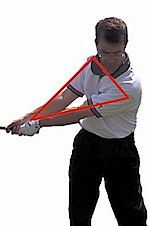
Another way to consider the motion of the arms in the golf swing is to think of the triangle formed by your arms at address. This swing thought can be used to help prevent getting laid off or across the line at the top, preserving the correct swing plane, and it can also aid extension back and through. Finally, it's absolutely critical for a proper takeaway.Takeaway Triangle

It's important to note that the triangle stays in front of the body or chest all the way through the swing, and it can even be used for short game shots. The sides of the triangle near the base (your upper arms) should stay connected to the sides of your chest.

Using this triangle swing thought keeps the elbows related to the hips, especially the right elbow to the right hip, and helps maintain the swing radius. It's important on the backswing to remember that the right leg stays bent to get the full benefit from the triangle.

Simply form the triangle at address, lift the triangle vertically on the backswing (as if it swings around your neck) by rotating the shoulders (the right elbow naturally folds as it rises); allow the triangle to lower on the downswing using hip rotation, and allow it to lift vertically on the through swing. The triangle stays in front of the body the entire time; the triangle does not become "horizontal" or more parallel to the ground until you reach the top (going back in the takeaway, it should feel vertical, with right arm above the left). A full 90-degree shoulder turn is essential to using the triangle correctly, with the right shoulder pulling the triangle into position at the top.

During the takeaway, the right arm should remain straight for as long as possible, and it will initially stay above the left arm, as mentioned above. This will help keep the club head outside the hands during the takeaway, which is key to avoiding an OTT downswing. When the right arm finally does fold up, the right elbow should be pointing down at the ground--not behind the golfer (both elbows should stay relatively close together--as close as possible to the distance they were at address). Separating the elbows at the top is a major flaw that can lead to the arms collapsing, and it's a sign that the arms are doing more than merely moving vertically.

The movement of the shoulders is key; the triangle in the takeaway moves in response to the right shoulder pulling back and up behind the golfer, while the left shoulder tilts down. The right palm faces down toward the target line during the takeaway, such that the club face angle matches the spine angle. The arms, wrists, and elbows do very little to get the club back, but the arms rise vertically to get the club up.

The raising and lowering of this triangle (along with wrist action) constitutes the upward and downward motion of the golf swing, while hip rotation (and associated shoulder rotation) constitutes the horizontal, circular motion of the swing. At no time should the arms pull the club back behind the body; the correct feeling is a lifting up-and-down in front of the body without much independent arm movement.

Martin Hall has criticized this "triangle thought" because the arms don't actually maintain perfect triangles throughout. Instead, he argues for keeping your arm extension. Don't let this deter you. As with anything in golf: If it helps you then USE IT! Yes, we're not talking perfect triangles (the elbows do bend) but you get the point.

The triangle concept perfectly illustrates the takeaway. The butt end of the club should point roughly at the belt buckle during the takeaway (before the arms begin rising). If you're used to quickly pulling the club inside with your hands then this will feel really weird and wrong--as if you're outside the target line. But you're not! You're keeping the club head OUTSIDE your hands until the correct moment in the backswing by maintaining this triangle and keeping the butt end of the club pointing at your belt buckle in the takeaway. You've heard that the pitch shot is actually an abbreviated full swing; I think the pitch shot is either the takeaway or just beyond it with a little bit of wrist action!

However, there is ANOTHER triangle worth mentioning: the so-called "eternal" or "magic" triangle, formed by the angle of the left arm, club shaft, and an imaginary line from the left shoulder to the club face. The longer this triangle is maintained, the greater the lag. However, the first triangle we discussed is really the key to the "eternal" triangle. Not surprisingly, this also is the "L shape" of the left arm to club and Ernie Els' "maintained box" shape (he focuses more on the angles of the right arm to the club as opposed to the left). Keeping these angles ensures the use of the joints as levers (as in physics), which produces maximum lag and energy transfer.

Here is a quick drill: Hold the club straight out in front of you and extend your arms out as far as they can. This should create a TRIANGLE between your chest and your hands. This triangle is the key to a consistent golf shot. We want to keep this triangle formed throught the entire swing.

[From Golf Swing Plane Tips: How To Develop The Perfect Golf Swing]

Take the triangle you form between your arms at the top of your swing and pump it up and down to waist high. Get the feeling that your right elbow grazes against your right hip. Don't jam it into your hip. Just make sure it connects in some way. Also, stand in front of a mirror and watch for the gap. When your right elbow grazes your right hip, you should see some space (daylight) between your forearms. If you see this, you are coming from the inside, and on your way to playing good golf.

[From Golf Tips - Lessons from the Golf Pros - The Magic Gap]

You can also imagine a triangle, formed on two sides by the shaft of the club and the left arm, with the third side an imaginary line from the club head to the point of the left shoulder. From the top this triangle must be tilted and brought down a ways without changing the length of the imaginary side.

This we call the "eternal triangle," because it must be retained as long as possible. As the speed of the golf club head increases, the imaginary side of the triangle lengthens, of course, and the arm-shaft angle starts to open up. But the triangle should be kept constant as long as possible.

[From Golf Downswing: Third Magic Move]

A one-piece takeaway also keeps your hands in front of you. Note that [Lucas Glover's] hands are still pretty much in front of his belt buckle, even though his wrists have begun to cock. (In case you're having trouble seeing it, the clubhead is just to the left of his elbow.)

Ruthless Golf: More Thoughts on Keeping Your Hands in Front of You

1. Grip Points to Belt Buckle...To ensure correct hand height, the butt of the club should point at your belt buckle at address.

2. Clubface Points at Ball...One useful checkpoint is to see that your clubface is pointing at the ball as you swing the club back (right). This will head off two Common errors: fanning the clubface open so it points at the sky, or holding it closed so it points down at the ground. Either mistake forces you to become handsy if you hope to return the club back to square at impact.

3. Wrist Cock Blends with Turn...When your wrists begin cocking up, they should blend with your turn to keep the club on plane. You can check this by stopping your backswing when the shaft is parallel to the ground.

Three 'Musts' for a Smooth Takeaway | Instruction Feature | PGA.com

When I ask amateurs to show me how they start back, most will move the club away with only their hands and arms. What I want to see is the hands and arms moving in sequence with the rotation of the upper torso. All three should move together as one unit until the left arm gets parallel to the ground--at that point the swing's momentum will keep the hands and arms on plane.

Sean Foley: Simple Swing Fixes: Golf Digest

A couple of things to notice in these photos: the shape of the triangle that she [Annika Sorenstam] keeps with her arms and chest, the way that the club head stays in the center of that triangle (in other words, no early wrist cock), and the way that her right arm stays above the left arm all the way to waist high.

The Takeaway: A Common Fault and Fix | Three Guys Golf

Notice how the upper part of my left arm is still attached to my chest, while the clubhead is outside my hands as the club has traveled about halfway back. My left wrist is still cupped, my right arm is above the left and my right knee is still flexed. These positions, though simple, are absolutely critical.

50 Best Swing Keys | GolfTipsMag.com

Compare any of the greats in history and pause the video on the DTL view when the shoulders have rotated roughly 45* you will notice all of them have the triangle at that point between their chest and arms regardless of lift of the arms or rotation only. If the left arm looks higher then the right arm at a 45* shoulder turn then likely that person has come away inside and very flat.

So it is more about arms and chest working away from the ball as a single unit not really the right elbow staying close to the body, if you look at a face on view you will see most golfers that right elbow when the shoulders get turned 45* is actually a pretty good distance from the body.

Right elbow is the key

A good way to take the club away from the ball as straight as possible without swinging the club overly outside or inside the target line is to focus on keeping the right forearm staying above the left during the takeaway. Even if you try to keep your right arm on top of the left on the backswing, it will automatically move under the left arm at the proper moment as you swing the club to the top. As your backswing continues toward its top, your right arm should start to fold at the end of the takeaway and move under your left.

Keep right forearm above the left

Simply put: The right arm should be on top of the left arm as you start the backswing, and then it should move under the left arm as you swing the club to the top.

Many amateurs fold and shorten the right arm too early as they snatch the club away. What you really want is a relatively straight right arm during the initial part of the backswing as this promotes width and good pace -- keys to hitting solid shots.

David Leadbetter: Move Your Right Arm The Right Way : Golf Digest

Most golfers ruin any chance of hitting consistent golf shots within the first 6 inches of the golf swing takeaway.

The first takeaway mistake that I see most often is for the golfer to hinge the right wrist early or bow the left wrist (often, both are done together). Simply hinging the right wrist 45 degrees will move the club about 3 feet without the body having to move an inch.

The other common golf swing takeaway mistake is pushing the golf club back predominantly with the left arm and shoulder.

This is typically coupled with early right elbow flexion (i.e., bending), which should not occur until the takeaway is completed. In other words, the right arm should remain completely straight until the club is past parallel to the ground.

Learn the Perfect Golf Swing Takeaway in 5 Minutes per Day - Online Golf Instruction

The right arms should stay “above” the left as you move the club away from the ball with the palm of your right hand pointing at the ball. This will keep the clubhead outside your hands and stop you from fanning the face open. When the club gets to parallel to the ground during the takeaway the clubhead should still be slightly outside your hands with the clubface parallel to the outside of your right arm.

Top 100 Teachers: Ask Brady Riggs Live! Golf Magazine Top 100 Teacher Will Fix Your Faults

Notice Nick Price’s right forearm and how it is comfortably above the left. This is all accomplished by pivoting the shoulders on a fairly steep plane. The higher the right shoulder, the higher the right forearm and so on…

In a correct pivot, the left shoulder’s first move is down and then slightly across. This is in direct contrast to what most golfers attempt to do with their shoulders, which is: a. turn them as much as they can and b. get the left shoulder behind the ball.

The Shoulder Pivot in the Golf Swing | Andrew Rice Golf