Showing posts with label Shawn Clement. Show all posts

Thursday, April 2, 2015

Toe-to-Heel Weight Distribution

Proper weight distribution
Proper Weight Distribution

Weight distribution in the address stance involves not only inter-foot distribution (i.e., weight distributed between the right and left foot) but also intra-foot distribution (i.e., vertical weight distribution within each foot); this post will discuss how the weight should settle within each foot vertically, from heel to toe, to create a balanced, stable stance during the setup capable of eliminating many potential downstream errors. Jack Nicklaus is correct: Most golf swing errors (90% or more) occur during the setup (i.e., GASP - grip; alignment/aim; stance/setup; posture/position); golfers should spend more time on GASP and takeaway than they spend on anything else because all that follows is a consequence of a good setup.

A quick Google search illustrates the most common bit of advice from various golf authorities regarding this subject: Most seem to advise the student to position more of their weight in the balls of the feet. For the anatomically challenged, the ball is the fleshy, firm part on the bottom of each foot located below the toes and just above the arch. The bottom of a normal foot contacts the ground primarily in three general areas: the heel; the toes, and the ball; the inside arch, in a normal, standing anatomy, is raised above the ground between the heel and ball of the foot, with the toe pads lightly touching the ground. (Actually the outsole of the foot also contacts the ground, but you should NOT feel that--especially in your golf setup.)

The theory behind the advocacy for positioning weight in the balls of the feet is always explained in terms of other sports; baseball, tennis, and basketball require ready positions that call for more weight situated in the balls of the feet to facilitate reactionary, springlike movement forwards, backwards, or to the sides. The obvious problem, of course, is that golf doesn't require any such sudden "reactions" from its "ready" position, so the reasoning is weak.

Then, of course, are the problems that can arise when skewing weight into the balls of the feet (and thus engaging the toes). As your weight shifts more towards your toes and away from your heels, the toes will begin absorbing body weight and you will notice that your upper body and arms tip excessively toward the ball, creating an unbalanced stance, and so the hosel of your club head will inch ever closer to the ball, introducing an increased risk of shanking. The address shaft angle will steepen, and you are more prone to be steep coming back down. If you go too far, you may unconsciously attempt to regain balance by shifting towards the heels during the downswing, which can move the club head across the line, cause early extension (loss of posture), and an increased chance of hitting pulls and slices. You can also tip further forward if you lose your balance; again, you'll see shanks and fat shots. None other than golf great Tom Watson advocates for this "athletic setup" with weight in the balls of the feet, but I wonder if he doesn't just mean "weight away from the heels." Hank Haney also states emphatically that more weight shoiuld be in the balls of the feet, not the heels. Jim Flick, the coach who helped Nicklaus in his later years, advocated for weight in the balls of feet, while his famous student, Jack, did not (see below). I had a recent local golf lesson from a PGA teaching professional who actually told me to shift more weight into my toes without any explanation!

There are a few who seem to advocate shifting more weight into the heels and with seemingly little in the balls of the feet, but this can cause the opposite problems as described with the "balls of the feet" crowd: Hooks, pushes, toe strikes, thin shots, and an unconscious downswing move that shifts weight towards the toes in an attempt to regain balance, or if unsuccesful, falling backwards. One particular "brand" of instruction in this cohort advocates "balancing on the ankles," though it's possible they actually mean being balanced between the heels and balls of the feet; it's hard to know because they never describe what "ankle balance" is. Too much weight in the heels produces an extremely flat shaft angle and a "sit down" look in the golfer at address, with a very erect posture.

The next largest (and most prestigious) group of golf gurus and professionals unambiguously advises amateur golfers to balance their weight evenly between the heel and ball of each foot. Shawn Clement uniquely describes such weight distribution by asking the student to imagine that the arch of each foot is a "suction cup" gripping the ground. And since we've already established that a healthy arch doesn't really touch the ground, Shawn is actually describing an equal distribution of weight between the heel and ball of each foot. None other than the great Jack Nicklaus advises golfers to distribute their weight this way--evenly between the ball and heel--in his great book, Golf My Way. When utilizing such a stance, you will easily be able to raise your toes very slightly off of the floor of your shoes and leave them that way throughout your swing, because the toes should have no weight on them. Other notable proponents of this advice include Ben Hogan, Jim McClean, Sean Foley, and Nick Bradley.

Geta
Japanese Geta Sandles

I believe this last group--Nicklaus's group--has it right: The best way to address the ball is to vertically distribute your weight in each foot evenly between the ball and heel. To find this position if you have address balance problems, you will need to shift away from your tendency; if you tend to concentrate weight in the balls of your feet (probably most golfers because of what traditional golf instruction has preached for years), you will need to rock back away from your toes at address until you feel your heels engage and your toes disengage. You should imagine you're wearing traditional Japanese Geta wooden sandles. Some of these sandles have raised wooden extensions that are roughly located at the ball and heel of each foot; they approximate how you should feel--both the heel and ball of the foot carrying an equal amount of weight. If you've been a toe-leaner, you're going to feel way back on your heels; and if you've been a heel-leaner (less likely and less problematic), you'll feel the ball of your foot engage more.

Other things you may notice when redistributing your address weight in this manner include a taller feeling posture with arms that hang freer (you've created more space for your arms), lower hands that feel more inside your eye line, and a flatter club shaft while at address. You will need to definitely unlock and protrude your glutes with a straight back to remain balanced. Your toes will feel ever so slightly raised off the floor of your shoes. Your quads will disengage and your glutes will engage more. It's easier to produce greater downswing speed by twisting the lower body (knees and hips) forward (swinging more "from the ground-up") when starting down from this balanced heel-to-ball weight distribution.

A drill for ensuring you achieve this position (or at least verifying that you're setup correctly) is to get into your address posture and then hang an iron from under one of your armpits using two fingers, with the club head hanging down. The shaft should hang straight down and pass through your knees and point at the ball of your foot (your armpits are over the balls of your feet). At the same time, you can utilize this drill to ensure your feet are shoulder-width apart (as they should be at a minimum for all fall swings, regardless of club length); in this case, the club shaft will hang down inside the heel. If you're doing video analysis, you can use vertical lines to check these positions as well.

The only times you should favor the heels or toes at address is when you face uneven lies. In the case where the ball is below your feet, shift back into your heels by bending your knees more and try to stay that way through impact. When the ball is above your feet, shift into your toes by straightening your knees more and maintain that feel through impact. You'll hit better shots from those trouble lies when remembering to make these adjustments.

Finally, this method of weight distribution isn't only helpful in the full swing. You can use it to good effect in the short game (chips and pitches) and putting, as well. Try putting with weight concentrated towards your toes in your stance; you will notice that it's very easy to move the lower body unintentionally, while it's easy to keep the lower body stable with the weight balanced between the heels and balls of the feet.

Most traditional golf instruction tells us that your weight should be over the balls of your feet. You’ll read this in books and magazines, and hear it from teachers and TV golf pundits all the time. Not only is this instruction dead wrong, you’ll lose power and consistency this way, but it’s also potentially harmful to your body.

Golf Swing 102c. Setup: The Perfect Golf Weight Distribution and Balance

Your weight should be 50-50 on your left and right legs and between the balls of your feet (those cushioned pads just below your toes) and your heels. I'm surprised how many people think their weight should be supported by their toes. Starting with your weight too far forward is one of the worst mistakes you can make. It throws off all of the critical angles—spine, legs, hips, shoulders and head. That creates a domino effect, resulting in a weak swing and fat shots.

Jim McLean: Find Your Balance

Your weight should be distributed between the balls and heels of your feet and equally distributed between the two. You should be able to tap your heels and wiggle your toes. At this point you have counter balanced your weight. You should be able to draw a vertical line from the back of your shoulders through your knees to the balls of your feet. Now you are in balance.

Set Up for Success

Good footwork, too often overlooked, promotes balance, power, and consistency. Good footwork starts with balance at address. From the beginning of the swing, the weight moves from the middle of the feet back to the heels. When you finish the swing, your weight will finish on your front foot heel. The weight should NEVER be on your toes.

Learn to Squash the Ball at Impact

When hitting shots, you want to make sure that your weight is centered on your arch. Not the balls or heel of your feet. If your weight is on the balls of your feet (Because you're too far from the ball) as you address the ball, your hips will be prohibited. The result is that you'll straighten yourself up in your downswing.

How good is your balance??

The ball tends to be lined up off the heel [when the weight is on your toes] and can lead to pulls and hosel rockets. To set up properly you want to ensure you have the weight in the middle of your feet. I often like to bounce slightly up and down to ensure I have achieved this position. As I go through my swing I am cognizant of trying to keep my weight over my feet and not let it sneak out over my toes or lean back on my heels at impact.

Set up for Success

While developing a sound foundation in your golf swing, focus on where your weight distribution is located. Ideally, you would like the weight evenly distributed between the balls of the feet and heels at address. If you reach too far to get to the ball, your weight will go too much on the toes. If you remain upright and bend your knees with too much flex, your weight has a tendency to go back on the heels.

Golfers need to feel it in the feet

A golfer should settle into the arches of the feet and allow them to compress. This will activate the feelings in the ball and heel of the feet. They will really come alive! This notion that a golfer sets up or balances on the balls of the feet is nonsense! Sure, there is weight on the balls of the feet, but it is a result of compressing the arches. Tiger has this mastered this in recent months. Prior to that he was back on his heels. This one, simple adjustment has paid huge dividends for Woods.

Tiger Woods Golf Swing with Sean Foley

So I just gave it a try, basically going for the feeling that my armpits were over the balls of my feet, and it instantly felt better - more balanced, more relaxed. Then a number of things started falling into place: I actually felt torque between my upper and lower body; I stopped swaying; my tendency to "lift up" at impact disappeared (which I realize now was what my body had to do to keep from falling over forward because of how far I was bent over); and I stopped yanking the club way inside on the backswing and lifting it to the top, which I've always done.

Eureka!!! The setup change that has me BOMBING it - Golf Rewound

Optimally, a golfer's weight should be evenly distributed between the heels of the feet and the balls of the feet, and he should be able to lift up the back of his heels slightly (or lift up his toes) without becoming unbalanced if his body weight is evenly distributed over the feet.

Address setup

What happens when weight distribution is off? The first thing you may experience is a swing that feels out of sync or off balanced. More specifically, if your weight is too focused over your toes, you will lose the whip power of rotation in your swing. You are instead using the "shot put" method with your body. This creates a dramatic loss of power.

Fix Your Golf Swing: Solution 1: Correct Weight Distribution

In ‘five lessons’ he says “Your weight should be a bit more on the heels than on the balls of the your feet, so that, if you wanted to, you would be able to lift your toes inside your shoes.” When you look at him setup from down the line it appears as though that’s where he has his weight distributed. It certainly doesn’t look like it’s on the balls of his feet.

Ben Hogan Feet Placement And Positioning

Friday, March 27, 2015

Become an Angled Pile Driver

Roman Pile Driver
Roman Pile Driver

Shift your weight. You're supposed to do that--first into your right foot on the backswing and then into your left foot on the downswing. Instructors explain this to new golfers who then typically proceed to sway their hips in an effort to transfer the weight. But that's not how it actually should occur; the hips shouldn't move at all to the right on the backswing and only fractionally to the left on the downswing. Instructors would be better served by telling their students to leverage the ground by pressing their weight into the earth going back and coming down, as they turn. That's a better description that results in a lot less lateral movement.

I'm a huge proponent of "swing centers." You have two. The first--the lower--is in the middle of your pelvis, a few inches below your navel. The second--the upper--is your sternum. You need to understand how these two centers should align in the golf swing at address (creating your "secondary spine angle" or "Reverse K"); at the top (upper center is over the right instep, pressing nearly straight down on the right leg, while the lower center remains in place); and finally their orientation coming down.

It's the transition--starting down--where the upper center switches it's "pressing" focus. It might seem strange, but the key to "shifting weight" properly doesn't just rely on your lower body; your torso has a large role, because the torso, along with the arms and club, represents a lot of weight; the legs simply serve as posts over which the torso weight is concentrated (makes sense if you think about it, because both legs are the same weight and collateral). The upper swing center should stay behind the lower, creating an angled midbody line that points inside the left foot at the top and coming down; this angle may even shallow somewhat in the downswing, meaning the lower swing center moves towards the target while the upper center moves little or not at all (this varies among players).

I like to think that I become an "angled pile driver" in the downswing. (Not to be confused with the wrestling variety, I'm talking about a mechanical pile driver, much like the angled one pictured above used in ancient Rome.) To start down, with my back still turned to the target, I feel that my upper swing center begins pushing into my left leg as my arms drop, causing my left foot to press into the ground; the tilt of the torso means the upper swing center is pushing into the left leg at an angle. My upper swing center acts as the "driver" and the left leg acts as the "angled pile." This is from where that "press a sponge" with the left foot image comes; I think the only real problem with that simple sponge image is that the student might believe it means to press straight down, which could cause too much lateral movement and get the upper center too vertical or the torso too much "on top of the ball" or even over the left leg (i.e., lunging).

In the attached images of Brendon Todd at the top of his backswing and start of his downswing (below from Golf Digest), the yellow circle illustrates the upper swing center and the red circle illustrates the lower center. The orange line indicates the torso tilt or secondary axis tilt created by the correct orientation between these two centers. The green arrow shows how the upper swing center is directing pressure into the feet--either the right foot at the top of the backswing or the left foot during transition and downswing. In the case of the left foot, you can see that the pressure is moving into the left leg at an angle, whereas it was much more on top of the right foot at the end of the backswing.

Green arrow shows "weight shift"
Follow the Green Arrow

When you press into the ground at an angle with your left foot, you're learning to leverage against the ground for power. Otherwise, you're just "firing a cannon from a canoe" by swaying left and spinning your hips. The correct move, however, is what causes a simple, centralilzed "weight shift" and hitting from the ground-up, which is one of those near universally espoused tenants of golf (in golf instruction, there's always some outlier who will disagree with something). This is from where hitting into a firm left side and bump the left hip advice come. This creates that appearance or feel of "squatting" that's so often described in great swings, where the upper center dips slightly (see Todd's head dipping down, as he pressures the ground using his chest to push into the left leg and foot). You're setting the stage to sequence the downswing properly when you make this your first move before starting down.

Pressing into the ground doesn't mean introducing tension. Be careful that you do not straighten the left leg early, extend early, or grip the club tighter. Another feel is that you're sliding into home base with your left leg. Your left leg should be generously bent when you pressure your left foot (it may feel like it flexes a bit more), and your left leg should gradually straigten out towards the finish. Ensure that you have a generous lateral bend as you rotate forward to prevent losing your incline to the ground (i.e., early extension); the chest is both pushing down on the inside of the left leg and covering it. Don't grip the club harder just because you're pressuring the ground or you may end up slicing.

Shawn Clement speaks about pressuring the ground in one of his videos on downswing weight shift ("Best Downswing Weight Shift"). He talks about the "weight shift" being "about an inch long" and that it "happens from behind you." This is another way to describe pressuring the ground. It's an apt description, as it removes the perception that the hips sway around to shift weight; instead, Shawn states that rotation causes the weight to move. Shawn describes and demonstrates the weight falling back into the left leg, with the torso still tilted away from the target. And when he does it, he looks just like an angled pile driver--his tilted torso pushes down into his left leg while his back is still turned. About midway through the second video on the transition, Shawn talks about the "squat," where the torso is pushing down into his left leg for leverage.

If you do this properly you should notice a more piercing ball flight and more distance, because the move leads to more lag and compression. If you've been hitting pulls of any flavor, you may notice more pushes, as your path is being moved more in-to-out.

So in review: From the top and before unwinding, feel like you're pressing your left foot into the ground, while your chest and shoulders stay back. Your head and chest may drop a little as you load into your left leg with your torso still angled away from the target. You'll be an angled pile driver.

The body should feel as though it's driving down and into your left leg as you rotate toward the target. A great way for you to ingrain this proper feel is to drive your right knee toward the target as you swing. This will help you move weight both toward the target and into the ground. The more effectively you do this, the easier it is to rotate the body and also to make a full extension of the arms through impact.

Ground Up vs. Top Down

An image I use with my students is to imagine a sponge filled with water underneath the left foot. Begin the downswing by squeezing the water out of the sponge.

Better Downswing Sequence In The Golf Swing

As you start down, you need to feel your weight going straight through your left foot and into the ground. In essence, you're using the ground as the resistance needed to generate power...

...But as you change direction and swing down, the pressure should increase dramatically -- in other words, squash the sponge!

David Leadbetter:Squash The Sponge

Maximum power is achieved, when hitting the ball, as your weight is hitting your front foot...

...Another common problem that occurs when your weight is not transferred to the front foot prior to impact is allowing the clubface to get ahead of your hands at impact. If this happens, you will be adding loft to the club and losing distance.

Arizona Golfer News


Saturday, April 19, 2014

The "Nicklaus" Head Swivel

I recently watched another great video by Shawn Clement on head position and lag and tried something he mentioned, and this alone has made a huge impact on my game from the first try. It directly relates to that universal golf fundamental: Stay behind the ball or keep your head behind the ball.
When you address the ball in your standard manner, turn your head 20-deg to the right and then tilt the right side of your head 20-deg down. Just your head…not your torso, so perform it as a "1-2" move after address. Your left cheek should be behind the ball, and your right ear pointed down to the ground, as if you were trying to drain water out of it. The head is both behind the ball and tilted to the right; if you've been on top of the ball, this will completely change your perspective of the golf swing…and for the better.
Bradley
Bradley's Head Movement
Why does this make a difference for me? First, the turn to the right (move 1) presets the head in a good position to allow a full, relaxed torso turn without any upper-body sway (i.e., the head is not blocking the left shoulder). This alone helps prevent a reverse pivot, because the head is not blocking the left shoulder. Second, the downward tilt (move 2) presets good secondary axis tilt away from the target, necessary to hit inside-out and to retain lots of lag for effortless power; you can't maintain tilt away from the target if your head is level or leaning left.

In addition, I monitor the following points: The 20-20 head swivel applies to the neck and head ONLY; be careful that you're not turning and tilting your torso more than the standard setup position, which can cause fat shots and shanks (remember, it's a "1-2" head movement only after standard address). The club head is lightly touching the ground behind the ball--almost hovering. I also let the club head lag my hands on the takeaway, keeping the club head outside my hands and ensuring my wrists are relaxed, so that I can sense a loaded club at the top and better retain lag coming down. Keep the club face pointing at the ball during the takeaway. Grip: Use a somewhat strong left hand grip and a neutral to weak right hand grip for most shots (alterations can be used to shape shots). I now understand Clement's analogy of "hammering into a door frame" and why one's head must be behind the ball (Would you hammer into a door frame with your head in front of it? Of course not; you wouldn't be able to see it or get any leverage). Though the 20-20 head swivel hinders the tendency of the upper-body to sway to the right on the backswing, the hips can still sway to the right, so be aware of this--all that's necessary is a rotation of the torso; no additional rightward shifting is necessary. I believe there are only a few universal requirements for a good golf swing, such as a FLW and forward shaft lean, and I also believe that staying behind the ball through impact is one of them.
If you dig deeper, you'll discover that Jack Nicklaus--arguably the greatest golfer of all time until Tiger gets his crap together--did this very thing as his swing trigger. And then you'll find out that he got it from Sam Snead. And then you'll see that Bobby Jones did it too. So there's something to it. It may look weird in the modern golfing era, but it has really helped my swing.

You'll also see that all modern pro golfers get behind the ball through impact; most simply don't preset it the way Nicklaus and Snead did at address or as a swing trigger--they achieve the correct head position while in motion, which contributes to the illusion that they stay on top of the ball because of their address positions. Examine the image of Keegan Bradley above. The vertical green line represents the back of the golf ball at address. The colored boxes mark his head positions throughout the swing: red is at address, yellow is at the top, and the green box is at impact. His head position at address is level and right on top of the ball, but by impact his head is well behind the ball's position and tilted right. The modern way to achieve Nicklaus' head position is to move into it during the swing; amateurs like me are better off presetting it address and leaving it there, as the former requires greater timing.

Another reason that this probably makes a difference for me is that I'm right-handed but left eye-dominant, which is not typical. Thus, I'm getting my left eye right on back of the ball.
You have to swing the club. To do that, your body must be in position, beginning with your head, which needs to start behind the ball and stay there all the way through impact.

Jack Nicklaus: My Lifetime Principles For Great Golf
First, it is a positive move, like the forward press of the hands, from which to start the backswing. Second, turning the head to the right makes it possible to take a longer, freer turn with the whole body than would be possible if the head were held straight to the front. Third, and most important, it is a method by which we help brace ourselves against swaying to the left on the downswing and moving our body out ahead of the ball at impact—a sure way to ruin a golf swing.
Give Every Shot A Cockeyed Look - 02.17.64 - Jack Nicklaus 
[Sam] Snead suggests that if we tilt our head slightly in the direction of our backswing, it will relieve a lot of the tension in the back and left side that keep us from making a full turn. 
Snead Says, "Tilt Your Head To Help Relieve Tension During Your Backswing" 
Jack Nicklaus was famous for turning his chin to the right before he took the club back. He moved his chin (head) to the right so that he [could] turn freely during the backswing.
Also, tilt your head slightly to the right at address. Because your spine should be tilted to the right at address, your head should be tilted as well. 
The Head Movement during the Golf Swing 
Most people's dominant eye is on the same side as their dominant arm, leg, etc. However, despite being right handed, I am left eye dominant. So is Jack Nicklaus. 
3Jack Golf Blog: The Dominant Eye and Golf 
Joe Dante, one of America’s best known teaching professionals, from his book Four Magic Moves To Winning Golf. “Keep the head still.” This impossible advice has been given in one form or another for about as long as there has been any literature on golf: “Keep your head down.” Keep your head still.” Keep your head fixed.” “Keep your eye on the ball.” “Don’t lift your head.” “Don’t look up.” You’ve heard these directions a thousand times. If they would only say, “Keep your head back,” they would be much closer to being right. 
Expert Advice - Head Movement 
The best way to stay behind the ball is to start with your head positioned behind the ball in your set-up. As you swing, keep your head from moving in front of the ball. You’ll turn through the ball correctly, resisting any tendency to lunge forward in the downswing, which can cause poor contact and any number bad shots. 
It’s vital, however, that we make sure our weight moves to our front foot to begin the downswing. In an effort to stay behind the ball, many inexperienced golfers hang back on their back foot during the downswing, the dreaded reverse pivot. The result is usually a weak push or slice.
Golf Tips; Stay Behind the Ball 
Staying behind the ball doesn’t mean limiting your rotation or your weight shift toward your forward side. Rather, staying behind the ball means keeping your spine tilted away from the ball at impact and bracing against a strong left side. 

Slice Killers! | GolfTipsMag.com
The most difficult thing for the average golfer to do, in my opinion, is to stay behind the ball. He has a tendency to move ahead of the ball with the body, and in doing so he develops an outside-in swing which causes such familiar troubles as slicing, shanking, and topping. This is particularly true on the drive, which so many players try to hit with too much power. 
Staying Behind The Ball 
The point is…you need to have tilt behind the ball at address and tilt behind the ball at impact with your weight moving toward your front side…and you need to find a feel that gets you there. 
Tilt behind the ball at impact 
If you start with your head directly over the top of your belt buckle then you must move your head over to your right shoe on the backswing. If you start with your head more toward your right shoe than your belt buckle, you won't need to move as much. 
Golf Instruction: Keep Your Head Still 
In Harvey Penick's, The Little Red Book, published in 1992, page 75 is entitled "Stay Behind the Ball" "All great golfers move their head slightly backward before and during impact, but never forward. A golfer must stay behind the ball. I mean set up with your head behind the ball and keep your head behind the ball. If you move your head forward during your downswing or through impact, you will hit a wee, ugly shot, probably a pulled slice." 
Keep Your Head Back and Behind the Ball Through Impact! Six Top Golf Pros Agree 
During the transition, his head naturally moves forward with the weight shift to the left side and his head gets further out in front of the ball by the time he arrives at impact. This forces him to release the club early just to make contact. 
How to Keep Your Head Behind the Ball in the Golf Swing 
Here's an easy way to help keep your head back and have an aggressive release. Simply focus your eyes on the back inside quadrant of the ball at address and remain focused on that spot on the ball until after impact. Doing that will guarantee that you keep your head behind the ball. 
Big Play: Ted Potter Jr homemade swing 
If you want to increase your clubhead speed while reducing tension, learn to lag―swinging the clubhead away from the ball last. Begin the backswing by rotating the upper body, while keeping the hands and arms passive. If the arms are truly relaxed, they’ll only move as a result of the torso turn. The clubhead holds its address position until everything else is in motion; once it moves, it “lags” behind the body. 
Lag Behind to Get Ahead

Saturday, December 7, 2013

Do the Twist

As a former slicer, you may--through various compensations--have developed a hook that occasionally--or maybe usually--turns into a vicious hook. On a bad day, you pull-hook a lot, which is partly left over from your slicing days. And then suddenly one day, you'll go back to slicing the crap out of the ball. And you'll marvel to yourself and wonder why and set out trying to hook the ball again. That's golf. Fun huh? But wait! Maybe you've never broken the slicing curse and have resigned yourself to trying to make the slice work.

Magic Move
The Thumb Press

I've posted before about ways to square the club face and ingredients for various ball flights. If you start slicing the ball (i.e., curving left to right unintentionally), your club face is open to the path upon which the club head is moving; this is why you can hit a pull-slice (ball starting left of target usually with an outside-in path), straight-slice (ball starting at target usually with an in-out-in path), or push-slice (ball starting right of target usually with an inside-out path). So path has an effect, but you can see that slice basically means 'open club face' in all three situations. If you're hitting a push-slice (starts right and curves further right), you're almost there and just need the club face to close through impact! If you're hitting a pull-slice, you've got the most work to do, because you're likely over-the-top (OTT) with an open club face. But in all cases, the club face must be squared! That should be your first priority; then you can work on ingraining the correct plane and swing path. As the saying goes, you can go from slicing to hooking to good golf but can never go directly from slicing to good golf.

Many fine instructors, such as Brian Manzella, teach that OTT (and many other related golfing errors like flipping) is a symptom of an open club face, not the cause (though you'll find others that absolutely attribute a slice to an OTT path). Why is OTT a symptom instead of the cause, some say? Because in an effort to compensate for the open club face, you move OTT (and again, the open face could be causing other swing flaws) in an unconscious attempt to get the ball moving left, so that the ball might slice into the fairway instead of the right woods. So OTT may very well be a compensation for the open club face, not the cause. This means that the open club face is actually discouraging you from hitting inside-out, which is the correct path into the ball!

Assuming a netural to slightly strong left hand grip, you should use a dorsiflexed right wrist (DRW) to hit the golf ball, because you'll ensure a flat left wrist (FLW) at impact, and this may be one of the few universal fundamentals espoused by all great golfers and teachers. And I believe there are various places in the swing sequence where great golfers achieve this position. Some great golfers cup the left wrist at the top (e.g., Hogan, Couples, Watson, Clement, etc.) but dorsiflex the right wrist coming down (thereby flattening the left wrist). Others (e.g., Tiger Woods and Steve Stricker) achieve a FLW at the top, and thus, a DRW at the top before starting down. And some teachers espouse creating the DRW as you move off the ball in the takeaway (the point of this blog post). Most weekend and high-handicap golfers should only hinge or dorsiflex the right wrist in the backswing and forget the temptation to squeeze more power out of the conventionally taught upward vertical wrist cock (i.e., radial deviation or thumbs pointing more and more toward you); vertical wrist action feels powerful (and it may be marginally), but it will cup the left wrist and straighten the right wrist at the top, and that all has to be undone properly by impact to square the club face.

David Duval
Duval's Closed Takeaway

Grip strength plays a role on the left wrist. Stronger grips tend toward cupping at the top, while neutral to weak grips tend toward flattening or bowing at the top. Want to slice on purpose? Use a weak grip and then cup the left wrist at the top--instant banana ball without major compensations. That's actually a good combination to use in a greenside bunker; but I digress.

Why is a FLW at the top antithetical to left wrist radial deviation at the top? Because of biomechanics. It's easy to see how a FLW limits or restricts radial deviation (i.e., upward vertical wrist action); the more you cup or dorsiflex the left wrist, the more you can vertically cock the left wrist up and create what Shawn Clement calls 'snuff boxes.' With a FLW at the top, the left wrist is restricted and can't radially deviate more than 90 degrees, which is all that's needed--especially by weekend golfers. Likewise, the DRW can radially deviate slightly but is prevented from going too far because of the blocking action of the FLW.

Too much vertical wrist cock can contribute to collapsing at the top (in addition to opening the face), especially with weekend golfers. In Stricker's case, he uses very minimal vertical wrist action, and so he's very consistent and long enough to score well against the best professionals; he may have the best professional golf swing for amateurs to mimic because of its simplicity and minimal vertical wrist action; however, he uses plenty of right wrist dorsiflexion!

And now for the point of this post: Using one of Brian Manzella's teaching points (which other teachers such as Joe Dante and Tom Tomasello have also espoused in one form or another), try setting the club face in the correct position early--even as you take the club back, using only one conscious wrist motion. Manzella calls it "twisting" the club (i.e., "twistaway"), such that you dorsiflex your right wrist, palm down, without radial deviation, as you take the club away. The left wrist flattens immediately; it may even arch or bow slightly, and the back of the left hand faces slightly towards the ground. The club face is pointing more down at the ball, as you take it away, staying square to the arc (some detractors would argue "closed to the arc"). Then take it to the top (the club face pointing more skyward than a slicer is likely used to), keeping in mind that you must keep good width, good lower body pivot to start the downswing, and then return the DRW back to the inside part of the ball.

Some notes of caution about the downswing. You'll notice, when you "twistaway" like this on your takeaway, your right palm is roughly on top of the shaft, which means that your right arm is above your left arm. You should immediately discern that you can't come back down exactly the same way, or you'll be OTT, hit pulls, pull-hooks, tops, toe shots, and produce thin, toe-deep divots. During your downswing, you have to shift left (left hip bump over the left ankle) and your arms sort of reverse positions: The right arm feels as if it initially comes down UNDER the left arm (instead of on top of the left arm as it was in the takeaway). The right shoulder feels like it's moving down towards the right pants pocket. In a sense, you're opening the face up just slightly as you come down, because a strong lower body move to start down--in addition to adding tremendous power and great sequencing--has an opening effect on the club face that counteracts the closing affect of the palm-down DRW. This really puts you in a powerful impact alignment, pressuring the shaft, with the hands leading the club head down, with a FLW and DRW right wrist. You're making a bit of a loop--back steeper and closed, and down shallower and a bit more open, instead of trying to go back open and then close the face quickly on the way down (what's conventionally taught but is very tough to do consistently). In reality, your wrists aren't changing positions at all to create this more open club face position; your body and arms are changing to allow for the correct contact, so that your right palm comes back down a little more to the inside of the ball, as opposed to on top of the ball (which is how you executed the "twist" takeaway). Using the "twist" takeaway, get the feeling that the right arm and right hand are coming UNDER the left on the way down and you'll hit inside-out with a club face that's closed just enough--not too much, and with no extra, crazy squaring manipulations needed on the way through.

You no longer have to swing OTT, cast, or flip to keep the ball from going right; you've removed the cause. You no longer need to rotate the hands over in a flash to close the club face. You have to learn to trust that you can hit inside-out, start the ball to the right, and then draw it back to the left, because you've already ensured a square club face. No manipulation coming down is necessary, other than just starting down properly. Manzella teaches this in his "Never Slice Again" video, but he's also published parts of it on his web site and in Golf Magazine. Joe Dante's "Four Magic Moves" book is also an old classic that covers this precept. Many others teach very similar concepts, and just as many are opponents of this kind of thing (like many golf theories--lots of contradictory opinions, with everyone of them thinking their way is the "right" way).

David Duval
Duval Closed at Top

Are there touring pros who are or have been shut or appear shut at the top? David Duval, Zach Johnson, Lee Trevino, Graeme McDowell, Greg Norman, Boo Weekly, Payne Stewart, Tom Lehman, Tom Weiskopf, and Dustin Johnson to name a few. But remember that this "shut face" position can be achieved at the beginning of the downswing or at any point before impact, and many pros, including Tiger Woods, do it this way (i.e., club face angled more toward the ground coming into impact due to the right palm rotating down toward the ground). Hogan went from cupped at the top to bowed left wrist at the bottom. Taking the club back already in this position and keeping it that way prevents the timing issues associated with achieving the position on the way down--very important for weekend golfers!

Why do you think you slice, because you come ‘over-the-top’? Reverse Pivot? Cut across the ball? ‘Hang back’ on your back foot, etc.? Nope. You may do one or all of the above, but these ‘flaws’ don’t cause the slice, you do them because you slice. You slice, because the clubface is too open. Period. Fix the clubface, and the slice goes bye-bye forever. The compensations will often also go away quickly when they are no longer needed.

Brian Manzella - Never Slice Again!

Once the hands move beyond the right thigh, the right wrist will start bending back which is classified as "dorsiflexion." This bending back of the right wrist creates the corresponding "flat left wrist" that is so well known in golf instruction.

As the backswing continues to progress beyond the right thigh area and the wrist bends back, the right elbow will start to fold. The right elbow actually does not travel very far in a good backswing. It simply folds and points toward the ground as the right palm faces the sky in the classic "waiters’ tray" position at the top.

The best way to describe the right arm on the downswing is that it should be "pushing down and out."

"Pushing down" allows the right arm to actively straighten while maintaining its bend in the right wrist.

"Out" is the second half of the equation as it directs the right arm to deliver the club head from the inside. Most players need to feel as if they are driving the right arm not only "down," but "out." I often times describe this feeling as if the right arm is being directed more towards right field.

TPC News and PGA TOUR Golf Events - TPC.com

The down cock of Hogan and Garcia has nothing to do with achieving distance. It is the maintaining of the cock [the hinge or DRW] in the right wrist until waist high in the down stroke that produces club head speed. The left wrist cock is unnecessary mechanical motion that must be recovered from. The left wrist cock[s] in a plane that is 90 degrees to the plane of the swing. Left wrist cock is one of the most unnecessary and hardest to recover from mechanical motions in golf.

"The Professor" Jack Kuykendall Answers Your Questions

When it is done, without moving the hands other wise, the right hand breaks backward at the wrist and the left hand breaks forward or inward, the hack of the left hand going under and facing, in a general way, toward the ground.

The Golf Backswing Part 3: The Thumb Press

Good wrist action is no wrist action. This is something I have been saying for years and years. It's one of my Surgisms. Yet, every so often I get a critic who is adamant that I actually cock my wrists. Well Surgites, today I'm going to let the video do the talking!

No Wrist Cock, PERIOD! | Swing Surgeon

A strong grip is by far the most common error I see with players who curve the ball too much from right to left. The right hand drifts to the right--away from the target--and moves underneath the club, as shown in the photograph below. With the right hand in this position, it will tend to turn over too much through impact. Because the position of the right palm roughly replicates the clubface, it's easy to see why this turning over of the right hand causes the clubface to close and the ball to curve left.

Hank Haney: Stop Losing Shots To The Left : Golf Digest

As you drive through the hitting zone, give the ball a slap with your right hand, changing your right wrist from bent back to bowed. Check the positions at left to see what it looks like.

Make a Power Release - GOLF.com

I have had tremendous success with this technique – primarily, I believe, because it taps into a [slicer's] instinct that screams – in order for my ball to not leak right I must swing as much to the left as possible. Essentially the drill gives the golfer a reason, something they’ve never had, to swing to the right.

  • Tilt the face down 30 degrees (1 hour)
  • Take normal grip
  • Adjust shoulders and arms to square the face at address
  • Swing out to right field

If you understand the above-described biomechanical maneuver, then you should realize that this "twistaway" maneuver is automatically/naturally used by a TGM hitter, who doesn't use a takeaway swivel action.

Backswing

At this stage [downswing, shaft parallel to the ground] the right wrist should still be bent back fully but the palm is now facing the ground not the sky. With the palm facing down this insures the clubface is also facing down or toward the ball and requires no scooping or manipulation to be squared up in time for the hit.

Golf Lag: Stop Casting, Lag like Tiger Woods

A clubface that points down was said to be a closed clubface. We now know that this is not true and in fact is a square clubface position. The clubface angle should match the angle formed by the back of your left hand on the takeaway. The more you have to manipulate the hands, the more clubface control you will lose. So next time you swing a club look at the toe position at your waist height. Is it open, square, or closed? [Toe-up means the club face is open.]

clubface position at waist height | Golfeneur

This golfer eliminated the shank very quickly when we got him to stop rotating the face open during the take-away. At the start, he was rolling his arms, right palm toward the sky, on the backswing, and he changed that to keeping the right palm facing down toward the ground for as long as he could throughout the backswing. Yes, it felt awkward as could be. The shanks disappeared instantly, but returned every time he failed to execute the new move. That’s good. There’s nothing like immediate feedback! But now his solidly struck shots went well left of the target. I explained that he no longer needed to try to flip the club closed through impact to correct the formerly wide-open face. He began to hit far better shots when he felt like he was keeping the face from closing through impact. His sensation was closed back, open down. It worked! Funny game.

The Case for the Face | John Dunigan Golf

The philosophy of the golf swing is that the position of the clubface throughout the entire golf swing is the single most important fundamental there is. It effects all other major fundamentals and is the glue that holds the golf swing together. When we swing the club with a square clubface, we naturally improve the path in which the club head comes into the ball, the angle that we approach the ball, our ability to get into a great impact position, our acceleration through the shot and our overall rhythm.

What is a Square Clubface?

[Tiger Wood's] right palm twists outwards as he starts the downswing. The motion is as if you are directing traffic to stop coming from your right side. There is a little straightening of the right arm along with the palm rotating to face away from you. This is the little secret that no says much about. Yet it happens in most good golf swings.

One of the biggest misunderstandings of the golf swing is that the hands have to rotate through impact. While this may be partly true, it directs the attention of the golfer to a point in the swing where all is lost already. This golfer has the same odds at getting the clubface squared at impact as me getting into a size 32 pants There’s too much error built into the swing and we already know what’s going to happen.

Secret to Squaring Your Clubface

Do you know why golfers don't change club path on the course? It is because they don't understand and cannot control the club face. When you have a club face that is open, the golfer will always correct this by swinging over the top, or left. Simple.

It's the Club Face Stupid! | Jim McClean

In addition to Dustin Johnson, many tour players have played successfully from a closed-face position, including Zach Johnson, Paul Azinger and Rory Sabbatini. The common denominator amongst them is they all rotate their body very aggressively through impact. This rotation neutralizes the clubface and prevents the ball from curving left. This technique can hold up very well under pressure because these players are not required to consciously close the clubface at any time through impact. Rather, the opposite is true: the harder they rotate and do nothing with the clubface, the straighter the ball will typically fly.

Video: Analyzing Dustin Johnson's Swing : Golf Digest

"David’s [Duval] clubface is amazingly square through impact," says David Leadbetter. "His clubface is closed at the top, the face pointing a bit toward the sky, which along with the strong grip would be a recipe for hooking for some players. But David works the club `under’ on the downswing, a bit like Lee Trevino, and that move can make a player incredibly accurate, especially with the irons."

David Duval’s Golf Swing | Golf Swing Gallery


Thursday, January 3, 2013

Get Off Your Right Side!

One of a golfer's biggest potential errors is to get lazy and fail to shift or transfer the weight FULLY to the left foot before starting down. We all know we're supposed to do it--bump to the left and then rotate. Sometimes we think we're doing it when we really aren't. Some can get part way over at impact but not far enough; the weight ends up, maybe, in the center of the stance to the inside of the left foot at impact. Maybe it stays more on the right foot than imagined. Usually, it's because we're working on some other part of the swing and become distracted from this absolute essential fundamental. All sorts of wayward shots result, including slices and fat shots.

The reverse pivot is the other golf weight shift evil that's far worse than failing to get fully to the left; these folks (fortunately not my problem) do it all backwards; they shift their weight left on the backswing and then right on the downswing, all the while thinking they're doing it correctly. You'll know them by the way the lose their balance and fall backward at impact, with more weight on the right foot at the finish than at address. Sometimes you'll even see them take a step backwards with the left leg!

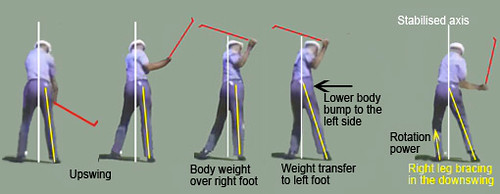
To get an idea of what "correct" feels like, use Shawn Clement's One Leg Drill to exaggerate the feeling of pivoting in a centered fashion and being firmly onto the left side to begin the downswing. At impact, most of the weight should be on the left foot. This is what is often called "hitting into a firm left side or left leg." Shawn calls it "bracing one's tilt against a firm left side." The inside of the right leg and foot should be the pivot point for a centralized backswing (with most weight movement to the right provided by the arms and club only--not a conscious shifting of body weight to the right), and the left foot and leg should be the pivot point for the downswing! The right leg's main function at impact is to ensure the tilted upper body doesn't fall over while mostly supported by the left leg. So, a key part of a great forward weight transfer is ensuring that you don't move too far off the ball to begin with! Make a centralized turn (you shouldn't move more than an inch of so off the ball during the backswing weight "shift." (really more of a turn than a shift) All sorts of GREAT shots result when getting off the right side by impact, such as power, slight draws, easier fades (with the right stance and grip adjustments), low shots played further back in the stance, hitting down, crisp contact, lower ball flights, great wedges, etc. The finish will be fully over the left side, with the weight concentrated toward the outside of the left foot, like it's supposed to be.

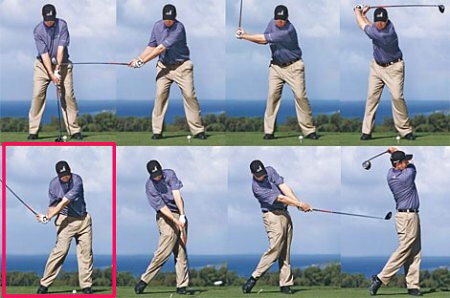
Shift before coming down!
Notice frame 5 - shift before arms come down!


Other drills to instill this feeling include Gary Player's "hit and take a step after impact" drill and completely lifting the right foot off the ground at the finish while remaining balanced on the left foot. Either of these makes the point that the right leg should have minimal involvement in supporting the body weight at impact and beyond.

Here's another feel to get the point of shifting into a solid left leg and stable left foot: When bumping the left hip targetward, act as if the left foot becomes firmly planted onto the flat surface of a foot stool and that the next act has one stepping up by straightening the left leg while rotating to put something on a shelf behind and above oneself. All of this should be happening while the arms are still at the top or nearly there! Don't start down with the arms before planting into that left leg, because that left leg is the power engine for the arms to accelerate from the ground up! Get the feeing that your hands and arms are lazy and kind of pause at the top (with the back turned), while you shift firmly into the left leg. In reality, the club head will keep going for a second and set at the top while you shift. The head should stay tilted back behind the ball.

Bump and fire!
Shift into left leg then fire!


Characteristics of a proper weight transfer during the downswing: The weight shifts linearly (targetward) into the MIDDLE of the left foot, BEFORE opening the shoulders and starting down with the arms and club. As the left hip bumps towards the target, there's a distinct, solid feeling in left hip and bent left knee, as the weight settles into the left leg (again, before starting down with the club), though the upper body is tilted away from the target. The bent left knee will shift from pointing behind the ball to pointing ahead of it, automatically. The right knee will fold in (again, linearly) behind the left knee, automatically. When the weight first transfers quickly to the left foot, the left knee is bent but gradually straightens as the left hip gradually rotates backwards and upwards during the remaining downswing motions (the left hip rotates upwards because the left knee straightens). This move is NOT abrupt or "stomping" in nature; it's a very smooth but rapid transition into the left foot (almost a pressing down feeling) that gets the weight left. At impact, there's practically no weight on the right foot. The weight will be firmly in the middle of the left foot at impact and will gradually roll to the outside of the foot at the finish.

The weight transfers in the swing purely due to the motion in the arms hands and club as they travel away from the target. Think of it this way – if I swing my arms, which each weigh 15 lbs, and a club in my backswing you can be sure that I am transferring weight onto my back foot. There is however no conscious shifting or body move that gets the weight over there.

There is no lateral body move, yet many players often wrote or spoke about a sense of weight transfer. The body stays centered while the weight is transferred by the motion in the arms and the club. Video HERE

All the best ball strikers studied displayed a tendency to transfer the weight to the front foot in a smooth and continuous flow with no backing up or slowing of the transfer...This meant that they arrived at impact with an 80/20 split favoring the front foot and the weight continued to move smoothly over to the front side beyond impact.

The tendency with higher handicap golfers (above 18) was for the weight to get too far back and then remain there all the way through impact. It was not unusual to see one of these golfers have a split of 70/30 favoring the back foot at impact.


The hips play a very important role in the golf swing. The problem is that most people do not understand the correct motion that they must make. The correct move is NOT a simple turn of the hips from the top of the swing, as many would believe.

In fact, the correct move is a slight lateral shift, or "bump", and then a turn. If you look at players like Tiger Woods and Nick Faldo, you will see a perfect example of this. These guys don't just turn their hips away from the top. Instead, their weight shifts laterally to the left side, which drops everything (arms and shoulders) into the slot. From there, they can just turn and fire through the ball as hard as they want.

Golf Tips - Hip Movement During the Swing

Secondly, good ball-strikers make a full weight transfer to the left as they complete their swing. You can't finish low if you hang back on your right side. Proof of the weight shift is your right heel.

If you've turned your hips aggressively and moved to your left side through impact, your right heel should be off the ground and closer to the target than your right toe.

Stay Low After Impact - Butch Harmon

Start the downswing by stepping down on your left heel and letting your left hip move slightly toward the target. As your lower body starts to move, pull your hands down, keeping your right elbow close to your right hip as long as possible.

Take our advice: Put your golf slice in the past

This “bump then fire” action, which is present in the techniques of many elite players, requires considerable discipline in ensuring that the weight transfer is properly executed before commencing the downswing rotation.

Understanding golf swing weight shift


Tuesday, November 27, 2012

Pivot: Clear the Hips

We hear this instructional catch phrase often: clear the hips. You also hear rotate the hips and bump your left hip toward the target and then turn. What should one really be doing? If you study professional golfers carefully from multiple angles in slow motion, you will notice that all of the above are true to one degree or another. What you might not pick up on is that more space is created for the arms to fall in front of the body than appeared to be there at address. How is that possible?

I briefly touched on this in a previous post on Shawn Clement's Braced Tilt. Good golfers keep their posteriors in a protruded position through impact, while high-handicap golfers (like me) tend to lose that protrusion established at address (in other words, the belt buckle starts looking up too soon). When golfers make this error, they may indeed shift to the left leg and rotate around the left hip, but the right hip gets thrown out over the target line and the shoulders arms and club soon follow (over the top).

This improper move is often called standing up through the shot and golfers are often incorrectly told that you didn't keep your head down or you looked up too soon. Doing this creates little room for the right elbow to fall back down in front of the right hip, and thus it's harder to approach the ball from the inside. I believe golfers like me develop this habit in a few ways: 1) the illusion that this is what pros are doing when you witness a swing from the front-on view; 2) the fear of striking the ground behind the ball or taking deep, painful divots, when ironically staying in the shot and covering the ball in the proper manner will shallow out the swing.

The correct move (as Clement eloquently describes) is that the right hip moves backwards, towards the target, and slightly upwards on the backswing pivot, with the weight on the inside of the right leg and right instep. This creates a "tush line" that is parallel to the target line with only the right hip is touching it. Now the key point. On the downswing, the left hip ALSO moves backwards to join the "tush line," while also shifting left and turning, such that the posterior remains protruded through impact; this protrusion is not lost until late in the followthrough. The right knee will kick in more behind the left knee instead of moving out too much toward the target line.

Moving the hips this way makes it easier to stay in the right posture through the shot; the chest will cover the ball and you will have more room for the arms to swing down and out. You will also notice that you finish your swing still in the correct posture and spine angle, as if laying one's head on a pillow. Done properly, there's no way to come over the top.

Shawn Clement, the Canadian golf instructor, starts off by demonstrating how one should perform a backswing hip pivot movement - by wiping the right buttock against the glass window in the direction of the target. That's a good swing thought for a beginner golfer who has difficulty performing a "correct" backswing hip pivot movement.

Note what he states about starting the downswing's lower body movements. He recommends that one keep the right buttock back where it was at the end of the backswing (at the tush line), and he recommends that one should think of pulling the left buttock back against the glass window and wiping away from the target (pivoting the left hemi-pelvis back and to the right, so that it is against the tush line). In other words, he is recommending that one should focus one's attention on the left hemi-pelvis, and he recommends that one should think of pulling the left hip back in a left hip clearing action - without allowing the right buttocks to move away from the tush line in the direction of the ball-target line.

In other words, a good "downswing initiating" mental image for a beginner golfer is to think of getting one's weight over onto the left foot followed by an immediate sensation of actively pulling the left hemi-pelvis back (away from the ball-target line) towards the tush line.

Backswing

Another major area we've worked on is my hip action. Like my shoulders, my hips now turn on a steeper angle to the ground in the backswing. It feels as if I'm sticking out the right side of my rear end as I turn to the top. This move counterbalances my left shoulder turning down: If I didn't stick my rear end out, that steep shoulder turn would put me out on my toes. On the downswing, it's all about my left hip—actually, the left knee, thigh and hip. I want to feel them clearing out, or turning to my left, so my right side can drive hard. From the top, my hips used to thrust toward the ball, which dropped the club too far to the inside and led to pushes and hooks. Now I think about pushing my left hip out to left field and then turning it behind me (above). That keeps the club coming in steep so I can really pinch the ball off the ground.

How To Make Your Swing Repeat: Matt Kuchar: Golf Digest


Wednesday, November 14, 2012

Shawn Clement's Braced Tilt

I'm a huge fan of Shawn's teachings; plus, he's very generous in that he gives away tons of free instruction via YouTube. Due to his generosity, I send him a PayPal tip each month. You can find his web site here; he also offers very reasonable online video analysis and a DVD instructional series.

Shawn has a lot of great ideas and methods that are highly effective. His drills should be mandatory for every golfer, regardless of whether you agree with his instruction or even try his swing method. The drills include his classic perpetual motion drill, feet-together drill, and one-leg drill. You can use these to ingrain the fundamentals of the Clement swing, which in my opinion is focused on helping the novice golfer learn to stay centered, the opposite of which (swaying) may very well be the biggest error a beginning golfer makes. I've written about the pivot in several other posts, but Shawn's method may be the one to develop a consistent pivot and swing, resulting in fantastic compression and contact with relative ease. In a sense, most of the effort is spent in the setup fundamentals and the rest left to physics.

Shawn teaches "bracing against a firm left side" with the body tilting away from the target starting at address and all the way through the swing. This involves presetting some secondary axis tilt, such that more weight is on the left leg at address, the head is behind the ball (until well after impact), and the weight in the right leg is concentrated on the right instep (he describes the address weight distribution as 60% left - 40% right). The backswing pivot is more a turning of the posterior than anything else, and the slight backwards weight shift is concentrated on the inside of the right leg and inside of the right foot; there should be a feeling of pressure ONLY on the inside of the right leg and right instep, and the right knee and right hip should feel "locked" in place briefly at the top, before the transition of weight back to the left leg. Another description is that it feels like sitting back on the right leg, so you should really feel it in the right hip.

Before you start thinking this is Stack-&-Tilt, it isn't, because Shawn teaches a backward and forward weight shift during the backswing and downswing, respectively. It's just that the weight shift he describes is very minute; he states that it is "about an inch long." I would describe it as: address, 60-40; backswing, 50-50 (or maybe 45-55) onto the inside of the right leg due to the weight of the arms and club; downswing, 60-40; and finish, 95-5 (again due to the weight of the arms and club). By contrast, S&T has the golfer starting 55-45 and leaning left at address, with no weight shift on the backswing (the upper body continues leaning left throughout); the weight favors the left side at address and progresses more and more left until the finish.

Shawn's swinging motion is passive and he describes it as "assisting momentum towards a target." In other words, one tosses the "arm-club unit" to the right on the backswing (the club feels somewhat weightless at the top) and then one allows it to fall on the downswing, with one's posterior providing a counterweight to the swing. In a sense, the golfer is setting up as a crane or catapult, and the butt acts as the means to propel the club. Shawn even says that the downswing weight shift "happens behind you," such that the butt moves left ("about an inch long") to shift the weight back into the left leg before the club comes through. The right butt cheek moves backwards on the backswing, and then the left butt check turns back to join it in a line on the downswing.

The result of this swing method is a tighter, circular motion that doesn't waste as much energy, and a stable low point. This results in increased consistency, compression, power, and divots in front of the ball.

Characteristics of Shawn's swing method include hips that turn nearly as much as the shoulders (don't go looking for McClean's X-Factor here), head staying behind the ball, arms and hands staying in front of the body, left foot prevented from spinning out, right foot staying planted longer, left knee ticking in towards the right leg on the backswing (even at address), allowable head movement, left heel unconsciously coming up on the backswing, passive arms (i.e., tossing the arms to the top and letting them fall), wrists that hinge naturally up-and-down due to the club's weight (i.e., float loading), and a takeaway that begins with a slight leftward move, as if one is already in motion at address (hence the perpetual motion drill). Shawn feels that a slight move that mimicks a throughswing as a starting motion (catching the next backswing) is best for keeping the swing relaxed and effortless.

My personal experience with this method is that it really adds distance and makes the golf swing "easy." However, I start coming off the rails with this swing by producing fat and thin shots, and the reason is two-fold: 1) there MUST be a move into the right leg on the backswing (even if it is very slight), and the correct feeling is one of pressure on the inside of the right leg with the right knee and right hip locked in place (i.e., I can occasionlly get too frozen over that left leg in the backswing); 2) the head--it must start behind the ball at address and remain there until post-impact (this one goes along with the first error--keeping the weight too left on the backswing can have the tendency to cause the head to be too far left).

Passive arms: It's important to simply get to the top and leave the hands and arms there, especially with the driver. Toss the arms to the top and then let them fall and/or move in response to the lower body's movement. Don't do anything else--pull or push. Allow the arms to simply drop and whip through in response to the lower body motion. Any attempt to consciously or unconsciously steer, pull, push, or guide the club will contribute to errors. Picking up on this in oneself is difficult because the difference between steering and just letting it happen is very subtle.

I have so many videos that explain what you are asking here; they all start with "Braced Tilt", "Braced Tilt Part 2", "Tilted Spiral" part 1, 2 and 3 and my latest, "Feel the Braced Tilt" which will explain so much for you; it all comes down to 60% on the lead leg; Use the trail leg as a support post to keep you against the led leg which is your leaning post.

One Leg Drill Amazing Power Compression; #1 Most Popular Golf Teacher on You Tube Shawn Clement - YouTube