Showing posts with label X Factor. Show all posts

Thursday, October 3, 2013

Hip and Shoulder Separation

Bae's Shoulder and Hip Separation

Many of my blog posts go over the same information, again and again, in different ways. That's because golf is often based on feels, and everyone learns a different feeling to engrain some fundamental. I write about what I try and what I find useful, primarily so that I can go back and revisit these things from time-to-time. I revisit them because they're the fundamentals that can easily be forgotten or overlooked; a round can suddenly go south because a grip has drifted too weak or too strong, pre-shot alignment is rushed and faulty, an unconsious sway on the backswing, improper weight distribution, etc.

I've posted extensively on the hips' role, the shoulders' role, how to pivot, separation, about lag, creating distance, etc. But I wanted to spend a few more electrons on the subject of separating the hips from the shoulders to generate power. Now, I've examined Jim McClean's X-Factor a few times on here, and you'll find the usual for-and-against golf enthusiasts out there on the interwebs debating that very subject. Reputable instructors will offer up valid logic on why you should or should not resist with your lower body while your shoulders turn on the backswing. Take a stance on just about any "unassailable" fundamental of golf and you will eventually find someone--someone with a low or scratch handicap--who disagrees.

I believe that the so-called "X-Factor" of hip and shoulder separation is far more important in the transition and early downswing at generating power and consistency than using separation in the takeaway and backswing to generate potential power. I believe this because there are examples of long-hitting professionals who turn their hips a lot on the backswing (more than they believe or more than Jim McClean says they should). But on the downswing, their hips ALWAYS start first, before ANYTHING else moves; I haven't seen slow-motion video yet of a single professional golfer who moves the shoulders before the hips (if they did, they would immediately be OTT and NOT hitting inside-out). Their entire pelvis shifts towards the target a few inches (and thus so do both knees, pushing weight into the left leg) and then rotates (the belt buckle turns) towards the target, followed closely and sequentially by the belly, shoulders, arms, hands, the club, and finally the club head. This sequential unwinding "from the ground up" produces the kinematic sequence--the use of the entire body somewhat like a whip to send energy from the ground up and out (inside-out) through the club head and into the ball.

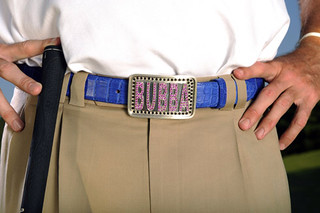
Sticking with the belt buckle swing thought mentioned above, try to start your downswing by first moving the belt buckle over the left (or front) leg WHILE SIMULTANEOUSLY rotating the belt buckle towards the target. All of this should happen while the shoulders are still mostly closed and the arms completely passive--almost floating. Another way to think of this--to ensure you're not throwing, casting, or hitting with your arms from the top--is to imagine that you have a golf club extending from your belt buckle and that you're trying to hit the ball using nothing but the belt buckle motion, while your arms come through afterwards with a second club. Your arms are lagging behind your belt buckle. FORGET YOUR ARMS! They will naturally, quickly, and fluidly follow the motion of your lower body. I've found that thinking of hitting the ball with my belt buckle (thus shifting my belt buckle targetward and rotating around at the same time) helps keep the instinct to hit the ball with the arms at bay.

A "from the ground up" downswing, that enables hip motion to separate from shoulder motion, starts in the feet and how the weight is distributed in them--front-to-back--to provide balance. Verified when I recently took a golf lesson from a local PGA teaching pro, I've had a bad habit of sitting back on my heels when taking my stance (setup as part of GASP), and this can absolutely destroy the ability to easily shift the hips forward and rotate and properly. I've had to make sure that my weight is shifted into the balls of my feet (shifted towards my toes but not in my toes); the weight is mostly in the arches, balanced evenly between the heels and toes. One should only be on the heels for a lie below the feet, and only on the toes for a lie above the feet. The correct athletic stance that promotes an easy shift and rotation of the pelvis while the shoulders remain closed feels almost as if one is preparing to dive into a pool or receive a serve in tennis. There are a few teaching professionals (e.g., Chuck Quinton) who, predictably, contradict this fundamental, but most touring professionals, like Tiger Woods and Tom Watson, and teaching professionals, like Shawn Clement and his "suction cup" foot analogy, advocate for the balanced ball-of-the-foot approach, and that seems to work best for me. Chuck's admonition seems related to keeping the left knee healthy (implying this is what caused Tiger's knee woes), but someone like Tom Watson is currently in his 60s and hitting the ball a mile. I think I'll believe Tom Watson and the PGA pro I saw on this one.

At the top, the shoulders should momentarily stay put (stay turned away from the target), while the pelvis (hips) execute the motions described above in the transition to the downswing. The shoulders and arms follow because they physically must do so. No thought should be given to moving the shoulders and arms (and club); simply let the hips start the process and let everything follow and unwind. In a sense (at least in terms of how it should feel), you're making a move to hit the ball with your legs and hips, letting everything else follow! The amount of lag generated by doing this correctly is amazing and the distance and consistency that is achievable by learning to trust this one movement cannot be overstated.

This is useful throughout the bag (except for the putter, where you want a stable lower body). You need to do this in the sand. You need to do this when pitching. You can even do this--albeit very slightly--when chipping. Let the lower body lead and find out how easy this game can be.

For me, this works best with a centralized backswing pivot, where the right shoulder pulls directly back and behind the head; in other words, no swaying. For me, a backswing sway can be so slight and so easily and unintentionally introduced when focusing on the right transition and downswing; it will wreck the benefit of a properly executed downswing sequencing. When you're doing it right--putting both a proper backswing pivot and hip-shoulder separation on the downswing--you'll be fully and naturally posted up on your left leg at the completion of the swing.

Watch your favorite guy on the Tour -- Tiger, Phil, Ernie, Vijay, me, anybody -- and forget about his arms and hands and head when he makes a golf swing. Just focus on his belt buckle.

Then watch another swing, this time trying to focus on your guy's hands in relation to his belt buckle. They're always, always just a little behind through contact.

Let your belly lead your hands - Golf - John Daly - ESPN

Rotating your lower body toward the target helps propel the ball from the sand and assists in maintaining acceleration. Try this for a swing thought: Turn your belt buckle to the target.

Tiger Tips: Belt Buckle To The Target : Golf Digest

The way they sequence that power’s delivery to the ball is the key to maximum efficiency and distance. For an effective kinematic sequence to occur they must start the downswing from the ground up. That is to say that the hips start or fire first, followed by the torso, then the arms and finally the club. If this order is compromised power loss and errant shots will occur.

The more turn you have while keeping the shoulders stable/still the greater your potential for the “X Factor” stretch in the downswing and generating power. If you found it hard to do this test you will find it difficult to sequence correctly in the downswing.

Blackburn Golf | Tips & Articles | Sequencing Successfully!

Conventional wisdom states that the downswing begins from the ground up. A golfer must shift his weight forward and begin rotating his hips before swinging his arms forward. Golf instructor Jimmy Ballard explains that when your weight shifts forward and your hips rotate properly your arms “respond naturally, falling into the correct downswing plane” as they approach the ball.

Slide vs. Turn Golf Downswing

The transition from backswing to downswing is crucial to generating power and accuracy. The key is to start the downswing with the lower body.

In the best swings the lower body starts forward while the upper body is still turning back. The left hip turns toward the target as the shoulders continue to coil. That takes terrific timing and a lot of practice.

Tom Watson: Lead With Your Lower Body : Golf Digest

Rotating through impact can be felt in different ways, such as a pull with the left side, push with the right side, downward push off the right foot, inward kick with the right knee, left hip clearing, etc. There are numerous ways to feel the body’s rotation. It doesn’t matter what your feel is as long as it starts with the lower body. It’s not a passive role by any means. There must be a conscious effort to turn the body all the way until the finish.

A great thought is turning the belt buckle to the target as quickly as possible as you swing through the ball. It targets a key area – the hips – and engages the lower body and creates speed in the unwinding process.

But remember, rotation must be sequenced correctly.The lower body shifts weight first and rotation to the target comes second. You maximize everything you got by following that sequence. Some amateurs do the opposite and rotate too early. This tends to throw the club outside the target line and cause slices and pull hooks.

Tour Players Rotate Through Impact | Scratch Golf School

The best way I can describe the feeling of using the body to hit the ball is, it’s an UNMISTAKABLE feeling that I used my legs and hips. After the shot has been hit, I feel a radiating all the way down my right leg and in my hips whereas, I feel nothing in my hands and arms.


Most amateurs just are not able to get the club in the slot because they rotate their shoulders early from the top of their swing. This, of course, throws the club outside the target line and usually results in a slice, a pull, or even a top.

Jim Suttie: The most important move in golf ... get in the slot

At the top of your backswing, your back should be facing your target if you have completed your shoulder turn correctly. Your back should stay facing your target for just a second as you begin your downswing. This will allow the golf club to swing down properly on the correct swing path as you approach the golf ball at impact.

Starting the downswing by opening up the upper body too early will lead to an over the top swing as well as an out to in swing path. This can lead to either a slices or pulled golf shots. At impact, the shoulders should be square to your target line so it's important that they don't open up too early from the start of the downswing.

Perfect Your Golf Downswing Transition

Keep your back facing the target at the start of the downswing.

What this 'feel' will do is keep your club to the inside on the downswing. If you open your shoulders real quick, and NOT have your back face the target, this will throw your club to the outside, and lead to an over the top swing, and hence a bad golf shot. This is a problem slicers are notorious for having.

So when you reach the top of your swing, do this:

Feel that your hips bump slightly laterally, then begin to turn out of the way.
The key is to keep your back facing the target for a split second longer as you make this initial move with your hips. You should feel that your back resists against your lower body. Your upper body stays still, your lower body begins firing, your golf club is automatically dropped into the slot, your golf ball goes straight and far!
Golf Tips - Fixing your Slice - Keeping Your Back to Target
A quick look back at Hogan’s original quote in this essay tells us that “...under no conditions should the downswing be inaugurated by the hands.” I agree wholeheartedly. It is folly. Watson agrees as well:
“A lot of fairly good players try to start everything down together: feet, hips, arms, shoulders. I made the mistake of trying to do that myself for several years with no great success. If you start everything down together, there is a strong tendency to throw the clubhead at the ball with the right hand too soon, dissipating your power and not helping your accuracy, either. I converted to starting down with the lower body and became both longer and straighter.”
Secrets In The Dirt
Do you[r] best to keep your back facing the target for longer and you will set up the ideal DOWN swing sequence that will move the golf club on a path that travels outwards through the ball rather than across the ball. You can do this by controlling your armswing and shoulders consciously and deliberately or by using your lower body in such a way that the result is that the shoulders are delayed.
May, 2012 | Golf Confidence Academy
Professional golfers transition to the downswing by moving their lower bodies. In every great golf swing the legs and hips move first. The torso follows the hips; the shoulders follow the torso; the arms follow the shoulders; the hands follow the arms; and the club follows the hands. That’s the order of the downswing. : The sequence is from the ground up. The lower and upper body have to be synchronized. Strong hips and stabilizers create strong downswing.
Cindy Reid Golf
Just like that basketball player, you want to be on the balls of your feet -- not the heels, not the toes. That's the key to balance. No good athletes in any sport play with their weight back on their heels. It's important that you start with your weight on the balls of your feet and keep it there through impact. You can easily check your set-up position in a full-length mirror.
Tom Watson: To Set Up Right Get On Defense : Golf Digest
If you swing your belly button back and through you are activating and/or energizing many of the muscles that Mike Austin wanted you to utilize in the swing, including the internal and external obliques, the transverse abdominis, the glutes and the sartorius, just to name a few. The good news is that you don’t have to think about those muscles, if you don’t want to. Just swing that belly button. The further and faster you move it (albeit smoothly) the further that ball will go.
The Belly Button | Mentored By The Legend – Mike Austin


Tuesday, April 23, 2013

Preset Open Hips

Open hips
Open hips/open stance.

If you're struggling with solid contact, it's always best to try something different in your setup. The swing itself is best when the setup, posture, grip, and alignment (GASP) create a somewhat automatic backswing and downswing. Trying to control small muscles in the arms in an attempt to provide power and club face control (i.e., steering) is a recipe for disaster. A good setup should help you "automatize" the swing.

Here's something I've found that really helps me create consistent, solid contact. Please note that, depending on your body type and swing mistakes, trying this may cause you more problems than it solves. Try it as a drill (at the very least) before you determine whether this is of any help. Of course, I can only theorize why it's helpful, and I will get to that shortly.

First, let's get to the heart of it: Setup like you normally would with feet, knees, hips, and shoulders aligned square to the target line, as the fundamentals tell us to do. You can even setup with slightly closed feet, and the correct shoulder position should feel somewhat closed, although in reality it's square (shoulders pointing left is a major no-no). Now, before swinging back, preset your hips into a slightly open position. Yes, you can do this even though your feet are square/closed and the shoulders are square, due to the mobility available in the hips (assuming you have no restrictions in the movement of your hips). In essence, you're starting from a correct preset impact position, and your hips are "out of alignment" with the target line compared to your shoulders.

Starting my swing from this position created very powerful near-center-face hits on all clubs, so I decided to analyze potential reasons why this apparent break from the fundamentals is helpful to me, especially given that open hips are supposed to contribute to slices and pulls.

First, I think simulating the impact position before starting the swing pre-programs the brain on what the impact position should be for a particular club and lie. You're giving your brain a "pass-through" point in the swing; instead of trapping the ball between backswing and followthrough, you've added a middle waypoint to connect those dots.

Next, you'll notice that opening the hips while keeping everything else square automatically puts a little more weight on the front leg and positions the remaining weight into the right instep where it should be. In reality, your knees will move slightly to the left when opening the hips, so you should let them (don't think about moving the knees consciously); the right knee will automatically tick inward a bit, which is a solid setup tip unto itself.

Next, when you swing back and rotate your shoulders to 90 degrees, you'll notice now that your hip turn is VERY restricted and that it's difficult to stay in a fully rotated position. The shoulders instantly want to release the tension, which means more power for your downswing. You're basically presetting a greater "X-Factor" or differential between the shoulder line and hip line at the top, which is what the X-Factor calls for. This tension is a good thing because it's going to provide automatic unwinding power from your body down to your arms and club.

You'll also notice that your weight automatically concentrates into your right instep where it should be at the the top of the backswing and thus you can't really sway to the right off the ball with the hips or shoulders.

The hands and end of the club handle also move fractionally more forward of the ball, which is where they should be at impact.

Finally, when you let that automated unwinding happen, your weight gets instantly back to your left leg as it was at address, because there was no sway off the ball. You're moving left well before impact without even thinking about it.

There may be other reasons, but I believe these are probably the main reasons why presetting open hips assists me in making reliable, solid contact.

I believe that there are other versions of this same line of thinking out there. Opening the left foot while keeping the right foot perpendicular to the target line (espoused by Hogan) or using a slightly open stance with closed shoulders (like Trevino or Couples) are really designed to do the same thing. It's important to note that all of these golfers favored a fade, and open body lines at impact are associated with a left-to-right ball flight. However, you can still hit a draw using this technique; experiment with different grips, ball position, turning the club, swinging more right, concentrate on hitting the inside of the ball, etc. Trevino stated that he used the same setup for draws and fades; he pictured a row of four balls, and for fades he would try to hit all four in a row, while he would only pick off the first ball without hititng the others for a draw.

You can preset open hips for all shots, especially including the short game and even for putting (it locks the knees into place and prevents swaying), and for full shots, you may choose to use it merely as a drill.

Speaking of Hogan, I believe DTL views of his swing show that he also preset his hips slightly open, because you will notice his right knee ticked in slightly and his left foot flared out with the right foot perpendicular.

Last but not least, all three main horizontal planes, i.e. feet, hips and shoulders should never be parallel to one another. Hence the idea of increasing the diagonality of the stance in three planes - hips open in relation to feet, shoulders closed in relation to hips. Of course shoulders are used for visual aiming while feet seeks for ultimate balance and ultimate benefitting from ground forces.

Biokinetic Golf Swing Theory: Setting the Swing Motion

Pre-Set Drill: A great drill to properly train the feel of Key #2: Weight Forward is to pre-set your impact position before making a golf swing. Here's how:

1. Set up over the ball as you normally would.

2. Move your left knee and hip towards the target and open them slightly. Let your hands shift towards your left thigh as you do this. You'll feel more weight on your forward leg.

3. Make a half to three-quarter backswing leaving your left knee and hip forward.

4. From there, bump the hips even farther forward, hit the ball, and swing to an abbreviated finish.

Doing this drill properly will set you on the path to achieving Tour-quality impact.

5 Keys | GolfTipsMag.com

A common error of golfers of all levels is lining up too far to the right of the target. This forces you to come over the top on the downswing to reroute the club on line, then release the hands quickly to prevent a slice and send the ball toward the target. These corrections put too much pressure on the small muscles of the hands to release the club at precisely the right time. You may be powerful, but you'll find yourself missing the target in every direction.

If you're going to make mistakes in alignment, make them to the left of the target. An open stance presets your hips in a cleared position, as they begin slightly rotated toward the target. You don't need a quick release of the hands; instead, you can square the club with the big muscles of the shoulders and back and approach the ball from an inside path. Keep your stance square to slightly open to develop a repeating swing. Don't let yourself drift to the right.

Set up for straight shots | Golf Features | IntoTheRough.co.uk

For pitch shots and chip shots, there is a much less aggressive turning of the body through impact. This is especially true for chip shots, as the chipping motion more closely mirrors a putting stroke. To overcome the less aggressive hip turning through impact, ideally we want to set up with an open stance to the target line with our body lines. This ensures open hips through impact, and the result is our arms can swing freely without manipulation to the follow-through position.

Believe it or not, this also comes into play with putting. Although it is common for teachers to tell students that their entire body alignment should be parallel to the target line, most tour professionals set up with open feet, knees, and hips (with the shoulders remaining square to allow a proper putter path). Again, this open alignment of the lower body allows the arms to swing down the target line in a free manner.

Golf Teaching Pros: Why the Open Stance?

If that sounds familiar, here's a drill to help you start the club back straighter and shallow out your downswing. Set up in a dramatically open stance, with your feet aimed 30 or 40 degrees left of the target. Then swing back along your stance line. This will prevent you from pulling the club to the inside and will create a wider arc. You'll get into a lower, flatter position at the top (below).

Jim McLean: Open Up To Fix Your Slice: Golf Digest

Saturday, September 8, 2012

Belt Buckle Basics

I've written about the belt buckle in previous posts on golf's triangles and always keeping the club in front, so I thought I'd write a little bit to unify the ideas, especially since this can be a key swing thought. This may be the most crucial golf swing thought for the full swing. Simple swing thoughts are best, and using the belt buckle is one way to unify a lot of swing thoughts and fundamentals and keep the approach to golf as simple as possible.

Your belt and belt buckle--especially when related to the butt end of the club handle--can show you a lot of things.

First, the belt buckle shows you whether you've made a good setup posture and address position. As Brian Manzella has stated, the belt buckle should point down toward the ball at address (at an angle) and the butt end of the club should point toward the belt buckle. It's almost as if your club is an extension of your belt buckle; in a sense, your belt is a loop around which the swing is powered. This will ensure that you have the correct pelvic tilt (i.e., protruding rear end) and that the club (and thus hands and arms) is in the correct orientation.

Second, the belt buckle shows you how to do a good takeaway or pivot back. In the beginning of your swing, the belt buckle and butt end of the club should maintain a close relationship. That is, the butt end of the club will continue pointing at the belt buckle, or remain close to the belt buckle, during the takeaway. Only once your club reaches waist height should the wrists begin hinging the club upward; the butt end of the club will begin to point down the target line but will still be in close proximity to the belt buckle, before the right arm folds into the full backswing. Think of the club shaft as an extension of the belt buckle in the takeaway.

Third, the belt buckle leads the downswing. As the downswing begins, the club's butt end and belt buckle become the most disassociated, with the club handle trailing the belt buckle. During the swing, the butt end of the club and the belt buckle quickly and dynamically become reassociated at impact, when the left arm and club reach an inline condition. In other words, the club handle quickly catches up with the belt buckle through impact. The club and hands finally pass the belt buckle on the followthrough and fully disassociate again at the top of the finish. Simply moving the belt buckle over your left leg WHILE AT THE SAME TIME turning the belt buckle to the target (while the shoulders remain closed and arms remain unengaged) may be the best swing thought for the downswing, as this reflects starting the downswing from the ground up (i.e., leading with the hips). Think of the club shaft as an extension of your belt buckle and imagine you're hitting the ball with your belt buckle (as if a club was extending from it). This thought will help you time the arms with the body and not get stuck (arms trailing too far behind); in other words, this thought is great for properly synchronizing the arms with the body rotation. Remember, the club shaft and belt buckle disassociate and reassociate based on vertical movement of the arms from the shoulder joints, not horizontal movement; the club, hands, and arms should always stay in front of the torso!

Finally, the belt buckle shows you where your ball is heading. Turn the body through so that the belt buckle points towards your starting line. If your belt buckle points right at the end of your swing, your ball is likely starting there (with the right spin, it may not end up there). Same thing if pointing left.

Another way to consider this concept is to visualize a 4-inch elastic cord connecting the end of your club to your belt buckle (there have been similar training aids available on the market). At address and during the takeaway, the 4-inch distance is maintained, but the cord begins to stretch in the backswing, creating stored energy. As the belt buckle dynamically turns towards the target and the left leg straightens, the energy is released and the elastic cord quickly returns to its original 4-inch length at impact (when the left arm and club reach an inline condition). Finally, the cord again stretches on the followthrough and to the top of the finish.

The belt and the belt buckle is a terrific alignment tool you can legally use on the course for a number of good things in the address position, posture, and swing. The butt end of the club handle (and thus the hands) are closely associated with the belt buckle in the takeaway, slowly disassociated from it to the top of the backswing, and then QUICKLY reassociated with it through the downswing and into impact. Then they dissassociate again on the other side. But remember, the hands and club handle should be close to the belt buckle again at impact (almost as if extending out of it, center-mast)!

In order for your belt buckle to point at the target on your finish, you must rotate your hips powerfully through the ball on the downswing. Powerful hip rotation alone, however, is not enough. You must also have a proper release and good lag on your downswing. But one of the easiest things to think about and visualize is where your belt buckle ends up as you complete your swing. Therein lies the power of the tip.

Golf Swing Tip: Finish With Your Belt Buckle Facing the Target Like Rory McIlroy

For each, square the face, angle the shaft, then stand to the handle so the grip points at your belt. That establishes the correct ball position.

Golf Digest's Best Young Teachers: Travis Fulton: Golf Digest

Top 100 Teacher Shawn Humphries says to keep your club pointed at your belt to stay on plane and hit better shots.

Hump Day Tip: Perfect Takeaway - Video | GOLF.com

At impact the golfer’s belt buckle will have shifted well left of the golf ball and will have begun turning left. The hands will also preferably be past the ball on all shots but the driver.

Weight Shift in Golf Swing – Herman Williams Golf

Point the butt of the club at your belt buckle and your belt line toward the ball.

"Belt line at the ball - Brian Manzella"

THE CLUB STAYS IN FRONT OF ME

My coach, Chuck Cook, says I do a great job of keeping the club in front of my body throughout the swing. Amateurs tend to swing mostly with their arms, so the body lags behind; better players can get fast with the body turn, so the arms lag behind. If you focus on turning back and through with the club staying in front of your chest, you'll find it easier to square the clubface and hit straighter shots.

Golf Instruction: Jason Dufner: Duf's Moves To Hit It Solid: Golf Digest


Thursday, June 21, 2012

Pivot: Create Separation

I mentioned this in a previous post on keeping the back facing the target for as long as possible in the downswing to help hit inside-out, but I felt I needed to emphasize the first part of this equation. You must create separation between the lower and upper body on the downswing (i.e., often called X-factor).

Once the back is facing the target, begin shifting weight to the left leg and rotating around it, while the back stays facing the target and the arms begin dropping. This move is discussed extensively by Ben Hogan in his milestone book (also by Jim McClean), and it's so critical to creating a powerful downswing that's driven by the lower body.

What really makes this work is the separation between shoulder and hip position. The shoulders should only catch up to the hips in the follow through. If they catch up early--or worse, outrace them--be ready to look for your ball in right field, because you'll likely get a slice.

If you get a push or slight slice, you simply need to close the stance (i.e., get the face closed to the path) to get that powerful draw working.

Another way to think of it: the shoulders mostly move first on the backswing and the hips mostly move first on the downswing. Voila! X-factor!


Saturday, March 17, 2012

Ball Focus: Inside-Left

I wrote about this briefly and anecdotally in another blog post, but I decided it needed a post of its own; it's that important. At least for me. I don't begrudge the many teachers out there who think the ball should appear blurry or the focus should be only on the target. But if you're focused on the target and then launch the ball into the woods 45 yards to the right of the target, focusing on the target does you little good.

We know that lagging the shoulders behind the hips is important to swing inside-out (the so-called X Factor). And we also know that the head should stay behind the ball through impact (or not move past its initial position created at setup for the woods and driver). We know, too, that the ball should start to the right and curve left to REALLY hit a draw (i.e., not a pull hook or straight hook).

I believe that focusing on the inside-edge or inside-left quadrant of the ball throughout the swing will assist in achieving all of these goals. First, it telegraphs to the body that you want to hit the ball on that spot, which encourages an inside-out swing. This means that one MUST keep the back to the target longer to avoid coming over-the-top by hitting the outside-right quadrant of the ball.

Second, focusing on that spot will tell the body to keep the head (and therefore upper body) from swaying ahead of the ball on the downswing. Keeping the head back allows the arms to come through, make impact, and then pull the golfer up to a nice, balanced finish. Get the feel that once you get over the right leg in the backswing that the head stays there while the lower body weight shifts to the left. Understand, however, that keeping the head back can cause the club face to close earlier.

Wherever your eyes are looking, your hands and the clubhead will want to go. If your eyes are looking at the back of the ball at address, then you are probably trying to square the clubface to the back of the ball at impact. Address and impact are two very different alignments in golf. Focus your eyes on the inside quadrant of the ball at address and your hands will strive to reach your new focal point. By making this small change, you will be well on your way to improving your downswing and obtaining much more manageable misses.

[From Classic Swing Golf School]

Other golfers need to focus on the ball. If this is you, try to hit the inside edge of the ball at impact.

A good thought for you might be to keep your back to your target and swing your arms down to the inside. Just try to avoid starting your down with your shoulders and upper body as this will throw the club down on a steep and outside path.

[From Golf World: Better shots through inside path | ScrippsNews]

When your head moves forward during the downswing, your whole swing plane moves ahead. That means you will tend to lose the ball to the right or leave the clubface open through impact.

One day, Lee Trevino was playing with the amateur golfer. Trevino gave only one advice to this golfer. He told him to keep his head back.

This amateur golfer was hitting a strong draw on that day.

[From Impact Position: Keep Your Head Back | Golf Tips & Lessons]

[Bobby] Jones was quoted: "Stay behind the ball is a splendid maxim. Should your head ever get ahead of the ball, at any point in the swing, a poor shot will no doubt result."

In Harvey Penick's, The Little Red Book, published in 1992, page 75 is entitled "Stay Behind the Ball" "All great golfers move their head slightly backward before and during impact, but never forward. A golfer must stay behind the ball. I mean set up with your head behind the ball and keep your head behind the ball. If you move your head forward during your downswing or through impact, you will hit a wee, ugly shot, probably a pulled slice."

[From Keep Your Head Back and Behind the Ball Through Impact! Six Top Golf Pros Agree]

Leaning back through impact can cause the face to shut quickly. For a power draw, Brett [Wetterich] releases the club straight down the line with the toe up.

[From Swing sequence: Brett Wetterich: 'hit it from the inside | Golf Digest | Find Articles]


Saturday, March 3, 2012

Swing Sequencing and Passivity

I've learned that normal instincts and proper swing actions diverge dramatically. Golf is full of these contradictions (i.e., swing left to make the ball go right, hit down to make the ball go up, etc.). Understanding these tenets intellectually is easy; putting them into practice is tough.

The swing instinct of the beginning golfer is to use the hands and arms to hit the ball; that's what feels natural. The resulting swing sequence of that instinct is something well known to frustrated golfers: the upper body leads the downswing, club gets laid off or across the line, the shoulders spin out, the arms are thrown out and away from the body, posture is lost, club casting, coming over the top, the knuckles of the left hand point up, and the ball pulls, hooks, and slices, depending on the club face position at impact.

At some point, with enough effort, the beginning golfer begins to implement the fundamentals that all the great teachers espouse: upper body turn on backswing (lower body resists), arms stay in front of the body, lower body leads on downswing (shoulders and arms resist), hips bump and turn, the club comes from the inside (drops in the slot), lag is maintained (no casting), no flying elbows (chicken wings), full extension, good release, left hand knuckles turn down, square/closing club face, etc. The feeling is described as effortless, passive, and a good impact feels like the ball isn't even there. The ball flight is either straight or a controlled fade or draw in the target direction. Of course, it takes time to implement the elements of a good swing and then to learn the proper order or sequence of those events. At some point, they move from being separate thoughts and actions that may occur asynchronously to a free-flowing, coordinated, sequenced series of moves that result in a passive, effortless swing and great, consistent impact.

The golf swing has vertical movement and horizontal movement movement. The vertical movement comes from the arms lifting up and down in front of the body; the horizontal movement is provided by the turning of the body. The small muscles in the chest, shoulders, and arms ARE NOT INVOLVED in getting the club back to the ball. The golfer must surrender to the quite correct tenet that he is not controlling anything with the arms; he is merely setting up properly (so that the ball is in the way) and then assisting natural physical forces to propel an object; when you feel "out of control" with the arms and small muscles, you're starting to learn the right feeling, which runs counter to intuition to use the arms in order to hit the ball.

  • One piece takeaway and backswing, where the arms stay in front of the body in a triangular formation and the right knee keeps the bend established at address.
  • Completed backswing has the shoulders turned 90 degrees (back facing target) and loaded into inside of flexed right leg. The arms are extended away from but still in front of the chest in their triangle shape. The right elbow folds naturally and the wrists set naturally, creating a "box" shape at the top of the swing that one should try to maintain for as long as possible. The club is pointing at the target at the top (not laid off).
  • Transition has the arms simply dropping (triangle still in front of the body) while the back remains turned and the weight shifts to the left leg and the left hip immediately rotates backward. The shoulders haven't rotated yet, so an X Factor is created between the shoulders and hips.
  • Get the feeling that the arms get to the top and stay there while the lower body moves and the arms drop down from the top (maintaining the "box" shape); the arms, hands, and small muscles should be completely passive and make no effort to swing or steer the club!
  • Downswing: As the still folded right elbow nears the right hip (from the arm dropping action), the hips rotate fully toward the target. This gets the arms coming from the inside--they cannot be thrown over the top in this manner.

The result is that the ball is hit effortlessly and the arms don't really do anything consciously (they're passive), which is the opposite of what one tries to do when beginning golf. The body can appear to move very slowly but the club head is actually moving quite fast; this is how pros like Ernie Els and Fred Couples can hit the ball far but appear to be moving in slow motion. A good ball flight with good distance results. The finish is natural and balanced (one can easily lift the right leg and remain balanced over the left). In short, it feels good, correct, and easy. Swinging faster is simply a matter of turning the hips faster; swinging harder is out the window, because there's no muscle tension involved. The body is learning to assist gravity and physics to let the club do the work. But the body's gut instinct is to tense up and rip it, which will result--consistently--in looking for one's ball in the trees.

It is important that a golfer understand that Hogan implied in his book that the arms/clubshaft are passively pulled down to waist level as a result of the lower body movement, and that a golfer shouldn't have to actively pull the arms/clubshaft down to waist level as a totally separate/independent action. Ben Hogan stated that his arms/hands "get a free-ride" down to waist level when he shift-rotates his pelvis at the start of the downswing [4].

[From Downswing]

Most amateurs try to help the club toward the ball by pulling on it from the top of the swing. They are, in effect, trying to help gravity—one of the greatest forces in the world. Mother Nature doesn’t need your help. She’ll get it done—if you don’t pull on the club.

When you’re at the top of the backswing in good balance, you literally let (key word even if it’s small) your arms drop through space as you turn your hips left and get your weight onto your left heel at the completion of what’s a lateral turn.

[From Golf Tips - The Fire Drill]

Williams, focusing on the speed of [Bobby] Jones's swing, calculated that from the top of his backswing to the point of contact with his ball Jones's hands and arms were accelerating at a rate of just over thirty-four feet per second per second.

What makes that interesting is that if you were to extend your arm and drop a golf ball, its acceleration rate as it fell to Mother Earth would be just over thirty-two feet per second per second. See where I'm going with this? It means that in the beautiful golf swing that propelled a ball 260 yards with a hickory-shafted driver, the great Bobby Jones did only a little more than let his arms fall out of the sky.

Bobby Jones depended on gravity to build his golf swing.

[From Ruthless Golf: Those Amazing Relaxed Swings]

Transferring your weight to start your downswing is crucial to an "inside" delivery-the key to cracking 90. From the top, you should transfer your weight from the back leg to the front. Resist the temptation to start your upper body or the club first. It's like a throwing or kicking motion.

[From Breaking 100-90-80: A monthly guide to the scoring basics - golf tips | Golf Digest | Find Articles]

Sunday, January 22, 2012

Drop the Hands to Hit Inside-Out

My main ball flight mistake is a push-slice. Video analysis shows that I pull the club too much inside and then swing just slightly over the top on the downswing and with the club face open slightly (or even maybe opening because of the motion). It's easy to see when the blur of the club is cutting across the ball. Try it as a drill or notice your practice swing.

The easiest way to swing the club without effort is to simply let gravity do it for you with maybe a little assistance to get some "oomph!" How? From the top of the backswing, simply drop the club and arms while the back is still turned, while simultaneously rotating the left hip backwards. This will stop the over the top move and result in a nice, relaxed, languid swing. The body will naturally react to this falling motion to prevent the arms from crashing into the body; Shawn Clement is a big proponent of this, as are many other teaching professionals.

The feeling I have is that I lift my arms straight up in front of my chest while turning fully (back facing the target), get to the top, and then drop my arms and hands while my back is still turned while also immediately rotating the left hip targetwards and backwards (again, the back is still turned); from there everything just happens automatically. This creates a tremendous "X factor," where the hips are open while the shoulders are still mostly closed (an X shape is formed due to the difference between the hips and shoulders). There's no flipping of the wrists; the left forearm turns so that the back of the left hand is flat and "slapping a wall" or "closing a gate." The pivot is driving the motion as the club "falls"--closing the club face while also approaching the ball from the inside. The blur of the club face feels flatter to the ground and appears more circular (less linear), such that the blur approaches the ball from the left-rear (the inside).

Two additional important points: The grip should be slightly loose but firm enough to rotate the club. AND turning the shoulders a full 90 degrees (back to target) will allow for an easier inside move.

This move gets the right elbow in front of the right hip coming down, a key position seen in almost every professional.

Another way this feel has been described is "swinging to right field." This is a baseball analogy (that isn't exactly true) but it ingrains the feel of a proper inside-out downswing.

This reverse looping action--often called "dropping the hands into the slot"--is taught by Hank Haney and many other professionals, including Bradley Hughes. But in reality, it's a classic way of swinging that has fallen out of favor with todays upright swingers. Ben Hogan made this two-plane approach famous.

Here's Bradley Hughes on Hogan's swing:

It's easy to see from Hughes' analysis of Hogan's swing that Hogan did a lot of great things, including keeping the club and arms in front of his body all the way through. He also used his pivot to square the club face rather than relying on an artificial rolling of the forearms. Keep in mind that Hogan fought a hook, whereas most of us fight slices; therefore, an overly active lower body is a great way for hookers to straighten out their shots and even start hitting fades, which is what Hogan did using the torque of his lower body. Slicers (like me), however, need more active arms and less body (hence…drop the arms while turning the left hip back). Too much lower body motion for a slicer will only make a slice worse (Haney).

Most amateurs try to help the club toward the ball by pulling on it from the top of the swing. They are, in effect, trying to help gravity—one of the greatest forces in the world. Mother Nature doesn’t need your help. She’ll get it done—if you don’t pull on the club.

When you’re at the top of the backswing in good balance, you literally let (key word even if it’s small) your arms drop through space as you turn your hips left and get your weight onto your left heel at the completion of what’s a lateral turn.

[From Golf Tips - The Fire Drill]

Wherever your eyes are looking, your hands and the clubhead will want to go. If your eyes are looking at the back of the ball at address, then you are probably trying to square the clubface to the back of the ball at impact. Address and impact are two very different alignments in golf. Focus your eyes on the inside quadrant of the ball at address and your hands will strive to reach your new focal point. By making this small change, you will be well on your way to improving your downswing and obtaining much more manageable misses.

[From Classic Swing Golf School]

Upon reaching the top of the backswing, simply allow the arms to fall vertically. The shoulders must be relaxed and the arms must feel light. This motion is dependent upon gravity, as well as, the golfer permitting the arms to drop from the top. This will allow the club to fall in the slot. With this technique, the golfer must resist the urge to work the club out to the ball. The outward action of the clubhead results from body rotation, therefore, the arms must fall from the top of the backswing before any rotation of the body begins.

[From Classic Swing Golf School]

Butch and I [Tiger Woods] worked hard on my first move down--letting my arms fall as my weight transfers to the left, and keeping the club more in front of my chest instead of behind me. When you see me make that little drop move with an air club, it's a reminder of that first move down. The lesson for you: Start the downswing by letting your arms drop as your weight shifts targetward.

[From The lessons I've learned: And what you can learn from them - golf swing techniques; managing a career in golf | Golf Digest | Find Articles]

From the top of the swing, the arms and hands are passive, essentially in free fall. As the club lowers to waist height, the feeling is that the right elbow drops in and the left arm is extended.

[From Breaking 100-90-80: A monthly guide to the scoring basics - golf tips | Golf Digest | Find Articles]

"The farther you line up left of your target, the farther you'll hit it to the right. With that being said, you've almost got to feel like you're swinging toward right field and putting some hook spin on your ball." ~Zach Johnson, PGA Touring Pro

[From Never Slice Again - Golf.com | GOLF.com]