Showing posts with label driver. Show all posts

Wednesday, May 15, 2013

Hitting Lag: More on Pressure Points #1 and #3

Lag Pressure
Lag Pressure.

I've posted before on the subject of lag and on various ways that have been cited to acquire it. To review for the uninitiated, the word lag is used in the full golf swing to describe how the club head SHOULD lag or trail the hands into the ball. All professional golfers have this lag to some extent, and it's responsible for powerful, compressed, penetrating shots that are associated--at least in the case of irons and wedges--with divots well ahead of the ball. This should not be confused with lagging long putts close to the hole.

Lag isn't necessarily holding wrist angles, especially in the case of the left wrist (assuming a right-handed golfer). But in TGM circles, lag is strongly associated with feeling Pressure Point #3 (PP3), which is essentially located somewhere along the side of the first-finger base knuckle of the right hand (again, assuming a right-handed player). Pressure in this side area of that first right hand finger is applied--as a pushing force--to the shaft on the downswing along with a dorsiflexed right wrist, straight through impact and beyond. This pushing force is applied by the gradual straightening of the right arm through impact (called Power Accumulator #1 or PA #1 in TGM); the right wrist doesn't really do anything except stay bent back. This is also called lag pressure, and many golfers feel that keeping a "trigger finger" helps them to feel this. Doing so automatically flattens or even bows the lead left wrist and ensures that the hands lead the club head into the ball.

I have found it easier to focus on PP3 and the right wrist position rather than trying to produce a flattened or bowed left wrist, which may be a valid way for others to teach and learn this fundamental. I will not go deeply into the differences discussed in TGM between swingers and hitters in this post, but PP3 is more associated with the hitter style (though it can be felt more passively in the swinger style). There are also other Pressure Points and TGM concepts that I'm not really going to discuss in detail here; all you need to do is Google TGM or buy Homer Kelley's complex book and you'll have an endless supply of advanced golf theory to consume.
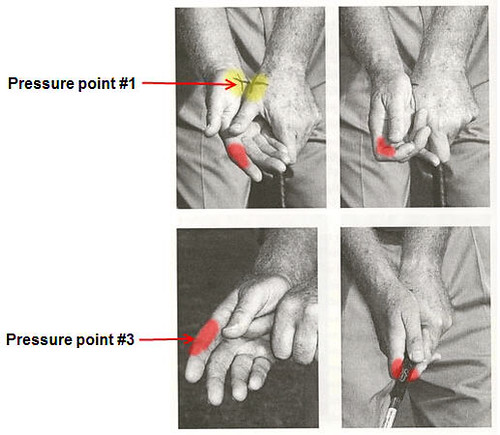
PP1 and PP3
PP1 and PP3

But there's an equally--if not more--important pressure point associated with the right side or hitting style (PA #1): Pressure Point #1 or PP1. The is where the lifeline of the right hand encloses the left thumb on top of the grip. The left thumb should NOT be visible to you when you apply this pressure point correctly (you should use a "short thumb"). And the kicker is, you should feel downward pressure applied to the base of the left thumb, which means the right hand may be rotated over to the left more than you may think or may have been told, even if you have a strong left hand grip. This helps secure the two hands together, helps prevent the club from moving around in the hands, and helps prevent independent movement. PP1 helps to produce lag pressure felt in PP3. You should feel PP1 through impact, as if the heel of the right hand is pushing the base of the left thumb through the ball (again, use a "short thumb" with your left hand). This pressure flattens or bows the left wrist through impact automatically, keeping the club head behind the hands where it must be. This assumes that your left wrist is kept very relaxed to allow the push force of the right hand heel to flatten or bow the left wrist.

Lag is also known by other synonyms, such forward shaft lean, delofting the club, hitting down on the ball, pinching the ball off the turf, trapping the ball against the turf, etc. Pinching, trapping, and hitting down are descriptions of feel, and many golfers get caught up the verbatim trap of trying to achieve these feels in reality. Forward shaft lean and delofting are the best synonyms of these when attempting to describe reality--what actually occurs when the hands lead the club head into impact.

The opposite of good lag into the ball is a cast or club head throwaway right from the top, followed by a flip at the bottom, where the right wrist flips forward early and the left wrist breaks down and dorsiflexes, the left-hand knuckles rising both skyward and targetward. Even a small amount of cupping through impact has a detrimental effect. This is a classic high-handicap, hacker error that adds loft to the club (e.g., turns a 7-iron into a 9-iron, depending on the degree of flip). In a sense, this mistake has the two wrists in antithetical positions at impact compared with their correct positions; in a flip, the right wrist straightens and the left wrist bends backwards in a conscious or unconscious attempt to lift the ball into the air, causing weak, uncompressed, high shots that don't fly very far and many other potential mishits like fat, thin, and sliced shots.

Since exploring and researching this topic more thoroughly, I wanted to post additional references to material on the internet that I've found helpful, especially since this seems to be a subject that isn't taught much or taught in a manner that's easy to understand. The mop drill demonstrated by many professionals goes a long way towards getting the amateur golfer familiar with the sensation of using PP1 and PP3, but I sometimes wonder if this tidbit isn't kept purposefully vague among golf teaching professionals much the way magicians are sworn never to reveal their secrets; yes, I think this fundamental of golf is that important to improving beyond the hacker stage, at least with respect to feel in the hands and arms.

Another drill that golfers may find helpful is the aiming point drill, where a point ahead of the ball becomes a target for the hands. In other words, the hands must get to that point before the club head, and where that point is will vary by the club length and the player (body type, swing speed, etc). With longer clubs the driver and woods, the aiming point moves closer to the ball or possibly even behind it.

I like Tom Watson's description of using PP3); he likes to keep everything loose on the backswing. But on the transition and downswing, he wants to feel that pressure in PP3 increase dramatically and feel that the right wrist dorsiflexes even more than it was at address. This down-cocks the wrist and produces tremendous lag without creating any tension at address or during the backswing; this creates more of a swinger style with some elements of a hitter style. It should be noted that some teachers want their students to create pressure at PP1 and PP3 right at address and carry that pressure all the way through; in other words, the grip pressure should be constant from address to finish. In this same vein, Mr. Watson also states that that a golfer should hit the ball hard with their right hand at the bottom, provided they start down from the ground up. As Mr. Watson says, "Hit it hard!" Also why Ben Hogan stated he wished he had three right hands!

You should still feel PP1 and PP3 when driving the ball. They key is to keep the ball well forward in your stance with the shaft leaning away from the target slightly at address. Even though we've been told to play the ball more back in the stance to hit a draw, using PP3 for your driver can cause you to hit down on the ball unintentionally, causing pop-ups that go nowhere. Keeping the ball more forward, especially if you don't sway off the ball, allows the club to release. In a sense (just as with the aiming point drill), you're allowing yourself time to let the right wrist straighten a bit more, square up the club face, and hit the ball more on the upswing.

And now, caution. Feeling PP1 and PP3 and pushing against the shaft with that right hand knuckle feels very powerful, but pushing too much with the right arm (without enough lower body's initiating movement) can also send the shaft outside too early, causing an over-the-top move (and thus a pull or slice). The way to counteract this potential error is to keep the butt-end of the club pointing down towards the ball for as long as possible in the downswing, while maintaining the feeling in PP1 and PP3. The end of the handle should first point out to the right of the target line (inside the ball) when coming down from the top, gradually reaching a point where it points towards the target, and then finally pointing behind the golfer's left hip when the fully rotated into the ball. If the end of the club points directly at the golfer during the downswing, that golfer is probably over the top.

Using PP3 can also be thought of as using a "trigger finger." The pressure in the right index finger can also be felt in the crook that wraps around the shaft, especially if that finger is well separated from the others. Using the finger this way increases swing awareness of not only where the clubhead is in relation to the hands (i.e., lagging or releasing) but also where the clubface is pointing at all points in the swing. During the release, the right arm and shaft should form a straight line pointing into the ground, and that trigger finger should be rotated over.

I vacillate between concentrating on PA#4/PP#4 (swinger style of pulling the club through) and PA#1/PP#3 (hitter style described in this post), but I sometimes believe that the swinger style (while still feeling PP#1 and PP#3) is more efficient and passive. For me, I need to make sure that I press that right hand knuckle into the right-side-top of the grip at address, which ironically also seats PP#1 better; then I'm free to swing using PP#4 and can forget about PP#3 and active hitting with the right hand. In other words, a solid connection with the right hand and the club is essential, regardless of the swing style. My tendency is to hold the club with no connection or a loose connection of the right hand pressure points. Now, keep in mind that you can vary the pressure with which you press this right hand knuckle into the shaft; experiment with different pressures--lighter pressures are most likely to yield right-to-left shot shapes, while tighter pressures are better suited for fades. Whatever PA/PP combination used, it's important to keep the end of the club handle pointing down-target for as long as possible to ensure an inside approach. Swingers may very well feel PP#3 but it should be passive and not active as it is for hitters.

How can this be fixed? Well, there needs to be an understanding that the clubhead will always follow whatever the other end of the club does. So, the grip actually should lead or direct the club towards the ball. Once the golf club reaches the "set" position at the top of the backswing (a right angle between the left hand and the shaft of the club) that position should stay the same until the hands and the grip of the club are about even with the golf ball. At that point the hands will begin to unhinge and release down into the golf ball.

Casting Recall: Stop the Power Loss

PP#1- Right heel pad of hand against left thumb

PP#2- Last three Fingers of left hand

PP#3- Right index finger against shaft

PP#4- Left arm against chest

Golfers use different combinations of these pressure points. A golfer who is referred to as a “swinger” because they’re left side is pulling the golf club primarily use pressure points #2 and #4. Golfers referred to as a “hitter” because they’re right side is pushing the club primarily use pressure points #1 and #3.

Positions, Pressure Points, And Power Accumulators | Matt DeJohn Golf

The problem most golfers have is that they have no concept of pressure points and lag pressure and they almost inevitably maximize their lag pressure in the startdown. And because you lose lag pressure immediately after you maximize it, the golfer has lost the lag pressure once they arrive to impact. And remember, once you start to lose the lag pressure, you cannot regain it in that swing.

What usually happens when the golfer loses that lag pressure at impact is that their hands stop or slow down greatly in the downswing and they wind up using their wrists (flipping) to move the clubhead towards the golf ball. One of the main things I try to emphasize in the FLW (flat left wrist) at impact is that in order to obtain it, the golfer should avoid trying to actually keep the left wrist flat at impact. Instead, use lag pressure properly and that will get your FLW at impact.

3Jack Golf Blog: Lag Pressure, Key Concept in the Golf Swing

Probably the biggest question I get in regards to TGM is about 'swingers' and 'hitters.' Before I go on explaining the difference between the two styles, I will note that according to physicist Dr. Aaron Zick, who was brought to the latest TGM Teaching Summit, there is no such thing as a 'pure hitter' or a 'pure swinger' on full golf swing shots. Instead, everybody does a little of both.

3Jack Golf Blog: Understanding the Basics of TGM -- Part III

During the past two years, my thinking has become more refined and I have moved beyond the limitations of TGM thinking, which believes that the swing styles of swinging (drag-loading) and hitting (drive-loading) are mutually exclusive swing styles. I now believe that it is perfectly acceptable to mix swinging elements with hitting elements in the same swing if a golfer can successfully manage to synergistically mix the two elements in a time-coordinated and synergistically synchronous manner.

Power mechanics of swinging

One of the most overlooked fundamentals of the golf swing is the point of pressure created by the club resting against and across the middle joint of the right-hand forefinger. This pressure point transforms that finger into the "trigger finger," meaning it plays a major role in the loading of the club on the backswing and the lagging of it on the downswing.

Where the grip falls across that finger is where we feel the lag of the club. To use this effectively, lay the handle diagonally across the middle joint of the trigger finger. During the swing, you want to feel the club's weight in that spot the entire time.

Breaking 80: Bobby Clampett: Golf Digest

You know that the Lag is felt during the downstroke as a steady pressure in the index finger of your right hand (aka Pressure Point #3 (PP#3)). Done properly the hands and the clubhead combine as Clubhead Lag feel that can be directed, or aimed at a target.

Consequently, the Aiming Point is a target on the delivery line where you fire the pressure in your index finger (PP#3) to. The Aiming Point is very rarely at the ball. Therefore you must not consider the ball as your target. Instead, the Aiming Point replaces the ball and becomes your new target.

The Aiming Point Concept from the Golfing Machine | Golf Lag Tips

2. BOTTOM HAND FOREFINGER PRESSURE

HERE’S AN IMPORTANT POINT: Nearly every bad shot in golf results from the shaft coming off the bottom hand forefinger before impact. When this occurs, it’s all but impossible to control the clubhead. As you address the ball, you should feel very little pressure on your bottom hand forefinger. However, as you start your swing, the weight of the club puts pressure onto your forefinger. This pressure must be sustained throughout the downswing, with the forefinger staying in front of the clubhead. To help maintain this pressure through impact, when taking your grip extend the forefinger down the shaft.

3. BENT BOTTOM HAND WRIST

AT IMPACT, THE FORWARD leaning shaft and clubhead exert force into the ball. When the bottom wrist is bent back, pressure is applied to the lead arm and shaft as the clubhead approaches impact. If the clubhead weight passes the hands prematurely, the bottom hand wrist straightens, slowing down the clubhead. To ingrain the correct feeling of the bent bottom hand wrist, sprinkle some grass on your left thumb and take your grip. Make some short pitching-length swings. If the right wrist stays bent, force is sustained during the downswing and the grass will remain in place.

For maximum distance here are four little known..but key points

When a ball is struck with "Lag" it explodes off the clubface! Without this "lag" the sound turns into one of mush, a soft Impact instead of a driving Impact.

So we have a Clubhead Lag Pressure Point (Pressure Point #3) which is the Right Forefinger and this is always directing the club to where, the inside back quadrant of the ball.

Golf Swing | The Secret of Golf

The right hand “V” will point straight up toward the chin, and the secret is accenting the forefinger position so it looks like a “trigger finger.” Going further, be sure the first joint segment of the finger is pressing into the side of the club in a manner that slightly puts the first knuckle on top of the handle as pictured here. The trigger finger will maintain side pressure on the handle from start all the way to impact.

Right Wrist Action for the Perfect Golf Swing | Herman Williams Golf Instruction

A trigger finger can help you better engage your golf swing. What’s a trigger finger? John Daly, for instance, as well as several other top players use some separation between their index finger and the rest of their grip as a “trigger” to help sustain proper grip pressure and assist in better hand rotation and in preventing the club from slipping too far into the palms of the hands. Give it a try and see what a trigger finger can do for your feel and overall swing.

Master Your Iron Play | GolfTipsMag.com

If you are holding the club with the last three fingers of your left hand and the middle two fingers of your right hand, and if your left thumb is cradled firmly in that little pocket of your right hand, with the part of the right hand below the thumb keeping a steady pressure, then you've got it.

You may have trouble keeping the pressure on with your right hand below the thumb. But believe me, this is the right way to hold the club. Master it and you are more than halfway home as a golfer.

The Swing is Simple - Arnold Palmer - SI Vault

Power is applied to the left hand, not the club itself, using the base of the right wristbone pressing against the top of the left thumb, to help the left hand move along its arc around the shoulder fulcrum.

The Wrong and Right Way to Apply Force

When your right palm exerts this slight pressure against the left thumb extending the grip away from your left shoulder, you will not need to have any tension in your left arm to help it remain straight and your left arm will have the same radius around your left shoulder from start up, through your back swing, down swing, and through impact. [This] pressure point has another function as well, it monitors the cocking and uncocking of the right elbow and sends this information to the motor cortex. It only feels this hinging motion and should never add or contribute to the actual cocking or uncocking of the right elbow.

TGM 101 - The GOLFING MACHINE

Again, the palm of the right hand presses hard against the thumb of the left.

Cure A Golf Slice - Harry Vardon


Sunday, March 24, 2013

Hover Craft

I think Jack Nicklaus' preference to hover his club at address could help many players, and I have found it helpful to me with all the clubs--even the putter. Why? It definitely smooths the takeaway and backswing because the club can't catch on the ground and be jerked off plane. It prevents unnecessary tension from forming in the arms and hands which can happen when "snatching" the club off the ground to execute the takeaway; in other words, it helps keep the arms passive in the swing, as it should be. Hovering the club or "underreaching" provides for the feeling of the arms and club hanging freely from the shoulders, so there's an enhanced sense of the club head weight. Fat and thin shots are greatly reduced, because the wrists are allowed to extend more fully at address instead of starting less extended and then extending more in the downswing.

In the case of the driver, it can preprogram your driver head to help find the sweet spot on the downswing. But it's important to hover it properly to promote this: Tee the ball so that you can hover the club to position the ball just a hair above and right of dead center, which is the sweet spot of modern drivers. Therefore, the club is just barely off the ground. Don't hover the bottom of the club even with the bottom of the ball.

With fairway woods I position the club on the barely touching the ground because I like to think of the ground as my tee; with fairway woods, I'm trying sweep the ball like a driver.

With the putter and irons, it's the same: just barely above the ground.

Provided the arm tension and posture remain constant, hovering the club should ensure clean contact. The key is to use your posture with fully extended arms (not locked) to hover the club; don't fall into the trap of lifting the club up with your arms.

...The problem is teeing up higher and placing the driver on the ground at address. For example, let's say that you tee the ball up so that 2/3 of the ball is above the driver head. If you return the driver head to its address position, you will hit a pop-up. So you will have to raise the driver head off the ground at impact. But if you do this, the driver head moves further away from your body and cause heel hits.To fix this and hit it in the middle of your clubface with higher tee height, hover the driver head (off the ground) just behind the ball. I think you will be able to fix your heel hits with this adjustment.

Can't Hit The Driver - Golf Samurai

When I watch a PGA Tour event, Champions Tour event or LPGA Tour event, I'm often struck by how many players hover the club at address. They do not rest it on the ground before starting their takeaway. To name a few players: Bubba Watson (click on the link here), Dustin Johnson, Jason Day, Matt Kuchar, Steve Stricker, Davis Love III, Jay Haas, Greg Norman, Yani Tseng, Cristie Kerr. Get the picture? Yet, I rarely see average golfers do this. These tour players all hover the club when the ball is teed, but a number also use the same technique on pitches and even putts. You should try it, too, especially if you feel you have difficulty bringing the club back, or would like to smooth out your takeaway, or have trouble making solid contact on pitches from tight lies.

Weekend Tip: Don't sole the club at address: The Instruction Blog: Golf Digest

JIM FLICK: I'm reminded of what the legendary player and teacher Paul Runyan described as "measuring out" or "underreaching" at address. Paul contended that if you didn't sole the club but held it just above the ground, and then kept your grip tension and spine angle constant throughout your swing, you would always hit the ball cleanly.

This principle is especially true for pitch shots, but it also holds for irons, fairway woods and, yes, the driver. And with today's fairways mowed so tightly, it really helps you make perfect contact. You want the club to return to the ball in a precise manner every time.

Jim Flick And Jack Nicklaus: Hover The Club At Address: Golf Digest

Another simple way to stay loose over the ball is to hover the clubhead just off the ground (above, right). Hovering the club promotes a free-flowing movement away from the ball and sets the stage for a smooth, rhythmic backswing. In many instances, when players rest the clubhead on the ground for any length of time, they freeze over the ball, which encourages muscle tension to creep in.

By hovering the clubhead you'll begin to feel the weight of the head. This will help you to start back at a nice, controlled pace.

David Leadbetter: Hover To Beat Tension: Golf Digest

The biggest problem amateur golfers like me and you have when it comes to the short game is chunked shots. To help prevent fat chips, try the under-reach technique. Begin by assuming your address position, with your arms hanging to their natural length. Choke down on the club about an inch (I go even shorter, about two inches), and hover the club just off the ground as you get ready to execute the shot. The combination of choking the grip and hovering the club will help you guard against hitting the shot fat. When you finally make a swing, simply concentrate on contacting the bottom half of the ball.

Golf Short Game Swing Tips at GolfGist.com


Tuesday, February 19, 2013

Address Procedure, Shaft Angles, and Taller Posture

I recently discovered a simple error I was making at address that affected the consistency of my contact in the full swing, especially with the driver. This unlikely culprit was also causing me to bend over too much from the hips with too deep a knee bend at address. What was this error? The angle of the club shaft to my arms was not large enough. In other words, I had preset too much radial deviation and not enough ulner deviation at address; my wrists were preset with too much wrist cock (too close to 90 degrees), which meant I had to bend over more from the hips, bend the knees more, and widen my stance in order to address the ball!

Taller posture
Taller posture, larger wrist angle

The result was inconsistent contact on the club face, and the club was also bottoming out behind the ball (fat) or hitting the top of the ball (thin and skulls). I would get a lot of pop-ups and skulled shots with my driver. The wrist angle naturally increases in the downswing as the wrists uncock, which means the difference between my address shaft angle and impact shaft angle was too great; the impact shaft angle is usually always more upright than at address, but too much can cause the errors I was experiencing.

I should note that the two work in tandem: a taller posture should cause one to address the ball with a more upright shaft and, thus, a straighter wrist angle (shaft-arm angle). And the opposite is true. Therefore, as the angle of posture (legs to trunk) decreases (moves away from 180 degrees towards 90 degrees), the shaft-arm angle also decreases (i.e., the hands get closer to the ground). And vice versa.

Other variables play a role. One's body type and equipment (length of shafts and lie angles) have an impact in this equation. You should experiment to find what's best for you to make solid contact in the center of your clubs. I wrote before about having the grip point at the belt buckle at address, but the truth is that this may be too flat for some players: it should point somewhere between the belt buckle and the belly button.

Every golfer needs a good procedure for helping to ensure a proper setup or address posture with respect to stance width and distance from the ball. It's easy to overlook the importance of a good address procedure as a fundamental, but when done consistently the same way with all clubs, it helps eliminate inconsistency introduced into the swing BEFORE the first move off the ball in the takeaway.

I've written before on how a wider stance helps promote a hook and higher ball flight, while a more narrow stance helps promote a slice (a wider stance presets the upper body further behind the ball and theoretically produces a flatter swing). What set me off on my quest was learning that I tended to bend over too far from the hips (also using too much knee bend) when addressing the ball, especially with the driver; this meant that my posture was not upright or tall enough. Increasing or straightening the wrist-club angle at address automatically induces a taller posture and reduces the amount of the downward wrist uncocking (ulner deviation) that occurs during the downswing! It's important not to go too far and completely straighten the angle, but getting closer to straight will help reduce the vertical variance in club movement through the ball when the wrists uncock. In reality, it also reduces the amount of horizontal variance, helping to return the ball to the center of the club face at impact, because you're presetting both downward and outward movement of the club head.

Using chalk on the club face, I noticed that my contact with the driver face was consistenly too high. Most of my misses were no longer left and right (horizontal) but up and down (vertical) with respect to impact on the club face. I could compensate slightly by hovering the club completely above the ball at address, but this was ridiculous as no golf professional does this, and the contact was still too high on the face. So, on a whim, I addressed the ball as usual and then raised my posture a few inches. Doing so caused the angle between the club shaft and arms to increase as my wrists had to increase in ulner deviation to keep the club aligned with the ball. Standing taller can also cause the stance width to decrease slightly, but what's more important is to recognize the relationship between the angle of the address wrist cock and the amount of upper body bend (or posture) over the ball at address. Subsequent drills using chalk as an indicator produced many more impacts located in or nearer to the center of the club face, which is essential for distance with any club but especially for the driver.

So I asked myself if there might be a more failsafe method of addressing the ball to achieve a taller posture, better stance width, larger arm-shaft angle, and correct distance from the ball, and I remembered something that I had poo-pooed away before but that most professionals do some form of when addressing the ball.

After ascertaining the proper aim behind the ball, one should first place the club behind the ball on the intended starting or target line (aligned to a close target a foot or so in front of the ball on the intended starting line). This should be done, initially, with both feet together with the ball located on a line running between both feet and perpendicular to the target or starting line. Most important is that the wrist angle at address is extended or closer to a fuller down-cocked position. The knees, hips, and shoulders should be on lines parallel to the target or starting line. The head should be located slightly behind the ball. At this point, one should assume the correct upper body posture by bending over from the hips with the arms hanging to get the correct distance from the ball; if you've suffered from too much wrist cock at address, your posture should feel much taller.

Address procedure
Address procedure

Now, all that's left to do is to move both feet to a stance comfortably wide enough, with a very slight knee bend, to maintain that upper body posture relative to the ball established when both feet were together! Your head and upper body should not move vertically when you take your stance. In other words, the posture stays taller. With the driver, only the right leg need move, as the ball position should be more forward. The shoulder, hip, and knee lines shouldn't move from their original positions; if they do, then the stance assumed has been too wide. If one wants to hover the club (to improve impact or smooth out the takeaway) then one should hover it when going through this procedure; otherwise, the upper body's posture will change when raising or grounding the club.

Notice that tour players look “big” compared to their clubs. Even with a longer iron, say a 4-iron, they seem to be standing “on top” of the ball, meaning the ball is not too far from their feet. Their spines are generally bent forward a fair amount, and the shaft of the club points at the belt-line, and often higher.

Are Your Golf Clubs Too Long? | Golf Things Considered

The clubshaft should be pointing to the belt buckle or slightly above it…

10 Checkpoints For Proper Setup Position ~ Create Golfers

In establishing the correct shaft angle, we also resolve the question of the correct position of the hands at address. Far too many players hold their hands too low at address - few hold them too high. Holding the hands low at address is a major cause of excessive wrist action in the swing. A vice to be avoided at all costs!

Here once again, is the routine:

1 Evaluate the shot.

2. Take up your grip and square the club face to it.

3. Ground the club correctly behind the ball.

4. Now place the feet into position.

Note that the positioning of the feet came LAST.

The average golfer often reverses the procedure, placing his feet first, then vaguely grounding the club he juggles with his grip in an attempt to get the club-face square. There is no logical sequence in his method and his last minute grip adjustments account for the fact that his grip is never the same one shot from the next.

Golf Lessons - Lesson 4 from Golf Today

In an athletic address position the arms hang comfortably from the shoulders with a slight cocking of the wrists as you grip the club. The toe of the club should be off the ground slightly, with the club resting more on the heel of the club. From this set up position it is easier for the wrists to cock correctly, starting the club on plane and setting the club at the top of the back swing.

Club lie angle at address and impact are not the same | Derek Hooper Golf


Monday, February 4, 2013

Driver Downswing: See the Ball at Eye Level

One feel I use to shallow out the driver is to feel that my eyes are behind and level with the back of the ball up to the point of impact. Impossible, I know, but we're talking about a feeling here, not reality.

Ernie Els - Head Back!
The head and chest are behind the club shaft, the head is actually behind its original position.

Another way to put this is that--of all the clubs--it's most important with the driver to exaggerate staying behind the ball! It's true that the longer the club the more behind the ball you should be at impact, but it's an absolute necessity to hit good, penetrating drives with the driver.

Look at slow motion video of most professional golfers and you'll notice that, up to the point of impact, their heads are located over their right leg when swinging the driver. In many cases, their heads move FURTHER right from the initial address position, which was already behind the ball! (You'll still notice that their heads are behind the ball with other clubs too--just not that far back.) Thus my feel of trying to get my eyes behind and level with the back of the ball. The continuing motion of the arms and club will pull you fully over into the left leg and into your balanced finish.

A wider stance and increased rightward tilt at address will help with staying behind the ball at impact, but it also encourages a hook. Remember that a wide stance is a hook condition, meaning that it inhibits lower body movement and encourages more arm movement through impact. If you find yourself hooking the ball wildly, you may need to go with a more narrow driver stance to help straighten out your drive; a narrow stance is a fade or slice condition, because the body can get ahead of the arms; as the stance widens, the swing plane becomes flatter, and the plane becomes more vertical with a more narrow stance. There are many such characteristics associated with different ball flights that you can use to encourage a shot shape you desire, but remember that you still must be able to get behind the ball and stay there up to impact.

Swinging this way also allows you to tee the ball up higher to encourage a high draw without the fear of sliding the club UNDER the ball and hitting pop-ups, which is common with golfers who swing the driver too steeply.

Staying back like this with the driver helps to shallow out the downswing and produces a flatter swing plane, causing the golfer to catch the ball on the upswing and impart an upward angle of attack, which reduces backspin, helps ensure an inside-out motion (often resulting in a nice draw), and thus, increases distance. Some instructors teach setting up with an exaggerated spine tilt to the right, but this doesn't help if the golfer immediately begins moving back over the ball (as if hitting an iron). As a matter of fact, it might be best to set up with a rightward tilt with the understanding that this right tilt will, initially, increase when the downswing begins.

Some golfers try to keep their head still or over the top of the golf ball. To make a full turn on a swing with your driver your head might move a little towards your back foot. That’s fine if not desired. You need to be well behind the golf ball at impact. One should have a straight line from the front shoulder to the ball at impact.

Golf Tips with Bobby Lopez: Why Is It More Difficult To Hit Your Driver Than Any Other Club?

David Leadbetter in 100% Golf, 2004, states: "the head and upper body stay behind the ball as you unswing and accelerate into impact." Try to maintain your spine angle from the set up all the way to the moment of impact and don't worry if your head has a little lateral movement. Your head and spine are behind the ball at impact.

Keep Your Head Back and Behind the Ball Through Impact! Six Top Golf Pros Agree

The key to solid driving is that you first get fully behind the ball as you wind up your backswing. Only then can your truly stay behind the ball as you unwind on the way back down. With the driver, one of the problems that I see a lot of amateurs struggle with is they get too far ahead of themselves on the way down, which results in the swing being too steep coming in to the ball.

Remember, you have to get back to the left side to strike the irons properly, which involves making sure that your body weight is centred more on top of the left foot as you hit the ball. With a driver, if you can first get behind it and then stay behind it, you will enjoy flighting your tee-shots with a good powerful trajectory.

The BIG Feeling - Denis Pugh

Anchor the head at the beginning of the downswing. There is no need to shift the weight forward the same as on an iron shot where you have to hit down onto the ball. Keep the head back to hit the ball on the upswing.

Driving the Golf Ball - Golf Swing Driver Tips

In the swing you will need to feel that you are staying behind the ball with your upper body as you aggressively drive the hips and weight over onto the front foot. This is where the “uphill” sense comes from – as the hips drive the head stays back you create the body motion that allows for the clubhead to move up into the hit. I like to refer to this as body curve.

Driver Set Up | Andrew Rice Golf


Saturday, September 29, 2012

Driver Shaft Lean at Address

I've noticed that I can set up to hit a driver with the shaft leaning too far forward when I'm not paying attention, with the club shaft pointing at my left hip. The mishits from a shot like this include fat shots and pop-ups, because this sort of setup encourages a downward hit into the ball. With the woods, we want an upward angle of attack.

If you look at video or photographs of professional golfers showing their driver setup positions, you will notice that most set up with their hands directly over or just behind the club head (and thus ball) at address, and the club shaft is either vertical or leaning slightly away from the target. The club shaft will point at the belt buckle or just to the left of it, and the angle of the club shaft matches the angle of the left leg. In other words, the club DOES NOT lean towards the target as it does for iron shots.

Setting up with the shaft vertical or leaning very slightly away from the target will encourage a sweeping driver or wood swing rather than a downward driver swing, which is encouraged by the opposite setup. To reach this position, don't move the arms; rather, adjust the stance to get the shaft (and thus ball position) adjusted properly.

Remember to keep the shaft pointing towards the belt buckle and this will assist in getting the driver shaft in the correct position. Also keep in mind that ball position in the stance is directly associated with the degree of shaft lean, either forward or backward, at address. The ball position for the driver should be relative to the hands and upper body, not the feet, and poorer players tend to push the ball position to far forward, especially when hoping to hit a push-draw.

It's important to experiment. It's possible that a hand position very slightly forward of the ball with a driver might assist in hitting inside-out and promoting a push-draw. Taken too far, however, will cause fat shots, pop-ups, pushes, and push-slices.

So if your hands are ahead at address, they will try to be ahead of the ball at impact promoting a "compression" of the golf ball equaling more distance and accuracy. The backward lean of the driver will promote a "sweeping" of the ball off the tee to create the optimal launch angle for your drives.

Jake Spott Golf Instruction: Shaft Lean Angle

One of the most common errors with the driver is to lean the club shaft too far forward. This club shaft alignment promotes a steep attack angle, robbing you of power and accuracy. Rory [McIlroy] is a great example of someone who doesn’t lean the driver forward at address, allowing him to get behind it and achieve the necessary attack angle.

Tip from Travis: Avoid the shaft lean « PGATOUR.com The Tour Report

The shaft of the club will appear to lean slightly toward the target with your short irons because the ball is positioned in the center of your stance. With your middle irons, the shaft of the club will lean only slightly toward the target (or not at all) since the ball is forward of center. With long irons and woods, your hands and the shaft of the club will appear to be in line. Again, as the ball position moves forward, the hands stay in the same place so the lean of the shaft disappears. With a driver, the shaft will lean away from the target.

Golf Setup - Proper Positions

With the driver, most golfers play the ball too far forward and stand too far away from it. This might feel powerful, but it sets some bad things in motion.

Lesson Tee: Butch Harmon: Rule No. 1: Position The Ball: Golf Digest


Thursday, June 21, 2012

My Wacky Left Shoulder Hitch

I am occasionally vexed by a hideous hitch in my left shoulder. What happens is that my left shoulder joint sometimes rises slightly upward at address (tension) and increases during the down swing, which exaggerates my shoulder tilt and causes all sorts of crazy shots--fat, pop-ups (especially with the driver), and thin shots. I've noticed it can creep in to my swing when I'm nervous or trying to belt one.

Not sure why it happens but it may be an unconscious effort to lift the ball during the swing.

And I'm not 100% certain how to cure myself other than to be aware of it; it's a sign of tension in my swing and address position.


Saturday, April 28, 2012

Adjustable Drivers

Adjustable drivers are all the rage these days; golfers can adjust various attributes of the club to suit their swings and help correct ball flight errors. My Nike SQ Machspeed driver is a square-headed, thud-making monster; I keep it adjusted to a flatter lie with a slightly closed club face position (because my ball flight error tends to be a slice).

However, I've noticed that on days when I'm making a good turn behind the ball and using a reasonably strong grip (slightly more than neutral), I can start pulling, hooking, and hitting really low shots off the tee with it. This is why it's important to be able to diagnose what's going on while playing. Two primary components of ball flight are swing path and club face; the two are joined at the hip and synergistic.

When I know I'm making a good turn behind the ball (full shoulder turn) and getting an inside-out swing path and the ball is hooking, pulling, or going low, I know that my club face is too closed to match that swing path. Suddenly, my adjusted driver becomes an enemy. True, I'm not slicing…I'm just doing the opposite, which can be disastrous too.

In those situations, a slight grip change may be all that's needed to correct the ball flight. I've noticed that the stronger grip I use for my other lower lofted clubs (like the 3-hybrid or 5-iron) can produce low and/or left ball flights with my adjustable driver, if I'm swinging on a good inside-out path. So (and every day on the golf course is different), I will slightly rotate my grip to the left (V's pointing between my neck and right shoulder as opposed to directly at my right shoulder) as a fix. Usually, this small change will straighten my ball flight and produce a higher draw shape.

However, go too far with the grip (or start making an incomplete turn) and the ball will start fading or slicing again. Golf is great, huh?

Saturday, April 7, 2012

Off-The-Shelf Drivers Are Too Long

Gripping down on the club (especially the longer ones like the driver and fairway woods) may be a great idea for some golfers that will lead to gains in accuracy while sacrificing only a minimum in distance. As a matter of fact, this is a testament to why many of us should just forget the driver and use a 3-wood to tee off. I recently played several rounds using only a 3-wood and noticed no real difference in my score; I also hit the fairways a lot more, which feels fantastic.

To fool us into thinking we'll get more distance, golf club makers have been selling us off-the-shelf drivers that are two or more inches longer than the ones the pros play. And many pros grip down even still. So, that should tell us mortals that we need shorter drivers or we need to grip down.

Gripping down will change the characteristics of the shaft, making it effectively stiffer. But gripping down an inch or so won't make that big of a difference. Take care. If you're gripping down on your driver it will take some getting used to.

But where this quest for distance is abused the most is on drivers. We see the average driver in the store at 46-47" in length now, when the old standard was 43", then 44" up to about 6-8 years ago.

And average golfers are buying them like hotcakes. But do you realize that very few tour players are using a driver over 45" in length? Why? Because they know they cannot be reasonably accurate with longer drivers! So, if the tour players know they can't control a driver that is 46-47" long, what the heck makes amateurs think they can ?

A few years ago, GolfSmith did an extensive live golfer test at their huge facility in Austin, Texas, where they had hundreds of golfers hit drivers of all sizes, shapes and lengths. They found that almost every golfer achieved his best average driving distance with drivers that were 43-1/2" long! Now, that was when 45" was the new "standard", but the point remains clear to me: Your driver is probably too long for you to hit efficiently!

***

So, I just began to choke up on these long drivers and my accuracy came right back, without a loss of distance! And I don't care what golf course you play, it's easier from the fairway.

Oh, and there's another significant side benefit to this alteration to your driver. When you shorten it, you can use lead tape to bring the swingweight back up to where it should be. By positioning those few grams of lead tape strategically on the clubhead, you can bias your driver for a draw (weight in the toe) or fade (weight in the heel).

You can also place the lead tape in the back of the head for a higher ball flight if you need it, or right on top of the crown behind the face for a lower ball flight.

[From Your Driver: Is It Your First Scoring Club?]

But I did toy with the idea, and even had Ping build me a driver with 5.5 degrees of loft and an extra-long, 48-inch shaft. The longer shaft, which many people assume is an automatic trick to generating more clubhead speed, didn't work at all. It threw my timing off, and I didn't hit the ball much farther even when I nailed it. I did much better with my standard 44½-inch driver, simply swinging a little harder.

Trying a longer shaft is a popular suggestion these days, but most players should, if anything, try a shaft half an inch shorter than what's in their driver. (The average, off-the-rack driver shaft today is 45½ inches.) Tiger Woods at his longest used a relatively short 43½-inch driver, with a steel shaft to boot. You'll find it easier to hit the sweet spot with a shorter shaft, and you can go after tee shots without losing much control.

[From 10 Rules From Bubba Watson: Golf Digest]

Wednesday, March 21, 2012

Low Trajectory with the Driver

UPDATE: Can now confirm that this is a MUST, especially with longer irons! Definitely gained yards and height by keeping the head back, but the bend in the right elbow (or keeping the box) needs to be kept as long as possible to prevent hitting fat. Another way to think of keeping the head back is to simply widen the stance, which automatically pre-positions the head behind the ball and more weight to the right side. Also, one of my old habits is to unconsciously try to lift the ball (a yip or flinch), because we've all been told to hit up on the ball with the driver, but this actually will cause thin and fat shots. It's more important to envision swinging level to the ground; pretend you're trying to drive a nail directly in the back off the ball with the driver and woods.

This is something that has plagued me. So I'm intrigued to try some of these strategies to correct it and give me a higher ball flight with my driver. In essence, I think I use too much of an iron swing with my driver; I end up with low pull-hooks, high push-slices, hitting behind the ball (fat), and toe shots. I've noticed that my head will often get ahead of the ball or that I'm fully on the outside of my left foot at impact, and thus the only thing I can do is hit more down and cut across the ball as opposed to sweeping it off the tee with an inside-out motion. I also often try to help the ball into the air using body english and arm motion, and this just makes things worse; the irony is that the ball will get more airborne by concentrating on hitting the back of the ball (sweeping it level with the ground) as opposed to trying to hit up!

I believe that a lot of my problems stem from being too aggressive with shifting to the left leg (again…left over from my S and T days), and that is especially troublesome with the woods. Yes, I think it's true that the weight must shift fully to the left, but for me I think it has been too quick as opposed to a gradual process. Pictures of pro golfers hitting driver at impact shows that their heads are well behind the ball and even over their right leg, while they finish fully on the left. Clearly, I'm not executing a proper weight shift and losing distance as a result.

The golf weight shift from right to left is a definite…but a GRADUAL definite. It's not an instantaneous, violent maneuver as I've thought of it before. As Haney says with regard to weight, one should roll from the inside of the right foot onto the left big toe and finally to the outside of the left foot and heel.

In reality, keeping the head back longer and preventing a rapid weight shift from right to left are nearly synonymous. They both refer to the same thing. And this error is never more glaring than when hitting driver. Get the feel that once you get over the right leg in the backswing that the head stays there while the lower body weight shifts to the left.

Also key is teeing up a little higher when you're trying to achieve a higher trajectory. The height difference will not be that different--maybe a quarter of an inch, but this will help get the ball back in a good position for the sweet spot with a more upward motion. Use with caution, however. Teeing higher requires that the ball be further forward in the stance, which may mean simply widening the stance.

Shallowing influences include positioning the ball further forward, swinging more around the body, and widening the stance.

When your head moves forward during the downswing, your whole swing plane moves ahead. That means you will tend to lose the ball to the right or leave the clubface open through impact.

One day, Lee Trevino was playing with the amateur golfer. Trevino gave only one advice to this golfer. He told him to keep his head back.

This amateur golfer was hitting a strong draw on that day.

[From Impact Position: Keep Your Head Back | Golf Tips & Lessons]

If you feel that you’re shifting to the left in the downswing to early, do some practice swings facing a mirror and watch your head to see if it’s moving left in the initial stages of the downswing. Also, watch yourself load your weight better into the right inste/heel as you hit the top of the backswing.

Another thing you can do is take you ball and as you tee it up, turn the label so it faces to the right. Now, as you go to hit your shots, watch the label. If you shift too much left, you will loose sight of it. The only way to see the label is if you stay behind the ball as the club swings through impact.

A final thing you can do are practice swings “feeling” more weight on your right foot as the club swings through. By feeling more weight on your right, it will stop you from shifting to drastically to the left. Once you get the feeling in practice swings, apply it to your shots.

NOTE: It’s not that I want to weight on the right foot at impact, it’s just a drill to stop the weight from shifting to the left too soon. So, do a bunch of practice swings feeling more weight on your right side into the downswing. Then, apply this new feeling to your shots. After you start hitting your shots higher forget favoring the right leg like this.

[From Stop Hitting The Driver Too Low]

Lift your left heel

At address, lift your left heel. Take a few practice swings with your left heel off the ground during the whole swing.

This will prevent your upper body to move forward on the downswing.

If you stop your head from moving forward, your clubhead speed will increase.

[From Impact Position: Keep Your Head Back | Golf Tips & Lessons]

Lee Trevino had a great tip or swing thought that I use when I want to hit a ball really high (#10 at Lake View requires me to carry a ball pretty high over some trees around an 80° dogleg).

His tip was "you want to feel as if you're head is moving backwards (to the right for a righty) at impact." Lee used the tip to hit a draw, but if you're square it's a good way to keep your upper body back through impact, too. Tee the ball up a bit higher if necessary too, yeah.

[From Trajectory is too low with my Driver]

When a golfer places too much weight on their front foot, it increases the chances of a golfer getting out front of and "stabbing" at the ball, which is likely to yield a low trajectory off the drive. However, by keeping one's weight back and leaving it there until impact position, the weight is more evenly distributed across the swing, which will help make impact with the ball on the way down, therefore increasing the chances of a longer, higher drive. Also, make sure not to swing too quickly and "lunge" at the ball, as this can create a low drive as well.

[From Causes of a Low Drive in Golf | Golf Tips | Golfsmith]

Lots of teachers will tell you to hit it on the upswing with your driver. But if you do it too much, it can cause slice. Some golfers start to hit well when I ask them to sweep the ball instead of trying to hit up on the ball.

...you can focus on the back of the ball instead of just looking at the top of the ball. The clubface contacts with the back of the ball. So you should focus on the back of the ball as well.

Here is a good swing thought. Picture a nail stuck into the back of the ball. When you swing down, I want you to drive the imaginary nail through the ball.
The problem is teeing up higher and placing the driver on the ground at address. For example, let's say that you tee the ball up so that 2/3 of the ball is above the driver head. If you return the driver head to its address position, you will hit a pop-up.So you will have to raise the driver head off the ground at impact. But if you do this, the driver head moves further away from your body and cause heel hits.To fix this and hit it in the middle of your clubface with higher tee height, hover the driver head (off the ground) just behind the ball. I think you will be able to fix your heel hits with this adjustment.

[From Can't Hit the Driver? | Golf Samurai]