Showing posts with label elbows. Show all posts

Saturday, February 28, 2015

Side Bend in the Golf Swing

Keegan Bradley
Bradley's Lateral Bend
Right Lateral Bending

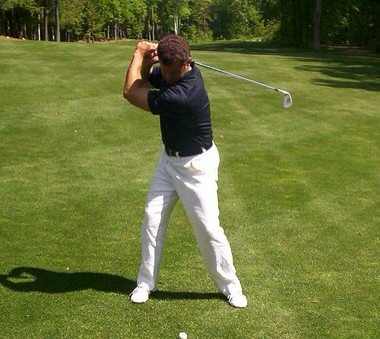
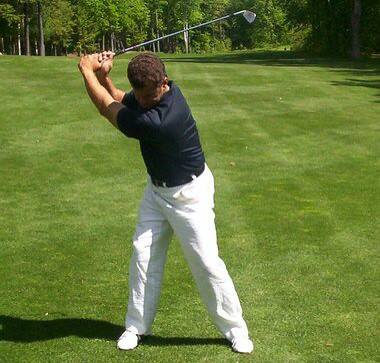
The transition--back still facing the target--begins when the spine bends laterally to the right, blended simultaneously with a rotational pivot around the left side (i.e., "bend-rotate"). This assumes and demands that the preceding thoracic spine position was a lateral bend to the left at the top of the backswing, left shoulder pointing down; if you stand up on the backswing (left shoulder too high), lateral right bending will send the left shoulder too high during the downswing.
Kelvin Miyahara calls this "engaging the spine engine," meaning that it forces the facets of the vertebra to behave like gears to drive the swing and keeps the lower back in a state of safer lordosis. He states that this lateral bending move must occur BEFORE starting down, but in reality I look at it as if simultaneous bending and rotating ARE "starting down."

Fundamental Automation

With proper right lateral bending, you will notice a few "fundamentals" that occur automatically. The left hip bumps both towards the target and back to the original tush line (while the back is still turned away from target), and the weight shifts into the left leg. This left hip tush-line-return move blends immediately with a left side rotation (i.e., "clearing the left side"). An analogy to the left hip rotating back and around is that the right foot rolls inward and right knee moves somewhat linearly towards the left knee (also analogous to the right hip "dropping"--more on this later). This left hip tush-line-return-and-rotate move is crucial to create space for the right lateral bend; otherwise, the arms will crash into the body if you merely bend laterally to the right WHILE sending the right side out towards the ball. Also, you will notice that the arms drop down automatically when right lateral bending without the loss of wrist angles, and the right elbow drops in close and in front of the right hip (the lateral bending forms a "pocket" or "catcher's mitt" in front of the right hip to receive the right elbow). The right shoulder will also drop very close to the right hip--again the back still slightly facing the target--and the club shaft will automatically shallow or flatten. The secondary spine angle will also increase (upper swing center leaning away from target more than at address); you will feel your head staying way back at impact. You will notice that the right elbow still has a generous bend in it at impact. Your hands are easily well ahead of the ball before the club head reaches it; the right elbow can easily lead the right hand (externally rotated humerus), because it was able to fall unhindered back into the "pocket" (i.e., front of right hip) created by the side bending. The tip of tail bone will actually move first towards the target and then away from the target, and lateral hip sliding is kept to a minimum (i.e., the left hip stays "inside" the left foot). All of these things happen somewhat automatically as a result of the correct bending-rotating motion.

Body-driven Motion

A note about the arms, wrists, and hands: They should not be doing anything until near impact; the motion of lateral bending and rotating, as described above, provides all the impetus needed to get the arms and club to automatically start down and reach a position at or near pre-impact. This totally supports Joe Dante's assertion in his famous Four Magic Moves book that the arms don't do anything until near impact.

Bending-rotating is what Monte Scheinblum refers to as "bump, dump, and turn," although I don't believe the arms "dump" into the body as he explains; the right lateral bend--properly performed--makes room for the arms and club to swing down in front of the body unhindered. Be aware of a tendency to stand up when doing this; correct lateral bending is a form of "covering" the ball. If you "stand up" it means you didn't really bend laterally; you likely rotated your right side out to the ball.

Elbows Close and Iron Man

As rotation around the left leg begins, the left shoulder should feel like it separates from the chin and realigns with the left leg (as in the Reverse K address position), moving around before moving up. Pretend there's a light shining from the middle of your chest (think of Iron Man) and that light should rotate to shine down towards the ball at the same angle established at address, and then begin angling up in front of the left foot, as the chest rotates through impact ("return cover angle" or primary spine angle); this is called "covering the ball" with your chest. The covering "chest light" should lead the arms and club back to the ball. The right elbow should swing down past the right hip unhindered (i.e., no crashing into the rib cage); the right arm feels as if it straightens towards the target underneath the left shoulder and is totally unhibited by the right side (it may lightly brush but should not crash into the right side). This is encouraged by keeping your elbows close together back and through.

Proper Finish

At the finish, you should feel very balanced and fully on the left leg, the pelvis will be forward of the upper torso, the left hip will feel high and jutted away from the target line, the upper torso will be leaning towards the target line slightly (i.e., head on a pillow), and the right shoulder will be rotated toward the target and touching the chin. These are all signs that posture has been maintained; otherwise, expect fat, thin, and weak, pulled shots.

Drills

You've likely seen the drill where the pro advises golfers to place their left hand on top of their driver, with the driver shaft vertical and the club head sitting on the ground, and practice swinging their right arm under their left arm. I believe this drill is trying to get you to feel right lateral bend. You can also do the windmill drill: Stretch your arms out so that they're horizontal to the ground and take your address posture; rotate back and through so that each hand points down at the ball.

Other Thoughts

Another way to encourage right lateral bending is to feel like your right hip drops down towards the ball during your downswing, which automatically gets your right shoulder to drop, thus initiating a right lateral bend. However, you must remember that it all begins with a left hip bump towards the target (back still turned) and a right elbow that drops unhindered back in front of the right hip.
Side-Bend and Rotate (Notes from 5, 12, 24 November 2014 and 12 January 2015)
Lateral bend, although it seems simple, is really quite complicated. Simplistically, it is just a side bending like the picture above. But add in that this must be done at a while you're at the top of your backswing with shoulders turned, while in the absence of downswing shoulder rotation (if for a brief moment), while your spine is being bent to the right, your shoulder is pulled down behind you while increasing lumbar lordosis (explained later) and while the rotator cuff muscles are externally rotating the arm. Now this seems very complicated.So when does lateral bending occur? It should start during transition. 

Spine Engine Swing: Lateral Bend 
The key is in varying the amount of lumbar lordosis during the swing. Also we are combining the lateral bend with the lumbar lordosis to set the spine gears in place. Any disconnecting of the gears at any point prior to contact will produce an adverse swing reaction (most likely, a hip or shoulder stall) that will cause other problems to occur such as casting, flipping, lunging, jumping, etc. 

Second Magical Key to the Spine Engine: Lumbar Lordosis

Tuesday, November 19, 2013

Right Arm Width: The Anti-Collapse

Collapsing
Arms Collapsing

One of my biggest golfing faux pas is collapsing at the top of my backswing. My right elbow has a tendency to pull the club back inside too quickly (too flat). Then at the top, in probably some unconscious effort to manufacture a longer swing and get the club parallel to the ground, my right elbow sucks in close to my right side--past 90 degrees--and my left arm collapses. As a result, I would get to parallel, but not like the pros do (through flexibility and athleticism); when I got to parallel, the club shaft appeared to be an inch or so from my right shoulder! It didn't feel this way during my swing, but it looked absolutely horrible in pictures and on video: My left elbow was almost at 90 degrees!!!

Proper width
Correct Width

My downswing then exhibited an over-the-top move and a flip at the bottom.

My teaching pro had me work on correcting the collapse by using a partially deflated rubber ball between my elbows as a drill to show me the correct feel for keeping my arms extended, wide, and in front of my chest during the takeaway and backswing. He told me that my elbows should maintain the same distance relationship (or near to it) at the top of my backswing as they did at address; the right elbow and arm should not be pulled behind oneself--an optical illusion we all think we see in the pros. The ball drill felt very strange indeed; it felt "wrong" to me. I had never really tried the correct feel, which feels shorter, compact, more linear, and vertical (and it really is because it's not as flat on purpose).

Something amazing happened when I watched video of me hitting a ball using the ball drill, besides the fact that I wasn't so collapsed at the top anymore; I had a flat left wrist at impact! A consequence of having a flying right elbow on the backswing, and sucking the club inside so far, was that my right elbow would crash into my right side on the way down--I was trapped! And the only way I could save the shot was to flip the club using my wrists! This made it clear to me--especially for an amateur hacker--that what you do on the takeaway and backswing CAN have a dramatic effect on what follows! (NOTE: Listen to your golf teaching pro!!!)

Many fine golf instructors have noted the importance of an extended left arm to create width in the backswing for power and consistency, and I believe the answer isn't the left arm itself: It's the right arm! The right arm should stay as extended as possible and push the club handle away from one's body, keeping the left arm straight passively. Pressure should be felt on top of the left thumb, and the right palm should face roughly up and to the rear at the top of the swing (as if the right palm is pushing the handle away from the target). The right arm should bend slightly (up to 90 degrees at maximum), but it shouldn't go below 90 degrees the way I was doing before, sucking the arms in close to the body and collapsing the left arm in the process. The hands can go as high as head level but shouldn't really go any higher, or the arms will disconnect from the body; also, the extension should only go as far as the left arm will allow while maintaining a slight bend in the right arm (again, ensuring no loss of connection). The club DOES NOT need to reach parallel to hit a powerful shot; don't worry about the pros who can reach parallel--they're pros and you're not!

This brings me to another point when it comes to addressing your swing problems: Don't be afraid to exaggerate a swing change, even if you might be overdoing it at first. You've got to give your body a new feel, and many great teachers such as Martin Hall, Hank Haney, and Butch Harmon advocate for exaggeration to ingrain a change in your game. As Martin Hall often says, "If you keep on doing what you've been doing, you'll keep on getting what you've been getting."

Coupled with maintaining a stable lower body (i.e., another of my errors was rotating my hips freely with my upper body) through torso rotation, I can consistently hit the middle of the club face this way. An overacting lower body can also contribute to sucking the club too far inside and its follow-on recovery moves of going OTT and flipping.

Another way to think of this: Try to keep your hands as far from your chest at the top as they were at address.

The second thing to consider is does the leading arm really bend on it's own? The answer is "no". It is the rear arm that pulls in. When your back arm collapses or pulls into your body, your front arm will naturally collapse. For this reason, our focus must be on the width that our rear arm is creating and maintaining.

Keep Your Left Arm Straight

If the arms travel across the body in the back swing, as is seen in many players, the club will be too far behind the body and it will take excessive hand rotation in the down swing to square the clubface. Conversely, if the arms move away from the body in the back swing the club will be above plane and the club will be returned on an outside to in path through the ball.
To learn to correct role of the arms, place a soccer ball between your arms in your address position and take some practice swings. Make a back swing keeping the ball between your arms and in front of your chest. This will ensure that the arms stay connected to your body coil and they remain in front of your chest with good width. All the ingredients you will require to generate good club head speed.

Golf in Japan

One of the staple tips we’ve heard over the years is “Keep your left arm straight.” By trying to do this, you could be preventing rotation and stalling your arm speed so why don’t we take the water skiing example and think of the lead arm like a rope where the roll of the right arm is to keep it tight – for the whole swing. There are a lot benefits to this including maintaining width in the arms, sequencing the arms with the chest, preventing the clubface from rolling open on the backswing, and creating just the right amount of lag on the downswing. Amateur golfers dream of lagging the golf club and in doing so create angles that are too much to control and ultimately can’t control them leading to the exact opposite at impact. Try going for an inch of lag instead of a foot.

The Backswing

At the top of the backswing, many amatuer golfers collapse their arms here as well. This is a crucial point in the swing where you want to make sure you have good extension and width. The right arm and elbow naturally folds as you swing to the top and your wrists are set and firm. The hands should also be a good distance away from your head or body. Collasping your arms will cause your hands to get too close to your head and you'll lose your golf swing width.


To increase width, you need to increase the spacing between your right hand and right shoulder (right-handed golfers) during your backswing.

Practice taking a backswing holding the golf club with just your right hand. Keep your right hand as far away from your body as possible during these practice swings. During this drill, reach your right hand toward the sky at the top of the backswing.

Golf tip: Remember, in your backswing, width equals power

When Nick came to me, his hands were too active on the backswing, which made his swing arc narrow--a big killer of distance. The club got too far to the inside, so he would shift his weight away from the target on the downswing to get the club back in position to hit the ball.

I wanted Nick to feel his arms staying in front of his body as he turned back. We worked hard on building a backswing where his right arm and hand were as far away from his head at the top as possible. This gave Nick, who is 6-feet-2, tremendous width in his swing arc.

One of the biggest problems that many golfers have is an inability to generate and maintain sufficient width in their backswings.

That problem could be related to flexibility but it’s also possible that it’s just a swing flaw relating to issues such as a narrow swing arc, a takeaway that’s too flat or laid off, or just a complete collapse of the arms at the top of the swing.


Because a swing change involves either a totally different motion or a wholesale change in your grip or setup, there's no way it should feel comfortable.

The best way to make a radical change like that is to take slow-motion swings, sometimes exaggerating the movement. Then you repeat it over and over.

Tuesday, June 18, 2013

Dump the Tray to the Floor

The left wrist should be flat at impact (assuming a right-handed golfer). That seems to be a universal point of agreement among most teaching professionals, regardless of what else upon which they disagree (and disagree they do). The converse of the flat left wrist (FLW) at impact is a corresponding dorsiflexed or hinged right wrist at impact; the two are inseparably linked, thus you can't have one without the other. Given these near universally accepted tenets of golf, if you study long enough you will find teachers that relate the position and loft of the clubface to the back of the left hand (Hank Haney), or you will similarly find teachers that take the opposite approach and match the clubface to the palm of the right hand (David Leadbetter). Either is correct as they have an inverse relationship. And either can help the golfer be aware of the loft of club (i.e., how delofted) and the direction of the club (i.e., whether pointed left, straight ahead, or right) at impact. If you're a right-handed player, you may find it easier to relate the club face position and loft to your right palm, but you've got to do it the right way.

Dorsiflexed RW.
Dorsiflexed RW, palm down.

There are numerous posts on the use of the wrists on this blog. But it's a good idea to revisit accepted fundamentals from time-to-time with a fresh look. In this post, I'm going to examine using the dorsiflexed right wrist and right palm to add power and direction in the downswing, without flipping at impact.

First, all the grip and downswing fundamentals (using the appropriate grip pressure points and arm-chest pressure points) apply. I've posted about this right palm-right wrist concept before. The right palm should begin rotating down towards the ground in the downswing when the club is about parallel to the ground; the right elbow maintains the bend established at the top of the backswing as this is happening. I think the way it's sometimes presented can be confusing, especially for golfers who utilize PP #4 (upper left arm pressed against the left chest). It can be an active or passive process, but I'm going to focus on using it somewhat passively. The grip pressure points in particular allow one to maintain awareness of club face position and lag pressure throughout the swing.

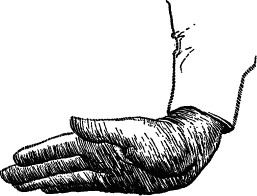
What is this? We all know that the right wrist dorsiflexes on the backswing into a position that looks similar to holding a tray of pizza or dishes at the top of the backswing. At least that's how it has been described. This is where many reputable teachers disagree; some want you to have a FLW at the top (or even on the way there), while others want you to have a slight cup in the left wrist at the top. I think that it's during the transition to the downswing when a good player will often max out this slightly dorsiflexed postion of the right wrist, producing the tray position and a FLW. Most weekend golfers would be better off forgoing the vertical wrist cock on the backswing (taught by many great instructors) and instead focus on just hinging the right wrist backwards (thereby insuring a FLW at the top). Another way to think of this is that the heel of the right hand comes into the ball first, not the right palm! The right palm is trailing the heel of the right hand and the right palm is facing the ground.

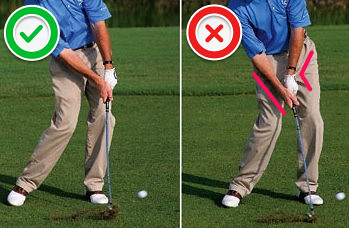
Proper, improper wrist action.
Correct and Flip Wrist Actions.

Regardless of whether you achieve a FLW at the top or during the transition (or later), I think a loose right wrist is essential in allowing the weight of the club to maximize the dorsiflexed right wrist angle in the transition and downswing. You can try to hold the wrist angle (as I once tried to do when first learning of this fundamental), but you'll likely find your shots heading right (unless you compensate somehow).

However, holding the angle is a good way to learn the position and the feeling of the hands-first-clubhead-second necessity, and you can start by just hitting chip shots this way, ensuring you have a FLW and dorsiflexed right wrist (DRW) at impact; you will find that your chip shots will be very crisp, and if you're remotely curious, you'll ask yourself how you can have that same crisp feeling in your full swing shots. You can! When chipping this way, I allow the weight of the club to set my right wrist, and then I hold it coming through. I can feel PP #1 and PP #3 working, sensing lag. I even feel PP #2 in the pinky and ring fingers of my left hand as they resist the breaking down of the left wrist. PP #1, 2, and 3 really work to maintain and feel this lagged position. Boom! A solid, compressed chip shot. Going back and hitting chips like this is a great tool for regaining the correct impact feel in the full swing, if you find yourself suddenly losing it.

But I don't want to consciously hold that angle (DRW) in a full swing, because it will slow down the momentum and deter the continued closing of the club face. The kicker is that you can feel the weight of the club set the right wrist at the top, when the club is still going back, and that's a signal for your brain to start the transition. You can then deliver the DRW at impact without having to forcefully hold it as in the chip example above. One must fight the urge to flip at impact, and again, the simple chip can help you learn to fight this; the correct way is to release the DRW well past impact (it's actually more of a right palm over rotation, where the club shaft and right arm form a straight line point at the ground). But the ball is long gone by this point, and the term "flip" is irrelevant by then (you can't flip at something that isn't there); if your left wrist cups late in the followthrough, don't obsess about it--you want it flat at impact and just beyond. Another swing thought or feel to use is that you're collecting the ball with a DRW (heel and palm of the right hand) by first contacting the inside portion of the ball and then slinging it out towards the target during the release!

Antecubital fossa.
Antecubital and right palm face right field.

This fundamental has been described in many ways. But let's go back to the tray at the top analogy. You want to take that tray and dump its contents on the floor in front of the ball! So on the downswing, you come into the inside portion of the ball with the right palm rotated downward and bent back on itself. The more bent back, the more your selected club is delofted. Likewise, assuming an inside-out path, if the palm is aiming is initially aiming right and closing at separation, you will get a push-draw. So you can see that there are numerous combinations of side-to-side and up-down motion of the palm that can produce a variety of shot trajectories and starting directions.

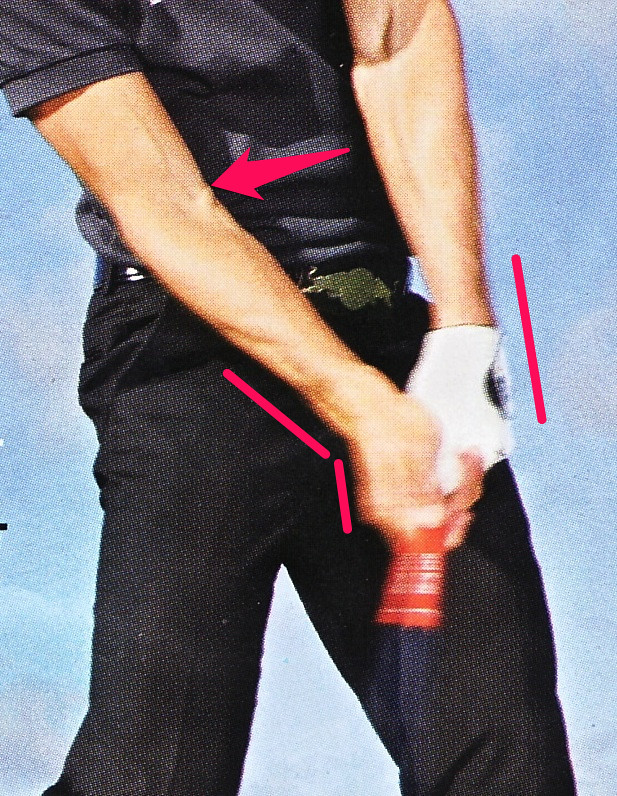
Now another important facet of this concerns the right elbow--specifically the opposite side of the right elbow or the inside-bending part known as the antecubital fossa. The interior bending part of the right elbow should actually face, along with the right palm, towards right field at impact (while still slightly bent), whereas an illusion is that it faces the target line. In other words, the right elbow itself should be rougly pointed directly AWAY from the target at impact, not directly at the right hip. And it's important to note that the still bent right elbow rides near or against the right hip rotating into the impact area and then quickly shoots past the right hip in the release.

So, let's put this altogether. At address, focus on the correct grip pressure points. Keep a loose right wrist (almost floppy feeling) and swing to the top. Let the weight of the club set the wrist into a dorsiflexed position at the top, with a corresponding flat left wrist. Coming down, begin rotating your right palm down to the ground WHILE SIMULTANEOUSLY increasing the dorsiflex in the right wrist (PP #1 feels as if it's increasing--pushing into the left thumb joint), as the still bent right elbow gets close to the right side. This must all be timed with the rotation of the body and while feeling connected, with the left arm pinched against the chest (PP #4). At impact, the DRW collects the inside portion of the ball and begins to release forwards (straightening) and turn over (rotating palm slightly down). Your right antecubital fossa should face out to the right at impact, while still remaining slightly bent (it straightens fully in the release slightly out to the right).

Get used to the feeling of that right wrist passing in front of you still bent backwards a bit. Then start putting with that motion through the ball. Then chipping, then pitching, and finally your full swing with that same bend in your right wrist. It might take a while to get this down, but the effort you put into it will pay off handsomely.

The Recreational Golfer™: Your Wrists at Impact

Your hands at this point will be slightly ahead of the ball, slightly--not leaning way over [but] just a slight bit [ahead], and the right wrist is bent back or "cocked." [actually hinged or dorsiflexed] One way to think about this is to push the pad of your right thumb down onto the knuckle of your left thumb. This will bend the right wrist. Or push the wrist bent.

Here's an Easy Golf Swing Lesson That Will Give You Huge Results

The Answer: What I did next changed my swing immediately. I let all the tension go in my right wrist, so when I took the club back, it set back on itself naturally. I felt a lot of pressure in my trigger finger of my right hand, so I know I was on to something. Before I could never feel that.

What I Did (Drill): I kept the fingers in my right hand very relaxed, and focused on a slight pulling motion. But the key was to pull down with the big fleshy pad under my right thumb, which helped retain the wrist cock in my right wrist. Following me?

What’s important here, is to feel your right hand bent back on itself, and staying there as you pull down. This is called “retaining lag”, and is a must if you want to hit the ball a long way.

Believe it or not, in the pictures below, you might not be able to see it, but my right hand feels and looks right on top of the shaft, with the palm literally facing the ground.

The second picture at impact, I feel like I’m smothering the ball with my right hand. That’s the feeling you need to get to compress the ball squarely, and achieve the nirvana of smashing that golf ball!

Golf Swing Release Drills - Watch This Video

Train the forearms to cross to show the ball who’s the boss immediately after impact. This is known as the release interval and the right palm (for right-handed golfers) should be facing the ground to multiply the power to the punch.

The function of the hands in the golf swing

Then, during your downswing, rotate your right palm toward the ground through the impact zone, to square the face. It's a counterclockwise rotation of your right hand. If you practice turning your palm through impact, not only will you lose your slice -- you'll be able to hit a draw, cut, or straight ball, at will. You'll be dangerous!

Johnny Miller: My No. 1s - GOLF.com

When your right hand reaches waist height, try to face your right palm toward the ground. At impact, you should feel like your right palm is facing the ground as well. David Leadbetter said the right palm mirrors the clubface. So by squaring up your right palm, you will be able to square your clubface. Some players have stronger grip, so your right palm doesn't exactly mirrors [sic] the clubface. But it's close. It's a good idea to use your right palm to control your clubface.

The Tips to Fix a Slice: Use Your Right Palm | Golf Tips & Lessons

The position of the right hand not only dictates the direction of the ball, but also the trajectory of the shot. Using the right hand as the controller again, make the palm face up at impact. Not only does this aim the club right but also adds loft to the club (see photo 4). This will allow you to hit a higher trajectory shot if the situation calls for it. Now, take the controller (palm) and face it downward, this de-lofts the club and causes the ball to come off the face much lower than its intended trajectory. The placement of the right palm at impact also affects the spin of the ball once it hits the green. A palm that is looking downward at impact is prone to have less backspin on the ball which means that it will roll out further onto the green. With the palm in an upward position at impact the ball will have more backspin which means less roll and more stop.

Princeton - Control The Ball With Your Palm - Chad Darby, PGA - The Turn Golf Magazine

Through impact, the hands lead a trailing clubhead. That delofts the clubface and makes it possible to hit down on the ball and squash it against the face. If you've ever wondered how good iron players make their shots bore through the air, this is it. Every effective iron player maintains the semi-cocked position in the right wrist through impact, the right palm facing down. Every bad ball-striker has the palm up. As I said only half-jokingly on a telecast last summer, if you want to be a terrible iron player and avoid getting to single digits, just flip that right wrist so the clubhead scoops and passes your hands.

Johnny Miller: 10 rules for sticking your irons: Golf Digest

A lot of people will talk about the #1 Power Accumulator (the folding and then straightening of the right arm) as like a boxer throwing a punch. The arm certainly moves in that type of motion. However, the HAND and the WRIST does not because in the boxing punch the wrist flattens. In the golf swing, the right wrist should be bent at impact.

3Jack Golf Blog: Hitting Revelations, Part II

Next, get your right hip and club driving TOGETHER to and through the ball towards the target. ALL GREAT PLAYERS unwind this way. Most will get a FEEL of the hip and the club head working and driving together IMMEDIATELY from back swing into the down swing.

Are you unwinding correctly?

The best way to describe the right arm on the downswing is that it should be “pushing down and out.”

“Pushing down” allows the right arm to actively straighten while maintaining its bend in the right wrist.

“Out” is the second half of the equation as it directs the right arm to deliver the club head from the inside. Most players need to feel as if they are driving the right arm not only “down,” but “out.” I often times describe this feeling as if the right arm is being directed more towards right field.

TPC News and PGA TOUR Golf Events - TPC.com

Monday, January 14, 2013

Take an Inside Path

We've all heard time and again that we need to swing inside-out, and there is no shortage of drills and instruction out there designed to help us do just that. But like most things in golf, there's usually a huge difference between what we THINK we're doing and what we're ACTUALLY doing during our facsimiles of a swing. Often when we try hard to follow the target or aim line with the club, we end up unintentionally swinging over the top (OTT). That might be okay if you're trying to hit a fade or slice, but this isn't preferable or as powerful as swinging from the inside and hitting a draw.

I've written about swinging inside-out numerous times (including Ernie Els' clever "keep the box" thought)--a move that produces an inside path to the ball, which is one half of the equation to hitting a hook or draw. The other half of the equation is that the club face at impact must be closed to the path to some degree. Too much club face closure relative to the club face path and the ball will hook wildly or pull-hook. We've been told to swing to right field, swing towards one o'clock, hit the inside-left of the ball, etc. I've tried all of these and they've all worked and then later failed me in one way or another, and I believe that's because I was still making an unintentional OTT move by being fixated on the target or aim line and fixated on getting the club head back to the ball with respect to the target line.

I think it might be best to occasionally drill what a REAL inside path to the ball feels like. One should start with imagination: imagine a half semi-circle behind the ball. The smaller the club, the tighter that circle should be if attempting to hit the inside. Now, how can one swing inside WITHOUT trying to steer the arms through impact, which relies on timing and small muscles too much? In other words, how can you make an inside swing using--mostly--the big muscles in the lower body to drive the swing?

I don't think I've seen a better description lately than Martin Hall's drill/feel for hitting inside-out (video below). At address, imagine there's a large tent stake that's about waist high, inline with your rear foot, and about three feet away from you. Your first thought coming down should be to use your club as a hammer to hit that stake before rotating down. This will shallow the swing path to inside-out instead of the steeper outside-in move.

Another thought is to feel like the butt end of the club handle (and thus the entire club) is pointing out to right field shortly after starting down (back is still turned at this point and hands and wrists remain passive). But avoid the impulse to throw the club head at the ball from the top. When the club reaches near parallel to the ground and the hands are located close to belt level, the shoulders and the end of the club handle (and thus the whole club) will be pointing out to the right and appear to be pointing at the inside left of the ball or inside the target line. The right elbow will have dropped in close to the right hip and the right wrist can dorsiflex (bend back) even further (right palm facing the ground) to keep the end of the club pointing off to the right and on plane. Keep the club and shoulders pointing this way for as long as gravity and centrifugal force will allow. You may notice that the weight shift driving all this is naturally moving the way many teaching professionals (such Hank Haney and David Leadbetter) describe: The weight shifts first into the left big toe and then around to the outside of the left foot. The reason is that the weight of the club and arms are moving in this direction initially!

The club head will "fall" (creating the appearance of a loop) and be located well behind you at this point--NOT pointing at the target line, which would be an OTT move. This swing thought solves several problems. For one, it helps ensure an inside approach to the ball, which is essential for hitting a draw and avoiding a slice. It also ensures that lag is retained because of how late the butt end of the club is still pointing out to the right; as a matter of fact, lagging the club and swinging inside-out are closely related, just as casting and swinging OTT are closely related. The club head shouldn't just lag behind the hands relative to the target line; it should ALSO lag behind the hands relative to right field (lags behind the hands and also behind the body for a time). Finally, it flattens a steep swing and should therefore lessen fat shots.

In order for the club to return to that lined-up position at address, it must approach the ball on the downswing on an inside-out path. In fact, the proper swing path will cause the club to strike the inside quarter of the ball.

“On line” and “target line” are not the same. If you could take a string and attach it to the inside quarter of the ball on one end and to the butt of the club at the top of the backswing, then keep the butt of the club sliding straight down that string on the downswing, the swing would be “on line.”

Swinging Inside-Out - Golf Instruction

So, the question is, “How do you get the club to the inside and in the ‘slot’ on the downswing?”

There are many ways to feel this. One of the most popular thoughts is the clock image. Feel like you are swinging the club from 7 o’clock to 1 o’clock. Some golfers need a body thought to get the club to the inside on the downswing. If this is you, you might want to think of getting your right elbow close to your right hip on the downswing. Too simple, you say.

Other golfers need to focus on the ball. If this is you, try to hit the inside edge of the ball at impact.

A good thought for you might be to keep your back to your target and swing your arms down to the inside. Just try to avoid starting your down with your shoulders and upper body as this will throw the club down on a steep and outside path.

For those of you who are very athletic and have strong legs, a good thought would be to move your weight to your front leg during the transition. This will allow the arms and club to fall down to the inside on the forward swing. Other people can relate to the butt end of the club. These people seem to gain distance (maybe 10 to 15 yards) simply by feeling the butt end of the club being pulled down at the ball. In any case, this seems to get the club on a good inside path.

Speed is another issue. If you have a fast change of direction it is called “hitting from the top.” If you are too fast during your transition, your club will never come down in the proper inside-outside approach angle. A good thought for you might be “slow at the top.’’

Jim Suttie: Better golf through an inside path

You may be hitting the outside of the ball at impact, imparting left to right spin. To correct this, you need to hit the inside of the ball at impact instead. To help you achieve this position, have the butt end of the club pointing inside the ball-target line as you swing your arms down. This will help you hit the inside of the ball.

Looking to get more power on your golf swing? Here's how - WorldGolf.com

Downswing Drops in the Slot with Right Palm Down

As the downswing starts, the right arm and shoulder simply drop straight down as the feet press firmly into the ground and the knees make a slight lateral shift. There is no body turn at this stage the right arm cant drop straight down if the chest starts turning.

This straight down drop is what stores the lag angle at right elbow and right wrist as the club drops on plane into the slot half way down. The secret at this stage of the swing is to feel the pressure against the right hand trigger finger as the right palm faces down at waist-high. From the top of the backswing it feels like hitting your right thigh with the heel of your right hand while your right wrist stays bent all the way back.

At this waist-high downswing position of the hands, the butt of the club should point at the golf ball, toe of club points upward (but not quite straight up) and right palm is facing the ground, or more technically faces the ball on the ground.

Right Wrist Action for the Perfect Golf Swing | Herman Williams Golf Instruction