Showing posts with label arc. Show all posts

Sunday, December 22, 2013

Round Out the Swing Plane

Spine Angle and Face Angle

I recently posted on the so-called "twistaway" maneuver taught by Brian Manzella (and as it turns out, many others, going all the way back to Joe Dante's Magic Moves book in 1962). As a short review, this is an extreme way for teachers to get hackers and slicers to return to impact with a square to closing club face. It does work, but you can quickly discern that not too many professionals perform a takeaway exactly like that, though some do appear "closed" at the top and many before impact.

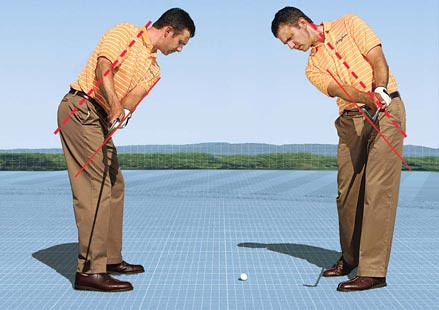
Whereas "twistaway" is extreme on purpose for the reasons stated above, there is a less-extreme--though related--school of thought that espouses swinging the club such that the leading edge of the club face stays parallel to the forward bend or "spine angle" throughout the swing. And you can find examples of many modern, professional golfers who swing this way, such as Hunter Mahan, Rickie Fowler, Luke Donald, Rory McIlroy, and Matt Kuchar to name but a few.

In the past, some would have called this "hooding" the club face or taking the club away "closed," but we've come to find out that the club face, when performing the takeaway like this, is actually square to the arc of the swing. The right palm can be thought of as a guide for how the club face is angled in the takeaway.

As an experiment, address the ball and perform your takeaway, stopping before the club shaft is parallel to the ground. Now stand up out of your posture and look at the leading edge of the face. If you performed the takeaway correctly (i.e., matching the face leading edge to your spine angle), the club face leading edge will be vertical when you stand erect. If you opened the face to get the toe of the club to vertical on your takeaway, you'll see that the toe, and thus the leading edge of the club face, is pointing right of vertical (assuming you're swinging right-handed). This means you opened the face going back. Now, many teach this conventionally and the club can be swung well this way, but it requires equal closure coming down to get the club face square again, which can introduce timing issues. Not good for the weekend golfer!

The reason I like this method of swinging the club is that I feel it actually helps keep me in the correct posture, both back and through. When I perform the takeaway and manuever the club face's leading edge to vertical, I tend to stand up out of my posture slightly. But when I keep the leading edge angled roughly 45-degrees to the ground on the takeaway, I have a mental marker for my spine angle. Therefore, I tend to get a slightly steeper shoulder turn (right shoulder pointing my downward), and thus my backswing is flatter (a flatter shoulder turn is usually associated with a more vertical swing plane).

After impact, the club face's leading edge is roughly angled 45-degrees to the sky (the right palm facing in the same direction), again matching the spine angle, when the club is parallel to the ground again (not completely toe-up as often taught), and my spine angle or forward bend again has a reference, so that I don't stand up too quickly out of my posture coming through. As a result, my right shoulder chases all the way through, my shoulders turn perpendicular to my spine angle (a'la Tom Watson's "secret"), and my finish--when performed this way--has my right shoulder pointing at the target and over my left foot! And I still have most of my forward posture, just like the pros. The chest has stayed covering the ball!

There's no need to consciously roll the club face closed through impact to square the face, because the club face is staying square to the arc all the way through; the club face is gradually closing all the way down and through impact. If you use too much hand action coming through (maybe left over from an old, conventional way of swinging), you'll pull or hook the crap out of the ball! Check your divots; a long, narrow toe divot means you're using too much hand action (either flipping or rolling the forearms too much or too soon).

Swinging this way flattens or rounds out the swing plane, without need to think much about it. I believe this is a more consistent way for weekend golfers to swing a club; it takes most of the timing out of the swing.

To check if your club face is square, take the club back until it’s about waist high, then pause your backswing and look at the club head. If the club face is square, it will match your spine angle.

How to Have a Good Takeaway in Golf

To improve your swing path and promote a square clubface at impact, practice making half swings so the club stops parallel to the ground on each side of your body. At these two positions, the leading edge of the clubface should be parallel to your spine. If it is, it means the clubface is rotating correctly and staying square to the swing path. Good path and a square face are the basic ingredients to straight, powerful shots.

Breaking 90: Match the leading edge to your spine angle

Test: Are You On Plane? One way to test your takeaway is by standing upright. If the toe of the club is vertical, your takeaway was on plane.

Shawn Humphries - Spine Angle

A narrow divot will mean the club has turned at impact; a hook or slice will be the probable result.

Golf Practice Drills: the perfect divot


Thursday, December 6, 2012

Swinging Back to the Inside Early

There are numerous ways to swing a golf club and hit a straight ball (by straight I mean possibly with a slight fade or draw). All methods require squaring the club face relative to the path in some way (i.e., mostly perpendicular to the path with maybe very slight open or closed face positions for the shot shape desired); some of those methods are active and some are passive. Active methods, such as rolling the arms, turning the knuckles down, or squaring up the back of the left hand, all require careful timing and skill to pull off consistently. Passive methods, such as using a stronger grip or a club face that stays mostly square to the arc with heavy body rotation, require less precise timing and are probably more suited to the weekend mid- to high-handicap golfer.

We've all been told that we need to swing inside-out to avoid coming over the top (OTT or swinging outside-in). Few really great golfers swing outside-in, though there are examples of pro golfers who've used a slight OTT move to good effect, such as Sam Snead. Killing the OTT move--apart from the open club face--is one of the first steps a slicer (most amateur golfers) needs to take. But what about the arc on the other side of the ball? Does the club REALLY swing "out to right field"? Here's where you'll see the divergence between those who actively or passively square the club face.

When a player actively squares the club face, the arms cross over and cause the toe of the club to quickly over take the heel, irrespective of the body's turn. Often the club will chase down the line (or even out over the line) after impact for a time before coming back inside, and such an inside move isn't very pronounced. A good player on a good day can make this work. But even good players struggle with this move and often end up with duck hooks on days when the timing just isn't there. This is what happened to Ben Hogan early in his career.

When a player passively squares the club face by trying to keep it perpendicular to the swing arc all the way through, the arms don't cross over actively. Any movement of the wrists and forearms is entirely unconscious. As a natural consequence of body rotation serving as a primary squaring mechanism, the club head immediately tracks back to the inside, such that the swing shape is inside-outside-inside, following a natural, crescent-shaped arc that intersects the target line at after impact. Whereas an outside-in swing shape is steep, the inside-outside-inside swing arc is rounder, flatter, and more shallow. The small muscles of the arms are taken out of it and the golf swing is powered more by the lower body and larger muscles of the trunk. It's easier to maintain lag pressure and thus lag, as the club head never passes the hands until very late.

Swinging back to the inside early is the way that Ben Hogan played golf later in his career, and many would argue that there has never been a more consistent golfer once he made this change. Hogan adopted a fade ball flight that was consistent and reliable; he never had to worry anymore about his ball hooking directly off the course. Other great golfers, including Jack Nicklaus, played a fade as their go-to shot. Matt Kuchar swings this way and is one of the most consistent modern players. This method of swinging really lends itself well to a slight fade or straight ball flight, with minor adjustments (mostly ball position) needed to coax the draw. Tiger Woods is trying to develop a fade ball flight as his go-to shot; you'll often see him practicing for a shot by exaggerating coming back to the inside.

Swinging this way works best with the correct hip movements (clearing the hips and covering the ball), and a good swing thought is the good old belt buckle--keeping the butt end of the club pointing at it as you turn through.

Want to know if you're doing it? Film yourself swinging down the line. If your club approaches the ball from the inside and the hands and club disappear behind your body low and early after impact, you have an inside-outside-inside swing shape. Another characteristic of this swing shape is the maintenance of connection between the left and right upper arms against the chest throughout the swing--often called staying connected. All of these characteristics make for a more consistent golf swing because no emphasis is placed on the conscious control of the small muscles in the arms.

Of course, the shorter the club, the less pronounced this move is, because the swing plane is more vertical and thus the inside-out-inside move is not as obvious.

As I said earlier, our goal was to take the timing problem out of my swing, including my hands having to roll over at just the right instant to square the clubface. Now, once I shift to my left side to start the downswing, I can turn hard, and my body will bring the club around. That's because I've kept my left arm pinned against my chest. With this connection, turning my body squares the face without any hand action.

With the body leading like this, my arms track back to the inside quickly after impact. I used to have too much "chase" in my swing, with the clubhead swinging straight down the line or even out to the right. My new swing shape proves that my arms and body are working together, like concentric circles, with my arms moving in orbit around my body.

How To Make Your Swing Repeat: Matt Kuchar: Golf Digest

Charles Howell III is getting back to what works for him. Howell relied almost exclusively on a fade when he was one of the game’s hot young prospects. After developing some bad habits while trying to incorporate a draw into his arsenal, Howell is back to the reliable left-to-right ball flight.

The main objective in Howell’s new swing? To get the club swinging more to the left after impact so the ball can start down the target line.

The plane of Howell’s old downswing looked ideal on video shot down his target line, but his club traveled too far in-to-out through the ball because of his steep, downward angle of approach.

“Because Charles hits down on the ball steeply, we had to have him swing more to the left to make the ball go straight,” Smeltz said. “We needed the club to approach the ball slightly more from the outside for the club to be traveling down the target line through impact. We had to get the club in front of Charles’ hands during the downswing. That got the club exiting more on plane and not swinging so far out to the right.”

For Your Game: Charles Howell III

The club orbits the body at an angle called swing plane – like a circle or ellipse tilted on its side. That angle can range from 45-60 degrees depending on the club. What most golfers neglect is how the club must travel back inside after impact. Instead of allowing a natural release to the left, they force the hands and arms to release the club down the target line in an effort to hit the ball straight or add more speed. This leads to inconsistency. In fact, releasing the club down the target line moves the club off its natural plane. The result can produce tremendous hook spin or block pushes depending on the angle of the clubface.

Better Players Swing Left | Scratch Golf School