|
| Proper Weight Distribution |
Weight distribution in the address stance involves not only inter-foot distribution (i.e., weight distributed between the right and left foot) but also intra-foot distribution (i.e., vertical weight distribution within each foot); this post will discuss how the weight should settle within each foot vertically, from heel to toe, to create a balanced, stable stance during the setup capable of eliminating many potential downstream errors. Jack Nicklaus is correct: Most golf swing errors (90% or more) occur during the setup (i.e., GASP - grip; alignment/aim; stance/setup; posture/position); golfers should spend more time on GASP and takeaway than they spend on anything else because all that follows is a consequence of a good setup.
A quick Google search illustrates the most common bit of advice from various golf authorities regarding this subject: Most seem to advise the student to position more of their weight in the balls of the feet. For the anatomically challenged, the ball is the fleshy, firm part on the bottom of each foot located below the toes and just above the arch. The bottom of a normal foot contacts the ground primarily in three general areas: the heel; the toes, and the ball; the inside arch, in a normal, standing anatomy, is raised above the ground between the heel and ball of the foot, with the toe pads lightly touching the ground. (Actually the outsole of the foot also contacts the ground, but you should NOT feel that--especially in your golf setup.)
The theory behind the advocacy for positioning weight in the balls of the feet is always explained in terms of other sports; baseball, tennis, and basketball require ready positions that call for more weight situated in the balls of the feet to facilitate reactionary, springlike movement forwards, backwards, or to the sides. The obvious problem, of course, is that golf doesn't require any such sudden "reactions" from its "ready" position, so the reasoning is weak.
Then, of course, are the problems that can arise when skewing weight into the balls of the feet (and thus engaging the toes). As your weight shifts more towards your toes and away from your heels, the toes will begin absorbing body weight and you will notice that your upper body and arms tip excessively toward the ball, creating an unbalanced stance, and so the hosel of your club head will inch ever closer to the ball, introducing an increased risk of shanking. The address shaft angle will steepen, and you are more prone to be steep coming back down. If you go too far, you may unconsciously attempt to regain balance by shifting towards the heels during the downswing, which can move the club head across the line, cause early extension (loss of posture), and an increased chance of hitting pulls and slices. You can also tip further forward if you lose your balance; again, you'll see shanks and fat shots. None other than golf great Tom Watson advocates for this "athletic setup" with weight in the balls of the feet, but I wonder if he doesn't just mean "weight away from the heels." Hank Haney also states emphatically that more weight shoiuld be in the balls of the feet, not the heels. Jim Flick, the coach who helped Nicklaus in his later years, advocated for weight in the balls of feet, while his famous student, Jack, did not (see below). I had a recent local golf lesson from a PGA teaching professional who actually told me to shift more weight into my toes without any explanation!
There are a few who seem to advocate shifting more weight into the heels and with seemingly little in the balls of the feet, but this can cause the opposite problems as described with the "balls of the feet" crowd: Hooks, pushes, toe strikes, thin shots, and an unconscious downswing move that shifts weight towards the toes in an attempt to regain balance, or if unsuccesful, falling backwards. One particular "brand" of instruction in this cohort advocates "balancing on the ankles," though it's possible they actually mean being balanced between the heels and balls of the feet; it's hard to know because they never describe what "ankle balance" is. Too much weight in the heels produces an extremely flat shaft angle and a "sit down" look in the golfer at address, with a very erect posture.
The next largest (and most prestigious) group of golf gurus and professionals unambiguously advises amateur golfers to balance their weight evenly between the heel and ball of each foot. Shawn Clement uniquely describes such weight distribution by asking the student to imagine that the arch of each foot is a "suction cup" gripping the ground. And since we've already established that a healthy arch doesn't really touch the ground, Shawn is actually describing an equal distribution of weight between the heel and ball of each foot. None other than the great Jack Nicklaus advises golfers to distribute their weight this way--evenly between the ball and heel--in his great book, Golf My Way. When utilizing such a stance, you will easily be able to raise your toes very slightly off of the floor of your shoes and leave them that way throughout your swing, because the toes should have no weight on them. Other notable proponents of this advice include Ben Hogan, Jim McClean, Sean Foley, and Nick Bradley.
 |
| Japanese Geta Sandles |
I believe this last group--Nicklaus's group--has it right: The best way to address the ball is to vertically distribute your weight in each foot evenly between the ball and heel. To find this position if you have address balance problems, you will need to shift away from your tendency; if you tend to concentrate weight in the balls of your feet (probably most golfers because of what traditional golf instruction has preached for years), you will need to rock back away from your toes at address until you feel your heels engage and your toes disengage. You should imagine you're wearing traditional Japanese Geta wooden sandles. Some of these sandles have raised wooden extensions that are roughly located at the ball and heel of each foot; they approximate how you should feel--both the heel and ball of the foot carrying an equal amount of weight. If you've been a toe-leaner, you're going to feel way back on your heels; and if you've been a heel-leaner (less likely and less problematic), you'll feel the ball of your foot engage more.
Other things you may notice when redistributing your address weight in this manner include a taller feeling posture with arms that hang freer (you've created more space for your arms), lower hands that feel more inside your eye line, and a flatter club shaft while at address. You will need to definitely unlock and protrude your glutes with a straight back to remain balanced. Your toes will feel ever so slightly raised off the floor of your shoes. Your quads will disengage and your glutes will engage more. It's easier to produce greater downswing speed by twisting the lower body (knees and hips) forward (swinging more "from the ground-up") when starting down from this balanced heel-to-ball weight distribution.
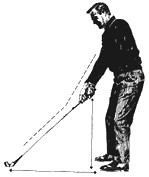
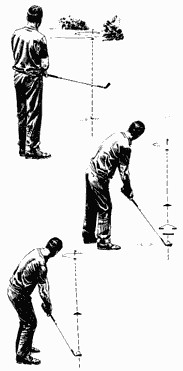
A drill for ensuring you achieve this position (or at least verifying that you're setup correctly) is to get into your address posture and then hang an iron from under one of your armpits using two fingers, with the club head hanging down. The shaft should hang straight down and pass through your knees and point at the ball of your foot (your armpits are over the balls of your feet). At the same time, you can utilize this drill to ensure your feet are shoulder-width apart (as they should be at a minimum for all fall swings, regardless of club length); in this case, the club shaft will hang down inside the heel. If you're doing video analysis, you can use vertical lines to check these positions as well.
The only times you should favor the heels or toes at address is when you face uneven lies. In the case where the ball is below your feet, shift back into your heels by bending your knees more and try to stay that way through impact. When the ball is above your feet, shift into your toes by straightening your knees more and maintain that feel through impact. You'll hit better shots from those trouble lies when remembering to make these adjustments.
Finally, this method of weight distribution isn't only helpful in the full swing. You can use it to good effect in the short game (chips and pitches) and putting, as well. Try putting with weight concentrated towards your toes in your stance; you will notice that it's very easy to move the lower body unintentionally, while it's easy to keep the lower body stable with the weight balanced between the heels and balls of the feet.
Most traditional golf instruction tells us that your weight should be over the balls of your feet. You’ll read this in books and magazines, and hear it from teachers and TV golf pundits all the time. Not only is this instruction dead wrong, you’ll lose power and consistency this way, but it’s also potentially harmful to your body.
Golf Swing 102c. Setup: The Perfect Golf Weight Distribution and Balance
Your weight should be 50-50 on your left and right legs and between the balls of your feet (those cushioned pads just below your toes) and your heels. I'm surprised how many people think their weight should be supported by their toes. Starting with your weight too far forward is one of the worst mistakes you can make. It throws off all of the critical angles—spine, legs, hips, shoulders and head. That creates a domino effect, resulting in a weak swing and fat shots.
Your weight should be distributed between the balls and heels of your feet and equally distributed between the two. You should be able to tap your heels and wiggle your toes. At this point you have counter balanced your weight. You should be able to draw a vertical line from the back of your shoulders through your knees to the balls of your feet. Now you are in balance.
Good footwork, too often overlooked, promotes balance, power, and consistency. Good footwork starts with balance at address. From the beginning of the swing, the weight moves from the middle of the feet back to the heels. When you finish the swing, your weight will finish on your front foot heel. The weight should NEVER be on your toes.
Learn to Squash the Ball at Impact
When hitting shots, you want to make sure that your weight is centered on your arch. Not the balls or heel of your feet. If your weight is on the balls of your feet (Because you're too far from the ball) as you address the ball, your hips will be prohibited. The result is that you'll straighten yourself up in your downswing.
The ball tends to be lined up off the heel [when the weight is on your toes] and can lead to pulls and hosel rockets. To set up properly you want to ensure you have the weight in the middle of your feet. I often like to bounce slightly up and down to ensure I have achieved this position. As I go through my swing I am cognizant of trying to keep my weight over my feet and not let it sneak out over my toes or lean back on my heels at impact.
While developing a sound foundation in your golf swing, focus on where your weight distribution is located. Ideally, you would like the weight evenly distributed between the balls of the feet and heels at address. If you reach too far to get to the ball, your weight will go too much on the toes. If you remain upright and bend your knees with too much flex, your weight has a tendency to go back on the heels.
Golfers need to feel it in the feet
A golfer should settle into the arches of the feet and allow them to compress. This will activate the feelings in the ball and heel of the feet. They will really come alive! This notion that a golfer sets up or balances on the balls of the feet is nonsense! Sure, there is weight on the balls of the feet, but it is a result of compressing the arches. Tiger has this mastered this in recent months. Prior to that he was back on his heels. This one, simple adjustment has paid huge dividends for Woods.
Tiger Woods Golf Swing with Sean Foley
So I just gave it a try, basically going for the feeling that my armpits were over the balls of my feet, and it instantly felt better - more balanced, more relaxed. Then a number of things started falling into place: I actually felt torque between my upper and lower body; I stopped swaying; my tendency to "lift up" at impact disappeared (which I realize now was what my body had to do to keep from falling over forward because of how far I was bent over); and I stopped yanking the club way inside on the backswing and lifting it to the top, which I've always done.
Eureka!!! The setup change that has me BOMBING it - Golf Rewound
Optimally, a golfer's weight should be evenly distributed between the heels of the feet and the balls of the feet, and he should be able to lift up the back of his heels slightly (or lift up his toes) without becoming unbalanced if his body weight is evenly distributed over the feet.
What happens when weight distribution is off? The first thing you may experience is a swing that feels out of sync or off balanced. More specifically, if your weight is too focused over your toes, you will lose the whip power of rotation in your swing. You are instead using the "shot put" method with your body. This creates a dramatic loss of power.
Fix Your Golf Swing: Solution 1: Correct Weight Distribution
In ‘five lessons’ he says “Your weight should be a bit more on the heels than on the balls of the your feet, so that, if you wanted to, you would be able to lift your toes inside your shoes.” When you look at him setup from down the line it appears as though that’s where he has his weight distributed. It certainly doesn’t look like it’s on the balls of his feet.