Showing posts with label consistency. Show all posts

Tuesday, November 19, 2013

Right Arm Width: The Anti-Collapse

Collapsing
Arms Collapsing

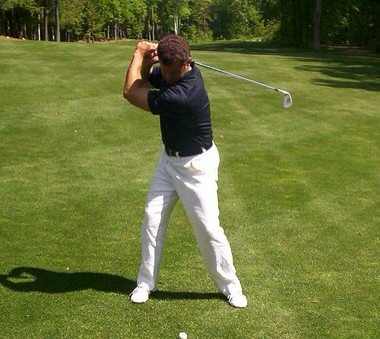
One of my biggest golfing faux pas is collapsing at the top of my backswing. My right elbow has a tendency to pull the club back inside too quickly (too flat). Then at the top, in probably some unconscious effort to manufacture a longer swing and get the club parallel to the ground, my right elbow sucks in close to my right side--past 90 degrees--and my left arm collapses. As a result, I would get to parallel, but not like the pros do (through flexibility and athleticism); when I got to parallel, the club shaft appeared to be an inch or so from my right shoulder! It didn't feel this way during my swing, but it looked absolutely horrible in pictures and on video: My left elbow was almost at 90 degrees!!!
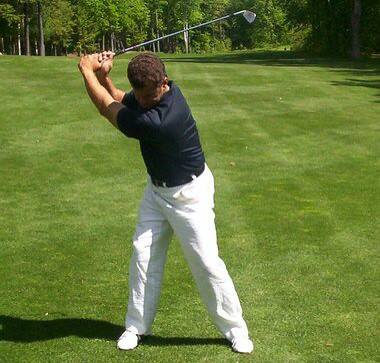
Proper width
Correct Width

My downswing then exhibited an over-the-top move and a flip at the bottom.

My teaching pro had me work on correcting the collapse by using a partially deflated rubber ball between my elbows as a drill to show me the correct feel for keeping my arms extended, wide, and in front of my chest during the takeaway and backswing. He told me that my elbows should maintain the same distance relationship (or near to it) at the top of my backswing as they did at address; the right elbow and arm should not be pulled behind oneself--an optical illusion we all think we see in the pros. The ball drill felt very strange indeed; it felt "wrong" to me. I had never really tried the correct feel, which feels shorter, compact, more linear, and vertical (and it really is because it's not as flat on purpose).

Something amazing happened when I watched video of me hitting a ball using the ball drill, besides the fact that I wasn't so collapsed at the top anymore; I had a flat left wrist at impact! A consequence of having a flying right elbow on the backswing, and sucking the club inside so far, was that my right elbow would crash into my right side on the way down--I was trapped! And the only way I could save the shot was to flip the club using my wrists! This made it clear to me--especially for an amateur hacker--that what you do on the takeaway and backswing CAN have a dramatic effect on what follows! (NOTE: Listen to your golf teaching pro!!!)

Many fine golf instructors have noted the importance of an extended left arm to create width in the backswing for power and consistency, and I believe the answer isn't the left arm itself: It's the right arm! The right arm should stay as extended as possible and push the club handle away from one's body, keeping the left arm straight passively. Pressure should be felt on top of the left thumb, and the right palm should face roughly up and to the rear at the top of the swing (as if the right palm is pushing the handle away from the target). The right arm should bend slightly (up to 90 degrees at maximum), but it shouldn't go below 90 degrees the way I was doing before, sucking the arms in close to the body and collapsing the left arm in the process. The hands can go as high as head level but shouldn't really go any higher, or the arms will disconnect from the body; also, the extension should only go as far as the left arm will allow while maintaining a slight bend in the right arm (again, ensuring no loss of connection). The club DOES NOT need to reach parallel to hit a powerful shot; don't worry about the pros who can reach parallel--they're pros and you're not!

This brings me to another point when it comes to addressing your swing problems: Don't be afraid to exaggerate a swing change, even if you might be overdoing it at first. You've got to give your body a new feel, and many great teachers such as Martin Hall, Hank Haney, and Butch Harmon advocate for exaggeration to ingrain a change in your game. As Martin Hall often says, "If you keep on doing what you've been doing, you'll keep on getting what you've been getting."

Coupled with maintaining a stable lower body (i.e., another of my errors was rotating my hips freely with my upper body) through torso rotation, I can consistently hit the middle of the club face this way. An overacting lower body can also contribute to sucking the club too far inside and its follow-on recovery moves of going OTT and flipping.

Another way to think of this: Try to keep your hands as far from your chest at the top as they were at address.

The second thing to consider is does the leading arm really bend on it's own? The answer is "no". It is the rear arm that pulls in. When your back arm collapses or pulls into your body, your front arm will naturally collapse. For this reason, our focus must be on the width that our rear arm is creating and maintaining.

Keep Your Left Arm Straight

If the arms travel across the body in the back swing, as is seen in many players, the club will be too far behind the body and it will take excessive hand rotation in the down swing to square the clubface. Conversely, if the arms move away from the body in the back swing the club will be above plane and the club will be returned on an outside to in path through the ball.
To learn to correct role of the arms, place a soccer ball between your arms in your address position and take some practice swings. Make a back swing keeping the ball between your arms and in front of your chest. This will ensure that the arms stay connected to your body coil and they remain in front of your chest with good width. All the ingredients you will require to generate good club head speed.

Golf in Japan

One of the staple tips we’ve heard over the years is “Keep your left arm straight.” By trying to do this, you could be preventing rotation and stalling your arm speed so why don’t we take the water skiing example and think of the lead arm like a rope where the roll of the right arm is to keep it tight – for the whole swing. There are a lot benefits to this including maintaining width in the arms, sequencing the arms with the chest, preventing the clubface from rolling open on the backswing, and creating just the right amount of lag on the downswing. Amateur golfers dream of lagging the golf club and in doing so create angles that are too much to control and ultimately can’t control them leading to the exact opposite at impact. Try going for an inch of lag instead of a foot.

The Backswing

At the top of the backswing, many amatuer golfers collapse their arms here as well. This is a crucial point in the swing where you want to make sure you have good extension and width. The right arm and elbow naturally folds as you swing to the top and your wrists are set and firm. The hands should also be a good distance away from your head or body. Collasping your arms will cause your hands to get too close to your head and you'll lose your golf swing width.


To increase width, you need to increase the spacing between your right hand and right shoulder (right-handed golfers) during your backswing.

Practice taking a backswing holding the golf club with just your right hand. Keep your right hand as far away from your body as possible during these practice swings. During this drill, reach your right hand toward the sky at the top of the backswing.

Golf tip: Remember, in your backswing, width equals power

When Nick came to me, his hands were too active on the backswing, which made his swing arc narrow--a big killer of distance. The club got too far to the inside, so he would shift his weight away from the target on the downswing to get the club back in position to hit the ball.

I wanted Nick to feel his arms staying in front of his body as he turned back. We worked hard on building a backswing where his right arm and hand were as far away from his head at the top as possible. This gave Nick, who is 6-feet-2, tremendous width in his swing arc.

One of the biggest problems that many golfers have is an inability to generate and maintain sufficient width in their backswings.

That problem could be related to flexibility but it’s also possible that it’s just a swing flaw relating to issues such as a narrow swing arc, a takeaway that’s too flat or laid off, or just a complete collapse of the arms at the top of the swing.


Because a swing change involves either a totally different motion or a wholesale change in your grip or setup, there's no way it should feel comfortable.

The best way to make a radical change like that is to take slow-motion swings, sometimes exaggerating the movement. Then you repeat it over and over.


Thursday, October 3, 2013

Hip and Shoulder Separation

Bae's Shoulder and Hip Separation

Many of my blog posts go over the same information, again and again, in different ways. That's because golf is often based on feels, and everyone learns a different feeling to engrain some fundamental. I write about what I try and what I find useful, primarily so that I can go back and revisit these things from time-to-time. I revisit them because they're the fundamentals that can easily be forgotten or overlooked; a round can suddenly go south because a grip has drifted too weak or too strong, pre-shot alignment is rushed and faulty, an unconsious sway on the backswing, improper weight distribution, etc.

I've posted extensively on the hips' role, the shoulders' role, how to pivot, separation, about lag, creating distance, etc. But I wanted to spend a few more electrons on the subject of separating the hips from the shoulders to generate power. Now, I've examined Jim McClean's X-Factor a few times on here, and you'll find the usual for-and-against golf enthusiasts out there on the interwebs debating that very subject. Reputable instructors will offer up valid logic on why you should or should not resist with your lower body while your shoulders turn on the backswing. Take a stance on just about any "unassailable" fundamental of golf and you will eventually find someone--someone with a low or scratch handicap--who disagrees.

I believe that the so-called "X-Factor" of hip and shoulder separation is far more important in the transition and early downswing at generating power and consistency than using separation in the takeaway and backswing to generate potential power. I believe this because there are examples of long-hitting professionals who turn their hips a lot on the backswing (more than they believe or more than Jim McClean says they should). But on the downswing, their hips ALWAYS start first, before ANYTHING else moves; I haven't seen slow-motion video yet of a single professional golfer who moves the shoulders before the hips (if they did, they would immediately be OTT and NOT hitting inside-out). Their entire pelvis shifts towards the target a few inches (and thus so do both knees, pushing weight into the left leg) and then rotates (the belt buckle turns) towards the target, followed closely and sequentially by the belly, shoulders, arms, hands, the club, and finally the club head. This sequential unwinding "from the ground up" produces the kinematic sequence--the use of the entire body somewhat like a whip to send energy from the ground up and out (inside-out) through the club head and into the ball.

Sticking with the belt buckle swing thought mentioned above, try to start your downswing by first moving the belt buckle over the left (or front) leg WHILE SIMULTANEOUSLY rotating the belt buckle towards the target. All of this should happen while the shoulders are still mostly closed and the arms completely passive--almost floating. Another way to think of this--to ensure you're not throwing, casting, or hitting with your arms from the top--is to imagine that you have a golf club extending from your belt buckle and that you're trying to hit the ball using nothing but the belt buckle motion, while your arms come through afterwards with a second club. Your arms are lagging behind your belt buckle. FORGET YOUR ARMS! They will naturally, quickly, and fluidly follow the motion of your lower body. I've found that thinking of hitting the ball with my belt buckle (thus shifting my belt buckle targetward and rotating around at the same time) helps keep the instinct to hit the ball with the arms at bay.

A "from the ground up" downswing, that enables hip motion to separate from shoulder motion, starts in the feet and how the weight is distributed in them--front-to-back--to provide balance. Verified when I recently took a golf lesson from a local PGA teaching pro, I've had a bad habit of sitting back on my heels when taking my stance (setup as part of GASP), and this can absolutely destroy the ability to easily shift the hips forward and rotate and properly. I've had to make sure that my weight is shifted into the balls of my feet (shifted towards my toes but not in my toes); the weight is mostly in the arches, balanced evenly between the heels and toes. One should only be on the heels for a lie below the feet, and only on the toes for a lie above the feet. The correct athletic stance that promotes an easy shift and rotation of the pelvis while the shoulders remain closed feels almost as if one is preparing to dive into a pool or receive a serve in tennis. There are a few teaching professionals (e.g., Chuck Quinton) who, predictably, contradict this fundamental, but most touring professionals, like Tiger Woods and Tom Watson, and teaching professionals, like Shawn Clement and his "suction cup" foot analogy, advocate for the balanced ball-of-the-foot approach, and that seems to work best for me. Chuck's admonition seems related to keeping the left knee healthy (implying this is what caused Tiger's knee woes), but someone like Tom Watson is currently in his 60s and hitting the ball a mile. I think I'll believe Tom Watson and the PGA pro I saw on this one.

At the top, the shoulders should momentarily stay put (stay turned away from the target), while the pelvis (hips) execute the motions described above in the transition to the downswing. The shoulders and arms follow because they physically must do so. No thought should be given to moving the shoulders and arms (and club); simply let the hips start the process and let everything follow and unwind. In a sense (at least in terms of how it should feel), you're making a move to hit the ball with your legs and hips, letting everything else follow! The amount of lag generated by doing this correctly is amazing and the distance and consistency that is achievable by learning to trust this one movement cannot be overstated.

This is useful throughout the bag (except for the putter, where you want a stable lower body). You need to do this in the sand. You need to do this when pitching. You can even do this--albeit very slightly--when chipping. Let the lower body lead and find out how easy this game can be.

For me, this works best with a centralized backswing pivot, where the right shoulder pulls directly back and behind the head; in other words, no swaying. For me, a backswing sway can be so slight and so easily and unintentionally introduced when focusing on the right transition and downswing; it will wreck the benefit of a properly executed downswing sequencing. When you're doing it right--putting both a proper backswing pivot and hip-shoulder separation on the downswing--you'll be fully and naturally posted up on your left leg at the completion of the swing.

Watch your favorite guy on the Tour -- Tiger, Phil, Ernie, Vijay, me, anybody -- and forget about his arms and hands and head when he makes a golf swing. Just focus on his belt buckle.

Then watch another swing, this time trying to focus on your guy's hands in relation to his belt buckle. They're always, always just a little behind through contact.

Let your belly lead your hands - Golf - John Daly - ESPN

Rotating your lower body toward the target helps propel the ball from the sand and assists in maintaining acceleration. Try this for a swing thought: Turn your belt buckle to the target.

Tiger Tips: Belt Buckle To The Target : Golf Digest

The way they sequence that power’s delivery to the ball is the key to maximum efficiency and distance. For an effective kinematic sequence to occur they must start the downswing from the ground up. That is to say that the hips start or fire first, followed by the torso, then the arms and finally the club. If this order is compromised power loss and errant shots will occur.

The more turn you have while keeping the shoulders stable/still the greater your potential for the “X Factor” stretch in the downswing and generating power. If you found it hard to do this test you will find it difficult to sequence correctly in the downswing.

Blackburn Golf | Tips & Articles | Sequencing Successfully!

Conventional wisdom states that the downswing begins from the ground up. A golfer must shift his weight forward and begin rotating his hips before swinging his arms forward. Golf instructor Jimmy Ballard explains that when your weight shifts forward and your hips rotate properly your arms “respond naturally, falling into the correct downswing plane” as they approach the ball.

Slide vs. Turn Golf Downswing

The transition from backswing to downswing is crucial to generating power and accuracy. The key is to start the downswing with the lower body.

In the best swings the lower body starts forward while the upper body is still turning back. The left hip turns toward the target as the shoulders continue to coil. That takes terrific timing and a lot of practice.

Tom Watson: Lead With Your Lower Body : Golf Digest

Rotating through impact can be felt in different ways, such as a pull with the left side, push with the right side, downward push off the right foot, inward kick with the right knee, left hip clearing, etc. There are numerous ways to feel the body’s rotation. It doesn’t matter what your feel is as long as it starts with the lower body. It’s not a passive role by any means. There must be a conscious effort to turn the body all the way until the finish.

A great thought is turning the belt buckle to the target as quickly as possible as you swing through the ball. It targets a key area – the hips – and engages the lower body and creates speed in the unwinding process.

But remember, rotation must be sequenced correctly.The lower body shifts weight first and rotation to the target comes second. You maximize everything you got by following that sequence. Some amateurs do the opposite and rotate too early. This tends to throw the club outside the target line and cause slices and pull hooks.

Tour Players Rotate Through Impact | Scratch Golf School

The best way I can describe the feeling of using the body to hit the ball is, it’s an UNMISTAKABLE feeling that I used my legs and hips. After the shot has been hit, I feel a radiating all the way down my right leg and in my hips whereas, I feel nothing in my hands and arms.


Most amateurs just are not able to get the club in the slot because they rotate their shoulders early from the top of their swing. This, of course, throws the club outside the target line and usually results in a slice, a pull, or even a top.

Jim Suttie: The most important move in golf ... get in the slot

At the top of your backswing, your back should be facing your target if you have completed your shoulder turn correctly. Your back should stay facing your target for just a second as you begin your downswing. This will allow the golf club to swing down properly on the correct swing path as you approach the golf ball at impact.

Starting the downswing by opening up the upper body too early will lead to an over the top swing as well as an out to in swing path. This can lead to either a slices or pulled golf shots. At impact, the shoulders should be square to your target line so it's important that they don't open up too early from the start of the downswing.

Perfect Your Golf Downswing Transition

Keep your back facing the target at the start of the downswing.

What this 'feel' will do is keep your club to the inside on the downswing. If you open your shoulders real quick, and NOT have your back face the target, this will throw your club to the outside, and lead to an over the top swing, and hence a bad golf shot. This is a problem slicers are notorious for having.

So when you reach the top of your swing, do this:

Feel that your hips bump slightly laterally, then begin to turn out of the way.
The key is to keep your back facing the target for a split second longer as you make this initial move with your hips. You should feel that your back resists against your lower body. Your upper body stays still, your lower body begins firing, your golf club is automatically dropped into the slot, your golf ball goes straight and far!
Golf Tips - Fixing your Slice - Keeping Your Back to Target
A quick look back at Hogan’s original quote in this essay tells us that “...under no conditions should the downswing be inaugurated by the hands.” I agree wholeheartedly. It is folly. Watson agrees as well:
“A lot of fairly good players try to start everything down together: feet, hips, arms, shoulders. I made the mistake of trying to do that myself for several years with no great success. If you start everything down together, there is a strong tendency to throw the clubhead at the ball with the right hand too soon, dissipating your power and not helping your accuracy, either. I converted to starting down with the lower body and became both longer and straighter.”
Secrets In The Dirt
Do you[r] best to keep your back facing the target for longer and you will set up the ideal DOWN swing sequence that will move the golf club on a path that travels outwards through the ball rather than across the ball. You can do this by controlling your armswing and shoulders consciously and deliberately or by using your lower body in such a way that the result is that the shoulders are delayed.
May, 2012 | Golf Confidence Academy
Professional golfers transition to the downswing by moving their lower bodies. In every great golf swing the legs and hips move first. The torso follows the hips; the shoulders follow the torso; the arms follow the shoulders; the hands follow the arms; and the club follows the hands. That’s the order of the downswing. : The sequence is from the ground up. The lower and upper body have to be synchronized. Strong hips and stabilizers create strong downswing.
Cindy Reid Golf
Just like that basketball player, you want to be on the balls of your feet -- not the heels, not the toes. That's the key to balance. No good athletes in any sport play with their weight back on their heels. It's important that you start with your weight on the balls of your feet and keep it there through impact. You can easily check your set-up position in a full-length mirror.
Tom Watson: To Set Up Right Get On Defense : Golf Digest
If you swing your belly button back and through you are activating and/or energizing many of the muscles that Mike Austin wanted you to utilize in the swing, including the internal and external obliques, the transverse abdominis, the glutes and the sartorius, just to name a few. The good news is that you don’t have to think about those muscles, if you don’t want to. Just swing that belly button. The further and faster you move it (albeit smoothly) the further that ball will go.
The Belly Button | Mentored By The Legend – Mike Austin


Friday, September 20, 2013

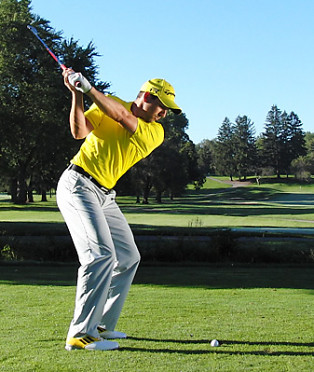
Shortened Backswing

Short backswing
Garcia's short backswing.

One of my major problems is that my backswing gets too long; I learned this by studying video from a recent golf lesson. I can get the club to parallel, but the club ends up too close to my shoulders because my arms tend to collapse, decreasing width. This error causes many problems, including a tendency to cast from the top (as the left arm re-straightens) causing a loss of lag; this ironically slows down clubhead speed, even though the point of such a long swing to begin with was to increase speed and thus distance.

The cure? Shorten the backswing. Think short-slow back and then fast down. Maintaining connection is the best way to accomplish a short backswing; keep the upper arms pinned against the sides of the chest throughout the swing. A drill for this when the arms are at fault is to place a small rubber ball between the elbows and practice the backswing without losing the ball; another drill involves using a towel under both arm pits (or similar drills); those drills, however, don't address other ways the backswing can get long, such as too much hip turn, too much wrist hinge, grip coming apart, etc. Usually, it's an arm problem: The arms become disconnected and unsynchronized with the movement of the body.

Essentially, the arms should stop moving upward when the shoulders reach a fully turned position; there's no benefit to continue lifting the arms and club in order to get the club artificially to parallel. The right arm should not be consciously bent at the top; one should think of keeping it straight and pushing the left hand away from one's shoulder. The feeling is of using a 3/4 backswing and full downswing. In reality, the club will continue traveling backwards much further, even though the downswing has started, preserving lag. There's also a sensation that the elbows are staying oriented to the hips, keeping their downward orientation, even though the upper torso is turning away from the hips slightly on the backswing.

When pro golfers reach parallel (or even past it), photos show their hands are pushed well away from their bodies, and their left arm remains straight. Many amateurs--lacking the flexibility or ability of the pros--attempt to manufacture a parallel position by bending the arms or wrists too much, and as a result overswing and get the club off-plane. Instead of generating speed, this goofy looking position actually hinders speed. We long-swinging amateurs would do much better with a shorter backswing; speed and distance would actually increase for most of us, as would consistency.

What if too much hip turn is your problem or part of your problem? Too much hip turn has definitely been one of my problems; it may be yours too if you find your right leg straightening significantly on the backswing or if you notice you pull the ball (an excessively rotated hip turn in the backswing will lead to overly active hips coming down). Clay Ballard of RST has a great thought for limiting hip turn. Imagine your right knee has a laser pointing from it to the target line; try to leave that laser pointing at the target line as you go to the top of your backswing to feel a proper coil with minimal lower body movement. There are other similar ways, but this way definitely will get you coiling better. Another way to diagnose excessive hip movement on the backswing is to see yourself in DTL video; you will notice a gap appearing between your knees if there's too much movement.

All right, if you are still reading, you may want to brace yourself because your game is about to change forever. I know I shouldn't be doing this for free because it's probably the best tip you are ever going to get, but here it is anyway...SHORTEN YOUR BACKSWING!!!!! Probably not the first time you've heard this suggestion, but it is time to heed this advice.

A technician at a local electronics store once told me a truth about electronics that is very relevant to golf, "The more things that move, the more things that can break." Well, the same thing is true for your back swing. When you take a big back swing, your left arm breaks down at your elbow and at your wrists. Strange as it sounds, you also tend to under-rotate your shoulders. Both of these things not only cause you to be wildly inconsistent, but also actually cost you distance. That's right folks, too long of a back swing makes you hit it shorter, not longer. If you maintain a straight left arm, you will rotate your shoulders farther instead of bending your elbow and wrists.

When I tell people to take the club back to about 75% of their normal back swing, they almost all still take the club back past parallel! Parallel is the absolute maximum distance that your back swing should ever go. It is the MAXIMUM, not the GOAL of a normal back swing. You should only take the club back as far as your shoulders allow you to turn without bending your left arm at all.

Shorten Your Backswing For More Control

Most golfers have long swings because their arm swing continues to move after their shoulders have stopped turning. If this sounds like you, try to stop your arm swing once your shoulders have stopped turning. Doing this, you will be able to start your downswing with your lower body instead of starting your downswing with a "casting" motion of your arms and hands.

Local golf: Shorten your swing for better consistency

Slow down and limit the length of your backswing for more consistency.

You don't hit the ball with your backswing, you hit the ball on the downswing. A backswing that is too quick, or too long, can easily get the club out of position, and can prevent you from storing the energy needed for a powerful, consistent downswing.
Golf Swing Video: Shorten Your Backswing For More Consistency
Human nature says that the longer your backswing, the farther you'll hit the ball. But if this was true, why is it that I can hit a ball 300 yards with a three-quarters swing but I can't hit it 400 yards with a longer swing?
How a Longer Backswing Can Lead to Shorter Shots in Golf
It's really this simple: given that clubhead speed equals distance - with all else being equal - if my swing is long yet slow and yours is small but fast, you will get more distance than I will.

While a big backswing tends to promote deceleration, a short backswing does just the opposite.

A short backswing promotes acceleration. Your proverbial win-win. Mentally, it is almost like you don't believe the short backswing will do the trick, so you accelerate to make up for it.

Shorten Your Swing For More Power
Most golfers will gain distance almost immediately by shortening their backswing. A more compact swing not only give you more distance but it also give you more control over your swing and therefor better accuracy as well. The extra effort required to get the club past parallel , which is working against gravity, increases the chance of getting the club in a bad position.
Shorter Backswing
The solution is very simple: shorten up your backswing. Intuitively, golfers feel that this new position will cause them to lose power. But as a recent commenter posted"What I thought would result in a shortening of my shots actually gives me more distance."
The #1 Golf Swing Fault Golfers Over 50 Make
Now that you understand that you don't have to have a long backswing to generate power, how far should you go back? I tell my students that once their shoulder rotation stops, so should the club. You want the shoulder rotation to determine your backswing length instead of your club still going back long after the shoulders have stopped. At first, this shorter backswing will feel like you don't have a lot of power so it will be more difficult to do, but as you get used to it, you will soon see your shots fly just as far, if not farther, with half the backswing.
The Pro's make the golf swing look so easy!

Focus on your left arm. When you are making your backswing, feel like your left arm is going to stop parallel to the ground. In reality it will be further than that, but this is a good starting point.

Along with your left arm is your hands. Think of your hands only going slightly higher than your hip height. Again in reality it will be further.

How to Shorten Your Golf Swing
Jim McLean, currently one of the best teachers on the planet, has a great tip for the over swingers. As his teaching assistant, I saw first hand how effective this simple tip can be. Here it is: When the shoulders stop turning the arms stop swinging. This concept matches the body with the arms on the backswing. It also shortens your backswing for consistency. Most high handicappers allow their arms to continue even after their shoulders stop turning. This leads to a disconnect between the body and arms, and an extra long backswing. All potential for serious inconsistency.
A Shorter and Connected Backswing for Consistency
First and foremost, you are going to get more control by shortening your backswing. The second reason why a short backswing in golf is better has to do with an increase in overall distance. It seems counter-intuitive that a shorter backswing will produce longer golf shots, but that is precisely what happens with the average player. Shortening your backswing will enable you to avoid many back problems that are common to golfers.
Is a short backswing in golf better?
"I recommend that at some point, every golfer practice hitting balls with a three-quarter backswing," said Joe Hallett, the director of the PGA Center for Golf Learning and Performance in Port St. Lucie, Fla. "Then, when everything seems to be going wrong, you can fall back on the three-quarter backswing shot. It's a nice safety net, and it will solve a lot of problems.
Shorten the Backswing to Calm Things Down

Imagine your backswing as short, wide and tight. As you swing back, make sure your hands are outside your right shoulder halfway back (when your hands are waist high on the backswing). Also, in this position the wrists should be fully cocked.

Easy, Tiger! Shorten your backswing for more accuracy

I have sat on the range watching people hit on a launch monitor and seen this 1000 times if I have seen it once.

A long sloppy arm controlled backswing that produces 80 mph of club speed and 110 mph of ball speed.

Followed by a short compact shoulder controlled back swing, that allows the hips to clear and produces 95 mph of club speed and 140 mph of balls speed.

Then the proverbial, “That shorter back swing feels so powerless, I don’t think I can do that.”

It doesn’t matter whether it’s launch monitor numbers, or just eyeballing a drive that goes 10-20 yards farther, it’s all the same.

Almost every golfer has a backswing that is too long

To get an idea of what I mean by keeping your elbows in front of you, grab a club and take your setup. At this point your elbows are basically right in front of your stomach. From here they will go UP a bit so that they are out in front of your chest, but it's preferable that they don't go anywhere else relative to your upper body.

The Gateway To Better Golf: Elbows in front

Any attempt by the golfer to independently move the arms “around” the chest or “behind you”during the backswing will disrupt this proper V shaped up and down in front of the chest motion, and cause the golfer to “get stuck” with the arms too far behind the chest, i.e. too far to the right side. You will then “come over the Top” during Transition, trying desperately to get “unstuck”, and then of course the severe out to in clubhead path and early wrist cock release occurs, the signature start of the downswing move of the high handicap golfer.

Gotham Golf Blog: Mastering the Craft of Ballstriking By Jim Waldron

The best way to understand where your arms should connect to your body is to stand up straight in your natural posture, letting your arms hang down; if your posture is ok, you will find that you arms hang on the side of your chest. Try and feel where the connection point is because this is the same point when you take your golf address. Connection between arms and body at address should happen more on the side of the chest rather than on top of the chest, with the shoulders remaining back in the natural body’s posture.

Connection

There is a trend on the professional tours these days to shorten the backswing with all clubs. Surprisingly, there has been little or no loss of power in doing that. To shorten the backswing, have your arms stop going back when your left shoulder stops turning (for right-handers).

It is risky to keep the arms moving up and back after that shoulder has reached its flexible limit. And don’t consciously cock your wrists. They take care of that by themselves.

Golf Tip of the Week: Shortened backswing helps with accurate distances