Showing posts with label torso. Show all posts

Tuesday, June 14, 2016

Tilted Parallelograms

The correct takeaway motion is really--in my opinion--a near total function of the rearward rotation of the right latissimus dorsi muscle, with zero arm lift initially and zero movements of the forearms, wrists, and elbows. By that I mean, once you've established a great setup (P1 position - see GASP), the simple, centered pivot movement of the ribcage (upper torso rotation or the "lat dowel" concept) will relocate the unchanged address configuration of the arms and club into a position (P2), where the club is both parallel to the target line and parallel to the ground, without any movements of the arms, wrists, hands, or elbows, and without any lifting from the shoulders before reaching P2. In all golf shots, including the putt, the right latissimus dorsi muscle can be thought of as the motion initiator from a static address position at P1; the right lat moves the club—not the arms.

The feel for me is that the club and arms move as an unchanged unit more around rather than up (up to P2), due to the immediate rearward and targetward rotation of the right lat muscle (the right shoulder moves back as the left shoulder moves across to a point just under the chin). The word “immediate” means that that the right rib cage turns “inside the feet,” with no sway of the right lat muscle towards the right leg. Because I use a relaxed neutral-to-strong left hand grip (heel of the left palm points at my right hip), the left hand remains initially cupped as it was in its address position, meaning that the angle formed by my left arm and club shaft (from my perspective looking down) at address does not straighten at all; if the angle did straighten, I would be flattening my left wrist and/or rolling my left forearm open--both unnecessary moves that require timed compensations to overcome on the downswing. The grip, arms, wrists, elbows, and shoulders are very relaxed and pliable, moving only in response to the initiating move of the right lat muscle rotating immediately back and towards the target.

Another important feel is that the right latissimus dorsi muscle’s rotation freely “slings” or tosses the arms and club through the P2 postion and up into the P4 position (top of backswing). Therefore, the P2 position can be thought of as a “pass through” position—not a point of definitive rest, and perhaps the “P” designation of golf positions would be better suited to mean “pass through” in lieu of “position,” as only P1 and P9 represent static moments in time.

During this move of the right lat muscle to the rear and towards the target, pay attention to the corresponding motion of the left shoulder. The left shoulder should not dip downward towards the left foot in the takeaway, which is advice that is often given to golfers (i.e., point the left shoulder at the ball going back). Some instructors even demonstrate this faulty move by placing a club across the shoulders and pointing the shaft directly at the ball going back. Often this motion is overdone, kinking the upper spine, and the golfer’s upper spine will tilt towards the target (instead of away from the target as it should); more pressure or “weight” will build into the left leg instead of the right (i.e., reverse weight shift or pivot). In reality, the right amount of “dip” is applied simply by the golfer’s primary spine angle or forward posture that’s set at address; it’s not necessary or beneficial to add more dip of the left shoulder going back in order to “steepen” the shoulders. The correct feel is that the left shoulder rotates across and over to the chin, due to the motion of the right lat rotating back. If you’re a “left shoulder dipper” then this motion will feel very flat—as I said in the beginning “more around and then up.” Remember this for short games shots too, such as chips, pitches, and greenside bunker blasts.

Looking down at P2 from the golfer's perspective, he will see the club's grip as roughly bisecting or lying across the instep of his right foot, with the left arm angled backward; this is an illusion of perspective, because the club shaft is really situated closer to the golfer's toeline from an observer's down-the-line view (i.e. the golfer's eyes are out towards the toes due to his inclined posture).

From this point onward, the right lat continues rotating backwards, towards the target, and now the arms and club's momentum from torso rotation move them very slightly and vertically up, where the hands will be over the right shoulder. The club should feel very light going back and up—almost weightless—as it’s being “flung” to the top, where it feels somewhat like it’s floating there momentarily. The right elbow bends and the wrists cock, creating a top of backswing position (P4), where the club shaft is now roughly parallel again to the target line and the ground. The key is that the arms and club are now in deeper positions than at P2, and that depth was created exclusively by torso rotation--not by pushing or pulling the arms horizontally across and around the body. The two lines formed by the shaft at P2, P4, and P6 (prior to impact) can be imagined as forming the top and bottom of a tilted parallelogram, when viewing a golfer from a down-the-line perspective. Without the depth created at the top (P4) as described, there is little room or hope for swinging the club back down from the inside.

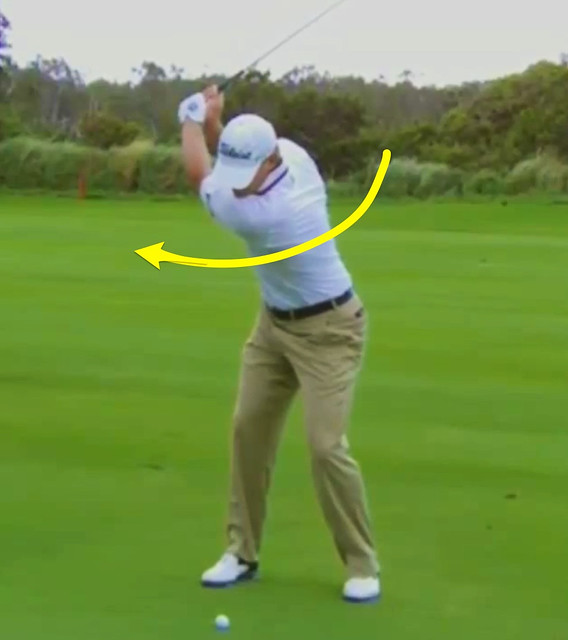
On the downswing, while reversing the vertical drop of the arms and club coupled with torso rotation (moving the “lat dowel”), the shaft will again pass roughly back through the bottom of the parallelogram at P6, just before impact. Both hands make a fast, fairly vertical semicircle from above the right shoulder down to the right thigh, as the shoulders rotate back to parallel with the target line; outside-in swings occur when the hands move out (instead of down) from this deeper vertical position, before or as the shoulders turn. And again, the club should feel light. This motion of the arms and club to get to P6 should feel very vertical; the arms and club return from their deeper position, again, due to the reversal of body rotation—not by moving the arms and club out at the ball, which would make the club feel heavier. There is no outward deployment of the club head towards the ball until the club has passed below P6, when physical forces—not the golfer's intention—will naturally deploy the club head outward from the fulcrum of the wrists. Observe the attached graphics of Rory McIlroy swinging a driver. At the top (P6), notice how far around his right lat muscle has rotated around behind him, towards the target. The red lines depict the top and bottom of the parallelogram, while the green lines represent the difference in depth (or tilt) between P2, P4, and P6 (just before impact). Notice how the club and arms drop more vertically down from the top rather than out towards the ball—the amount of depth is about 1.5 feet between P2 and P4. In reality, this is just another way to think of the classic swing plane. The torso is rotating forcefully, but the arms and club are dropping rather than swinging out, which is a golf swing illusion that causes many problems.

When Things Go Wrong

Performed as described, this is a very effective method of swinging the golf club and producing excellent, consistent contact and ball flights. But there are a few key places where things can go wrong, and you'll notice when contact consistently suffers and you get unpredictable ball flights:

  1. Monitor your grip positions—especially the left hand. Remember, the heel of the left palm should point at the right hip at address (palm on top), which is essentially a strong grip position. This helps prevent flipping the wrists at impact, which is often an unconscious compensation for an open club face position. The stronger grip allows you to lag the club and square the face, without any compensations. Keep your left hand grip relaxed and correctly pressured by the fingers. The last three finger tips of the left hand should be pulling the grip upward into the heel of the left palm. Keep the right hand grip fairly neutral (examine Rory McIlroy’s grip).
  2. At address (P1), look down at the angle formed by your left arm (with its strong left hand grip) and the club shaft. The angle is rougly 120 degrees or so. You must maintain that left arm-club shaft angle during your torso rotation to P2, before lifting to the top. This means the club shaft and hands will move well inside
  3. Be wary of the unconscious tendency to activate any of the arm, wrist, or hand muscles to move the club into the described "tilted parallelogram" positions. For example, noticing where the club and arms move as a result of the right lat moving first, one may unconsciously change focus and begin placing the arms and club into those positions, using the arm muscles (i.e., club shaft bisecting the right instep at P2). These positions are the ends and not the means. The cure is to again focus solely on moving the right lat (the "lat dowel") back and towards the target as the only initiating move, the momentum of which actually “slings” the club into position. The arms, elbows, wrists, grip, and shoulders should remain relaxed and pliable; they are followers—not initiators or assistors.
  4. Remember that the feel is more around with the arms and club (due to torso rotation) rather than up (shoulder tilt or arm lift). You may also fall into the trap of the right lat moving back but also forcefully up, which will send the left shoulder sharply down toward the left foot and elevate the arms and club more than necessary. This can cause a reverse pivot and place your upper swing center too far forward. Your maintained posture supplies all the "up" that's required. The correct feel is that the left shoulder moves across from your perspective—not down! When the pivot is conducted correctly, the upper swing center (the base of the neck) stays back where it should be.

However, his shoulder rotation can be considered to be relatively horizontal, and there is no dipping of the left shoulder down towards the ground. From a biomechanical perspective, his shoulders are rotating nearly perpendicularly around the axis of his mid-upper thoracic spine, and this natural upper torso rotary movement should occur naturally/automatically without any need for conscious thought. ~ Backswing

One last thought - avoid dipping your left shoulder as you initiate the backswing. You want to turn away from the ball with your left shoulder, not drop it! To avoid dipping, pull around with the right shoulder. The left will follow without excessive dipping. ~ Maintain a Proper Takeaway to Succeed

First, when turning your right shoulder back you must keep you right arm away from the direction of your right shoulder turn. What you should feel is the right arm should try to stay extended away from your body only allowing the wrist to set back behind your head. Second, simultaneously turn your right shoulder back behind your right ear on as level of a turn to the ground as possible. This way the shoulders should turn flat to what ever spin[e] angle you have at address (no dipping). By the way, your left shoulder is not pulled under your chin, it comes up to under your chin (level shoulders to spin[e] angle). ~ Make a Better Shoulder Turn

I found over the years having my students push straight back using their front shoulder, would wind their shoulders around their spine, BUT I have found some golfers push their front shoulder DOWN instead of around their spine. This can lead to problems. ~ The Takeaway Using the Front Shoulder

The shoulder turn moves the club inward, NOT back and up. So if the player just turned their shoulders, without any hand or arm movement, then the club would be inside but not back and up. These two movements MUST work together to achieve the proper sequence. The trailing forearm moves the club on Plane by "tracing" the Plane. The bending, and folding of the trailing elbow also raises and lowers the club and cocks and uncocks the target side wrist. Never raise the arms and club by lifting from the shoulders sockets! ~ The Golfing Machine

In the completed grip, the main pressure points are the last three fingers, with the forefinger and the palm pad adding assisting pressure. The three fingers pressed up, the pad presses down, and the shaft is locked in between. ~ What Would Hogan Do? - Grip

Many people lift the club too soon with their arms, while even more suck their arms behind their bodies and either come over the top, or lift the arms late and then drop them back behind the body and get stuck. ~ Throw it Over Your Right Shoulder

When you start your takeaway, the first thing you should think of is a one-piece move with your shoulders, arms and hands and club) moving together. There is no independent action with your hands wrists or even your elbows. For the first 2 feet or so, nothing should move independent of your upper body moving together. ~ Using Your Arms in the Takeaway

Once mastered this activation of the Latissimus will pull the right shoulder back and push the left shoulder forward creating the perfect initial takeaway position everytime. This will also set up the body allowing the right sequencing of the kinetic chain from shoulders to tru[n]k to hip motion for an efficient and strong backswing. ~ The Perfect Golfswing Takeaway

Friday, March 27, 2015

Become an Angled Pile Driver

Roman Pile Driver
Roman Pile Driver

Shift your weight. You're supposed to do that--first into your right foot on the backswing and then into your left foot on the downswing. Instructors explain this to new golfers who then typically proceed to sway their hips in an effort to transfer the weight. But that's not how it actually should occur; the hips shouldn't move at all to the right on the backswing and only fractionally to the left on the downswing. Instructors would be better served by telling their students to leverage the ground by pressing their weight into the earth going back and coming down, as they turn. That's a better description that results in a lot less lateral movement.

I'm a huge proponent of "swing centers." You have two. The first--the lower--is in the middle of your pelvis, a few inches below your navel. The second--the upper--is your sternum. You need to understand how these two centers should align in the golf swing at address (creating your "secondary spine angle" or "Reverse K"); at the top (upper center is over the right instep, pressing nearly straight down on the right leg, while the lower center remains in place); and finally their orientation coming down.

It's the transition--starting down--where the upper center switches it's "pressing" focus. It might seem strange, but the key to "shifting weight" properly doesn't just rely on your lower body; your torso has a large role, because the torso, along with the arms and club, represents a lot of weight; the legs simply serve as posts over which the torso weight is concentrated (makes sense if you think about it, because both legs are the same weight and collateral). The upper swing center should stay behind the lower, creating an angled midbody line that points inside the left foot at the top and coming down; this angle may even shallow somewhat in the downswing, meaning the lower swing center moves towards the target while the upper center moves little or not at all (this varies among players).

I like to think that I become an "angled pile driver" in the downswing. (Not to be confused with the wrestling variety, I'm talking about a mechanical pile driver, much like the angled one pictured above used in ancient Rome.) To start down, with my back still turned to the target, I feel that my upper swing center begins pushing into my left leg as my arms drop, causing my left foot to press into the ground; the tilt of the torso means the upper swing center is pushing into the left leg at an angle. My upper swing center acts as the "driver" and the left leg acts as the "angled pile." This is from where that "press a sponge" with the left foot image comes; I think the only real problem with that simple sponge image is that the student might believe it means to press straight down, which could cause too much lateral movement and get the upper center too vertical or the torso too much "on top of the ball" or even over the left leg (i.e., lunging).

In the attached images of Brendon Todd at the top of his backswing and start of his downswing (below from Golf Digest), the yellow circle illustrates the upper swing center and the red circle illustrates the lower center. The orange line indicates the torso tilt or secondary axis tilt created by the correct orientation between these two centers. The green arrow shows how the upper swing center is directing pressure into the feet--either the right foot at the top of the backswing or the left foot during transition and downswing. In the case of the left foot, you can see that the pressure is moving into the left leg at an angle, whereas it was much more on top of the right foot at the end of the backswing.

Green arrow shows "weight shift"
Follow the Green Arrow

When you press into the ground at an angle with your left foot, you're learning to leverage against the ground for power. Otherwise, you're just "firing a cannon from a canoe" by swaying left and spinning your hips. The correct move, however, is what causes a simple, centralilzed "weight shift" and hitting from the ground-up, which is one of those near universally espoused tenants of golf (in golf instruction, there's always some outlier who will disagree with something). This is from where hitting into a firm left side and bump the left hip advice come. This creates that appearance or feel of "squatting" that's so often described in great swings, where the upper center dips slightly (see Todd's head dipping down, as he pressures the ground using his chest to push into the left leg and foot). You're setting the stage to sequence the downswing properly when you make this your first move before starting down.

Pressing into the ground doesn't mean introducing tension. Be careful that you do not straighten the left leg early, extend early, or grip the club tighter. Another feel is that you're sliding into home base with your left leg. Your left leg should be generously bent when you pressure your left foot (it may feel like it flexes a bit more), and your left leg should gradually straigten out towards the finish. Ensure that you have a generous lateral bend as you rotate forward to prevent losing your incline to the ground (i.e., early extension); the chest is both pushing down on the inside of the left leg and covering it. Don't grip the club harder just because you're pressuring the ground or you may end up slicing.

Shawn Clement speaks about pressuring the ground in one of his videos on downswing weight shift ("Best Downswing Weight Shift"). He talks about the "weight shift" being "about an inch long" and that it "happens from behind you." This is another way to describe pressuring the ground. It's an apt description, as it removes the perception that the hips sway around to shift weight; instead, Shawn states that rotation causes the weight to move. Shawn describes and demonstrates the weight falling back into the left leg, with the torso still tilted away from the target. And when he does it, he looks just like an angled pile driver--his tilted torso pushes down into his left leg while his back is still turned. About midway through the second video on the transition, Shawn talks about the "squat," where the torso is pushing down into his left leg for leverage.

If you do this properly you should notice a more piercing ball flight and more distance, because the move leads to more lag and compression. If you've been hitting pulls of any flavor, you may notice more pushes, as your path is being moved more in-to-out.

So in review: From the top and before unwinding, feel like you're pressing your left foot into the ground, while your chest and shoulders stay back. Your head and chest may drop a little as you load into your left leg with your torso still angled away from the target. You'll be an angled pile driver.

The body should feel as though it's driving down and into your left leg as you rotate toward the target. A great way for you to ingrain this proper feel is to drive your right knee toward the target as you swing. This will help you move weight both toward the target and into the ground. The more effectively you do this, the easier it is to rotate the body and also to make a full extension of the arms through impact.

Ground Up vs. Top Down

An image I use with my students is to imagine a sponge filled with water underneath the left foot. Begin the downswing by squeezing the water out of the sponge.

Better Downswing Sequence In The Golf Swing

As you start down, you need to feel your weight going straight through your left foot and into the ground. In essence, you're using the ground as the resistance needed to generate power...

...But as you change direction and swing down, the pressure should increase dramatically -- in other words, squash the sponge!

David Leadbetter:Squash The Sponge

Maximum power is achieved, when hitting the ball, as your weight is hitting your front foot...

...Another common problem that occurs when your weight is not transferred to the front foot prior to impact is allowing the clubface to get ahead of your hands at impact. If this happens, you will be adding loft to the club and losing distance.

Arizona Golfer News


Saturday, April 19, 2014

The "Nicklaus" Head Swivel

I recently watched another great video by Shawn Clement on head position and lag and tried something he mentioned, and this alone has made a huge impact on my game from the first try. It directly relates to that universal golf fundamental: Stay behind the ball or keep your head behind the ball.
When you address the ball in your standard manner, turn your head 20-deg to the right and then tilt the right side of your head 20-deg down. Just your head…not your torso, so perform it as a "1-2" move after address. Your left cheek should be behind the ball, and your right ear pointed down to the ground, as if you were trying to drain water out of it. The head is both behind the ball and tilted to the right; if you've been on top of the ball, this will completely change your perspective of the golf swing…and for the better.
Bradley
Bradley's Head Movement
Why does this make a difference for me? First, the turn to the right (move 1) presets the head in a good position to allow a full, relaxed torso turn without any upper-body sway (i.e., the head is not blocking the left shoulder). This alone helps prevent a reverse pivot, because the head is not blocking the left shoulder. Second, the downward tilt (move 2) presets good secondary axis tilt away from the target, necessary to hit inside-out and to retain lots of lag for effortless power; you can't maintain tilt away from the target if your head is level or leaning left.

In addition, I monitor the following points: The 20-20 head swivel applies to the neck and head ONLY; be careful that you're not turning and tilting your torso more than the standard setup position, which can cause fat shots and shanks (remember, it's a "1-2" head movement only after standard address). The club head is lightly touching the ground behind the ball--almost hovering. I also let the club head lag my hands on the takeaway, keeping the club head outside my hands and ensuring my wrists are relaxed, so that I can sense a loaded club at the top and better retain lag coming down. Keep the club face pointing at the ball during the takeaway. Grip: Use a somewhat strong left hand grip and a neutral to weak right hand grip for most shots (alterations can be used to shape shots). I now understand Clement's analogy of "hammering into a door frame" and why one's head must be behind the ball (Would you hammer into a door frame with your head in front of it? Of course not; you wouldn't be able to see it or get any leverage). Though the 20-20 head swivel hinders the tendency of the upper-body to sway to the right on the backswing, the hips can still sway to the right, so be aware of this--all that's necessary is a rotation of the torso; no additional rightward shifting is necessary. I believe there are only a few universal requirements for a good golf swing, such as a FLW and forward shaft lean, and I also believe that staying behind the ball through impact is one of them.
If you dig deeper, you'll discover that Jack Nicklaus--arguably the greatest golfer of all time until Tiger gets his crap together--did this very thing as his swing trigger. And then you'll find out that he got it from Sam Snead. And then you'll see that Bobby Jones did it too. So there's something to it. It may look weird in the modern golfing era, but it has really helped my swing.

You'll also see that all modern pro golfers get behind the ball through impact; most simply don't preset it the way Nicklaus and Snead did at address or as a swing trigger--they achieve the correct head position while in motion, which contributes to the illusion that they stay on top of the ball because of their address positions. Examine the image of Keegan Bradley above. The vertical green line represents the back of the golf ball at address. The colored boxes mark his head positions throughout the swing: red is at address, yellow is at the top, and the green box is at impact. His head position at address is level and right on top of the ball, but by impact his head is well behind the ball's position and tilted right. The modern way to achieve Nicklaus' head position is to move into it during the swing; amateurs like me are better off presetting it address and leaving it there, as the former requires greater timing.

Another reason that this probably makes a difference for me is that I'm right-handed but left eye-dominant, which is not typical. Thus, I'm getting my left eye right on back of the ball.
You have to swing the club. To do that, your body must be in position, beginning with your head, which needs to start behind the ball and stay there all the way through impact.

Jack Nicklaus: My Lifetime Principles For Great Golf
First, it is a positive move, like the forward press of the hands, from which to start the backswing. Second, turning the head to the right makes it possible to take a longer, freer turn with the whole body than would be possible if the head were held straight to the front. Third, and most important, it is a method by which we help brace ourselves against swaying to the left on the downswing and moving our body out ahead of the ball at impact—a sure way to ruin a golf swing.
Give Every Shot A Cockeyed Look - 02.17.64 - Jack Nicklaus 
[Sam] Snead suggests that if we tilt our head slightly in the direction of our backswing, it will relieve a lot of the tension in the back and left side that keep us from making a full turn. 
Snead Says, "Tilt Your Head To Help Relieve Tension During Your Backswing" 
Jack Nicklaus was famous for turning his chin to the right before he took the club back. He moved his chin (head) to the right so that he [could] turn freely during the backswing.
Also, tilt your head slightly to the right at address. Because your spine should be tilted to the right at address, your head should be tilted as well. 
The Head Movement during the Golf Swing 
Most people's dominant eye is on the same side as their dominant arm, leg, etc. However, despite being right handed, I am left eye dominant. So is Jack Nicklaus. 
3Jack Golf Blog: The Dominant Eye and Golf 
Joe Dante, one of America’s best known teaching professionals, from his book Four Magic Moves To Winning Golf. “Keep the head still.” This impossible advice has been given in one form or another for about as long as there has been any literature on golf: “Keep your head down.” Keep your head still.” Keep your head fixed.” “Keep your eye on the ball.” “Don’t lift your head.” “Don’t look up.” You’ve heard these directions a thousand times. If they would only say, “Keep your head back,” they would be much closer to being right. 
Expert Advice - Head Movement 
The best way to stay behind the ball is to start with your head positioned behind the ball in your set-up. As you swing, keep your head from moving in front of the ball. You’ll turn through the ball correctly, resisting any tendency to lunge forward in the downswing, which can cause poor contact and any number bad shots. 
It’s vital, however, that we make sure our weight moves to our front foot to begin the downswing. In an effort to stay behind the ball, many inexperienced golfers hang back on their back foot during the downswing, the dreaded reverse pivot. The result is usually a weak push or slice.
Golf Tips; Stay Behind the Ball 
Staying behind the ball doesn’t mean limiting your rotation or your weight shift toward your forward side. Rather, staying behind the ball means keeping your spine tilted away from the ball at impact and bracing against a strong left side. 

Slice Killers! | GolfTipsMag.com
The most difficult thing for the average golfer to do, in my opinion, is to stay behind the ball. He has a tendency to move ahead of the ball with the body, and in doing so he develops an outside-in swing which causes such familiar troubles as slicing, shanking, and topping. This is particularly true on the drive, which so many players try to hit with too much power. 
Staying Behind The Ball 
The point is…you need to have tilt behind the ball at address and tilt behind the ball at impact with your weight moving toward your front side…and you need to find a feel that gets you there. 
Tilt behind the ball at impact 
If you start with your head directly over the top of your belt buckle then you must move your head over to your right shoe on the backswing. If you start with your head more toward your right shoe than your belt buckle, you won't need to move as much. 
Golf Instruction: Keep Your Head Still 
In Harvey Penick's, The Little Red Book, published in 1992, page 75 is entitled "Stay Behind the Ball" "All great golfers move their head slightly backward before and during impact, but never forward. A golfer must stay behind the ball. I mean set up with your head behind the ball and keep your head behind the ball. If you move your head forward during your downswing or through impact, you will hit a wee, ugly shot, probably a pulled slice." 
Keep Your Head Back and Behind the Ball Through Impact! Six Top Golf Pros Agree 
During the transition, his head naturally moves forward with the weight shift to the left side and his head gets further out in front of the ball by the time he arrives at impact. This forces him to release the club early just to make contact. 
How to Keep Your Head Behind the Ball in the Golf Swing 
Here's an easy way to help keep your head back and have an aggressive release. Simply focus your eyes on the back inside quadrant of the ball at address and remain focused on that spot on the ball until after impact. Doing that will guarantee that you keep your head behind the ball. 
Big Play: Ted Potter Jr homemade swing 
If you want to increase your clubhead speed while reducing tension, learn to lag―swinging the clubhead away from the ball last. Begin the backswing by rotating the upper body, while keeping the hands and arms passive. If the arms are truly relaxed, they’ll only move as a result of the torso turn. The clubhead holds its address position until everything else is in motion; once it moves, it “lags” behind the body. 
Lag Behind to Get Ahead

Saturday, January 4, 2014

Torso Turn

You know...I've made several faux pas on this blog, and if you read through carefully, you'll no doubt find contradictions and errors (because golf instruction is full of contradictions and disagreements), and I've fallen prey to my fair share of fixes and tips, only to change my mind about them later. Remember, the ultimate purpose of this blog was to document my discoveries and breakthroughs, and some of those, unfortunately, turn out to be dead-ends (though some of them may not be dead-ends for you).

Torso Turn in Backswing
Torso Turn in the Backswing

But here's something I've stated a lot on this blog in numerous posts: "shoulder turn." What's the big deal? They turn, right? Well, yes. But we have to be careful, because each shoulder is capable of independent movement with respect to the torso (the rib cage and abdomen). The hips can also make a good deal of movement. The mid-spine (thoracic) and high-spine (cervical) have a wide range of rotation, while the lower spine (lumbar) is mostly limited to up-down movements. Yes, it's possible for you to FAKE a good turn by moving your arms, hips, and shoulder joints. This fake turn doesn't feature a lot of mid-torso movement, which is what we actually need. In other words, the mid-spine should turn the most, with the hips turning to complete the turn. The shoulders and arms MOSTLY go along for the ride.

Henceforth, when you read this blog and see the phrase "shoulder turn," please understand this is really synonymous--and actually more correctly descriptive--with an upper "torso turn." Is it a big deal? Yes. Because the shoulders will turn PASSIVELY when the chest and abdomen rotate back and through. Those muscles in the ribcage, back, and abdomen are the ones to focus on when conducting the takeaway, backswing, downswing, and finish. The shoulders, arms, wrists, and hands (and thus club) just go along for the ride MOSTLY (see gotchas below); there's no real need to consciously move them.

Actually, with just a torso turn, the arms are automatically brought to chest height during the takeaway. All that's necessary for the full arm motion from that point onward is a lift of the hands and club that amounts to about six inches of vertical movement above their address position! The torso turn provides the in, back, and up motion for the arms (i.e., depth), while a slight lift due to the right elbow bending provides the remaining up (i.e., width); no more is needed because of the posture (left shoulder low, right shoulder high). Yes, the arms lift, actually, very little in the backswing, and they DO NOT pull the body back at all! They merely lift up slightly. The hands should feel very wide and far away from your head and shoulders, but there should be no tension in getting there: Swing the hands away wide using your torso and let your arms stop moving when your torso stops turning!

I love to think of the torso as a large cylinder that juts out at an angle from a bulky bipod (legs). Using that analogy, it's much like a large reflecting telescope, pointing approximately 45-degrees into the sky (i.e., forward flexion or spine angle), sitting on a two-legged stand. Now for the backswing and downswing motion, just think of the telescope cylinder itself rotating IN-PLACE clockwise (back) and counter-clockwise (left) [something a real telescope would never do], while maintaining that 45-degree tilt!

If that’s difficult to envision, imagine a large dowel, rod, or pole that runs through the mid-back and through each latissimus dorsi muscle, about 3 inches below each armpit and extends out from the body about a foot on either side. The focus here is to first point the “lat dowel” at the ball and then “hit” the ball with the other end of the “lat dowel.” On the backswing, point the left side of the dowel down towards or even behind the ball for a big windup. Midway through the downswing, the dowel will be roughly parallel with the ground on both sides. Just after impact, the right side of the dowel will point down towards the ball, indicating that you have used lateral bend. At the finish, the right side of the dowel will point forward and to the right of the target, depending on your flexibility. At all times the imaginary “lat dowel” has rotated around on a tilted plane, which is ironically the visual analogy that is often used for the shoulder line. But remember that each shoulder has a generous range of independent movement in multiple directions, which makes it easy to fake a good torso turn by moving the shoulder joints. Moving the “lat dowel” eliminates the cheating. The "lat dowel” analogy is a very effective swing thought for the short game: chipping, pitching, greenside bunkers, and putting too.

A swath of golfing problems will disappear when you learn to maintain your posture or spine angle and simply turn the upper torso back and through (i.e., use the torso muscles to turn). Many of the aspects of the swing that are taught independently are suddenly addressed, automatically. I've found more power and consistency with increased lag, because the wrists are less likely to flip. I've found that my hips don't move as much in relation to my upper body. Posture or spine angle maintenance is reinforced, such that the shoulders rotate perpendicular to the forward flexion angle. The tension in the left lat muscle--the sign of a good backswing coil--suddenly shows up. Because the arms, wrists, and hands are passive, the angle of the club face stays in the correct position in the takeaway, mimicking the spine angle. I've found the same torso motion is used, more or less, in every golfing stroke, including chipping and putting.

As the shoulders turn in response to the torso turn, forget the "left shoulder to right foot" tenet; focus instead on the right shoulder and ensure that it gets as near as possible to the RIGHT foot (i.e., the sternum should be over the inside of the right foot), which automatically creates the necessary tilt behind the ball and prohibits reverse pivoting while preserving a proper coil. This thought is especially important for the driver, but a more centered pivot might be the ticket for irons, pitch shots, and chips.

The gotchas (at least for me): Ensure the arms are lifting at the same rate your mid-torso is turning to keep your arms in front of you. You should be able to--during rehearsals--look at the club head during the takeaway and notice that it's still well outside the hands and the club face angle matching the spinal posture. If you just let the arms go and focus only on turning the mid-torso, you may suck the club inside early and then lift the arms late; the left arm ends up too far behind you and pinned too much across the chest, when the hands and club should stay in front of the chest. This error can cause some plane shift problems (e.g., laid off) and waywards shots. Also, a subtle bump into the left leg (weight shift) should be sandwiched between the torso turn back and through to help ensure an inside-out swing. Be aware of the tendency for the arms to collapse at the top; the arms should stop moving when the torso turn is complete; the arms should be relatively straight and tension-free; and the hands should be well away from your head, signifying a wide swing arc with no possibility of a collapse.

The turn away and back to and through the ball is accomplished by turning your torso. It is so often referred to by teachers and players as a shoulder turn, that many people believe that is the part of the body that should turn. This is confusing for new players and causes both new and experienced players to make the wrong move.

When you consciously think of making a shoulder turn, instead of rotating your torso, your move will be to force your left shoulder back. When you do that, your left shoulder comes up or flattens in golf terminology.

Quit Calling it the Shoulder Turn!

Mistakes occur when the hands or wrists initiate the first movement. Start to bring the club back using your torso and shoulders, not your wrists and forearms.

3 Keys for a Smooth Takeaway

The arms can be the culprits [of posture loss] if they initiate the swing by pulling the turn of the torso. The torso starts the backswing by rotating to the right, maintaining the address spine angle and the arms following.

Pinewild Country Club of Pinehurst

The first move away from the ball is absolutely essential. The hands, arms, stomach and chest must all turn together, as a unit. If you can't manage that, well, good luck, you've got very little chance to hit a good shot. But if you do manage it, you then have only to hinge the wrists and turn the shoulders to complete a perfect backswing. It's as simple as that. I've eliminated the complexity. I sincerely believe that anyone who masters these three easy backswing steps will have a rock-solid golf swing for life.

The Backswing - Nick Faldo

To turn more, you need to turn your torso during the backswing. As you swing back, try to turn your bellybutton 45 degrees to the right.

Backswing Shoulder Turn: How to Turn More

What is the pivot? The pivot is a blend of weight shift and a circular turning of the body. Or said another way, the pivot is both a lateral and a rotational movement of the hips, and the rotational movement of the torso and shoulders.

The Pivot and a Flat Left Wrist

One of the most confusing terms in golf instruction is "shoulder turn". Instructors that talk about shoulder turn to describe the amount of body turn during the backswing are hurting their students. What this means is if you start your backswing by pulling the club away with your hands, you may be hurting your swing right at the start of the backswing.

Instead of pulling the club away with your hands, push the club away with the turning of your chest. It will maintain the arms/body geometry and increase your chances of an on-center strike.

A Golf Backswing Mistake to Avoid

Early arm lift to line the left arm up with the turn and keep the hands in front of the chest…GOOD!!!!!!

[L] ate arm lift because the left arm is across the chest and the hands and club are way behind the turn…BAD!!!!

The left arm must lift

Getting the right shoulder over the right foot (lefts for lefties) helps you keep tilt behind the ball, gets you into position to have a shallow AoA [angle of attack] and no room for your arms to over run your turn.

Guess what…lag city.

Monte Scheinblum's Blog

So, summing up, for the production of power, a golfer should have a neutral (comfortably straight) spine at address. During the backswing, the thorax should rotate a lot relative to the hips; and the shoulders should rotate perpendicular to the spine angle which was set up at address. During the downswing, the spine should remain in its forward flexion, at least until impact, and the left hip should rise at that stage.

Anatomy of the Golf Swing – The Trunk/Torso

"While the arms do swing up and down and the wrists hinge and set, these motions are secondary to torso rotation," Parees said. "That is what creates the majority of speed in the swing."

PGA Golf Instructors | Golf Tips To Improve Your Golf Game

From a physics standpoint, a longer coil has more power, so in the back swing you might try to turn back from the mid-section to lengthen your torso coil rather than thinking of turning with only the shoulders.

Hip Sway in Golf - How to Add Club Head Speed

The term "shoulder turn" is misleading. You can easily make what looks like a full turn by pushing your left shoulder under your chin and lifting your right shoulder behind your head. That’s a full shoulder turn, isn’t it? Maybe, but it’s far from what you need to make a great golf swing.

What you really need to do is to make a full chest turn, turning your whole upper torso a full 90 degrees so that your back faces the target, and your sternum faces directly away from the target. When done correctly, this will create a high degree of separation (the "X-factor") between your hips and your shoulders, stretching the large, powerful muscles of your core, generating lag and putting you in the correct position to execute a fantastic transition and downswing sequence.

Drill 302. Backswing: Making a Full Shoulder Turn

Core Rotation: A big part of Sam’s [Snead] power comes from the core rotation of his body and flows through his arms and hands, down the shaft and into the clubhead. Shoulder turn? Yes, it’s important. However, without core rotation you’ve only got about 50 – 60 percent of your normal power. Imagine throwing a baseball without turning your core. Not much power there. Look at how far Sam turns his core especially in his hips.

5 Swing Keys to Consider in Sam Snead’s Swing – and Yours!

One of the more frequent mistakes I see golfers make is to stand up or lose their body angles through impact – the "stand and deliver" move! The loss of body angles or posture causes the body to stop rotating and as a result the hands now assume the responsibility of squaring the clubface. Remember – if the body does not rotate to clubface square, then the hands will help out. This move is very difficult to time, especially under pressure, and often leads to the hands overworking or flipping through impact. If the hands rotate the clubface too early the shot misses left and if they’re a touch late, then the shot misses right.

Hands Flipping

As you stand to the ball with the wrists slightly up, there is a straight line practically from the club head up the shaft and along your arm to the left shoulder, and as your hands are already waist high it needs only the inclining of the shoulders as we turn (on the pivot) to bring them shoulder high, without having altered their relative positions at all.

They [the arms] have not been lifted. They have gone up in response to the shoulder movement. This accounts for the curtailment and the control of the modern swing.

The Controlled Golf Swing

Finishing the backswing with a turn of the body, instead of a lifting of the arms, makes it easier to match up the timing and peak speed sequence of the arm swing and body rotation throughout the downswing to impact.

Golf Swing Synchronization

If the elbows bend, we shorten our radius and are not consistent with the position and length of our arms/club. Makes it much more difficult to return back to impact in the same position that we started (the goal). Also, elbow bending lends to "arm lifting". Having the arms take over and lift on their own, is the worst move for the golf swing. No power or repeatability. Lifting is a very weak move and the shoulders will stop rotating.

Move Less … Get Good!

Sunday, September 1, 2013

Latissimus Dorsi Golf Swing

The golf downswing should be powered from the ground up. This is a near universally accepted fundamental in golf. And I don't believe it's wrong; however, it's possible that--like many things in golf instruction--it is misleading.

I am now a believer in pulling instead of pushing in the golf swing, and translated to TGM principles, I suppose that would indicate that I'm more an advocate of swinging versus hitting, respectively. What does this mean? Recall that pulling the right shoulder back in the takeaway and backswing is the correct pivot move versus pushing the left shoulder back behind the ball. Executing a pull takeaway and backswing engages a different set of muscles--muscles in the right side of the back that pull--a more efficient biomechanical motion. Pushing the club back uses a different group of muscles in the left chest and triceps; and this less efficient movement can introduce many errors into the pivot and torso turn. Likewise, pushing on the downswing can introduce errors and rob one of power.

For the backswing, concentrate on pulling your right latissimus dorsi or “lat” (the large wing-like muscles on the sides of your back) immediately back behind you and as far away from the ball as you can. In the downswing, do the opposite with the left lat; it moves first before anything else. I like to think of a “lat dowel” (a wooden dowel that extends through both lats) as powering the golf swing—including chips, pitches, putts, and bunker shots. Thinking of only the lats rotating and moving the arms and club gets you turning instead of swaying, and it really builds up tension across your back that you want to release. It also takes concentration off of your arms and wrists, which is a good thing in golf when you want to swing rather than hit at the ball. The motion gets your right side deeper on the backswing, making room for you to come from the inside, and prevents you from faking a “shoulder turn” using the very independent movement of the shoulders themselves.

Don’t worry about your hips turning as a result of this rotary lat motion—they should! Ignore those who tell you to keep the hips still, as I believe this advice gets more amateur golfers to sway than anything.

This “lat dowel” motion is not unlike trying to start a lawnmower; you would have to pull hard using your lats to get the engine to turnover. Rowing a boat with dual oars also illustrates the pulling-pushing difference: You would pull against the resistance of the water to propel the boat forward using both lats predominantly, and you would push using predominantly both chest muscles to get the oars back into position for the next pull. Trying to propel the boat through the water using a pushing motion of the chest and triceps would be less efficient, because those muscles aren't as big or strong as your lats and shoulders that are designed to pull. The physics of pulling trump pushing nearly every time. Have you ever seen a motorboat pushing a water skier? Have you ever seen a truck pushing its trailer?

So what about starting your downswing from the ground-up? Well, I've found that pulling with my left lat (or really releasing it) automatically engages me from the ground-up. I don't have to think about bumping my left hip and then turning my left hip back; all that happens without thought when you're telling your body to pull down fast with the left lat. You can't pull if you're not connected to the Earth, and you can't pull from the left side if you're not over your left leg.

As a right-hander, I personally like the golf feeling that my right-side Lat muscle is pulling on the backswing, stretching the Lat on the other side, which then pulls the downswing. (And, of course my external and internal obliques are aiding the rotation—it’s unconscious, and it’s called the anterior oblique sling.)

Bottom line: the conscious turning is accomplished from the sides and back, not from the front. And, it happens lower than shoulders, and higher than the hips (which are both just joints and bones, and are just along for the ride).

Guest Column #2 (The Biomechanics of the Golf Swing) | Monte Scheinblum's Blog

Your legs should play a supporting role, but the real key to starting down correctly is to engage the left side of your torso (for righties), particularly your latissimus dorsi, or "lat" muscle.

Smith: How To Control Your Power : Golf Digest

The correct concept involves “pulling” your arms down in front of you using the large muscles of your back and shoulders. You should feel as if there is a point just under your left shoulder blade (the opposite for left-handers) that is the center of this pulling action.

Put your back into it | Spotlight E.P. News

As you start down, make a lateral move toward the target with your left lat. Your left hip and entire lower body will support this move naturally. Now you're ready to unwind.

Rick Smith: How To Get Down : Golf Digest

The latissimus dorsi has the largest surface area of any muscle, and it is capable of producing tremendous power. By stretching it in the backswing and then quickly shortening it in the downswing, the latissimus dorsi transfers and amplifies power up the kinetic chain from the hips to the upper body.

Latissimus dorsi muscle | Golf Loopy

The target-side latissimus dorsi helps pull the golfer onto his target side while countering the force generated by the pectoralis muscles on both sides of the golfer’s body.

Generate speed and power with each swing

To get the feel of contracting the latissimus muscle, simply go to the top of your swing and pose, then drop your lead arm, feeling as if a point in the middle of your left scapula is actually contracting and pulling the left arm down.

Here's the big thought: You're not pushing the club down; you're pulling it down. And you're not using your arms, hands or any other part in the front of your body; you're using your back.

The age-old question is, "What starts the downswing?" Now you know the answer: In the upper body, the back moves the front.

It's good for your game

This feeling of having your lat muscles engaged is what you want to hold onto throughout the entire golf swing. That's what keeps the shoulders down and keeps you "in the box." It keeps you connected to your core muscles and all the muscles in the torso, allowing you to use your big muscles in the golf swing.

Learn How to Activate the Correct Golf Muscles in Your Golf Swing