Showing posts with label spine angle. Show all posts

Saturday, February 28, 2015

Side Bend in the Golf Swing

Keegan Bradley
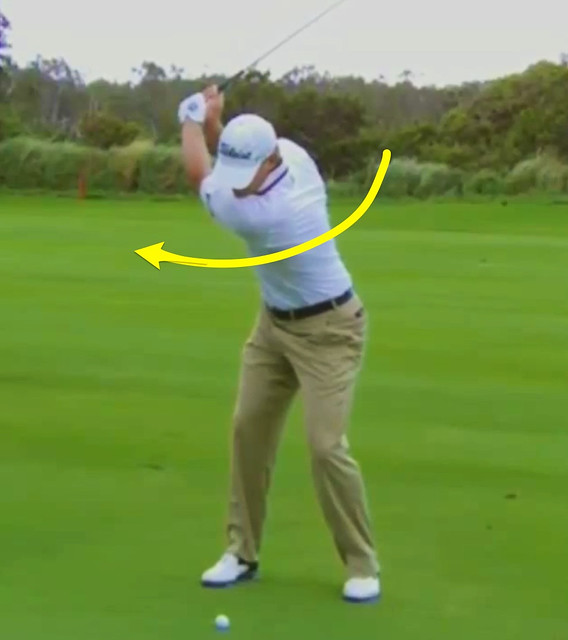
Bradley's Lateral Bend
Right Lateral Bending

The transition--back still facing the target--begins when the spine bends laterally to the right, blended simultaneously with a rotational pivot around the left side (i.e., "bend-rotate"). This assumes and demands that the preceding thoracic spine position was a lateral bend to the left at the top of the backswing, left shoulder pointing down; if you stand up on the backswing (left shoulder too high), lateral right bending will send the left shoulder too high during the downswing.
Kelvin Miyahara calls this "engaging the spine engine," meaning that it forces the facets of the vertebra to behave like gears to drive the swing and keeps the lower back in a state of safer lordosis. He states that this lateral bending move must occur BEFORE starting down, but in reality I look at it as if simultaneous bending and rotating ARE "starting down."

Fundamental Automation

With proper right lateral bending, you will notice a few "fundamentals" that occur automatically. The left hip bumps both towards the target and back to the original tush line (while the back is still turned away from target), and the weight shifts into the left leg. This left hip tush-line-return move blends immediately with a left side rotation (i.e., "clearing the left side"). An analogy to the left hip rotating back and around is that the right foot rolls inward and right knee moves somewhat linearly towards the left knee (also analogous to the right hip "dropping"--more on this later). This left hip tush-line-return-and-rotate move is crucial to create space for the right lateral bend; otherwise, the arms will crash into the body if you merely bend laterally to the right WHILE sending the right side out towards the ball. Also, you will notice that the arms drop down automatically when right lateral bending without the loss of wrist angles, and the right elbow drops in close and in front of the right hip (the lateral bending forms a "pocket" or "catcher's mitt" in front of the right hip to receive the right elbow). The right shoulder will also drop very close to the right hip--again the back still slightly facing the target--and the club shaft will automatically shallow or flatten. The secondary spine angle will also increase (upper swing center leaning away from target more than at address); you will feel your head staying way back at impact. You will notice that the right elbow still has a generous bend in it at impact. Your hands are easily well ahead of the ball before the club head reaches it; the right elbow can easily lead the right hand (externally rotated humerus), because it was able to fall unhindered back into the "pocket" (i.e., front of right hip) created by the side bending. The tip of tail bone will actually move first towards the target and then away from the target, and lateral hip sliding is kept to a minimum (i.e., the left hip stays "inside" the left foot). All of these things happen somewhat automatically as a result of the correct bending-rotating motion.

Body-driven Motion

A note about the arms, wrists, and hands: They should not be doing anything until near impact; the motion of lateral bending and rotating, as described above, provides all the impetus needed to get the arms and club to automatically start down and reach a position at or near pre-impact. This totally supports Joe Dante's assertion in his famous Four Magic Moves book that the arms don't do anything until near impact.

Bending-rotating is what Monte Scheinblum refers to as "bump, dump, and turn," although I don't believe the arms "dump" into the body as he explains; the right lateral bend--properly performed--makes room for the arms and club to swing down in front of the body unhindered. Be aware of a tendency to stand up when doing this; correct lateral bending is a form of "covering" the ball. If you "stand up" it means you didn't really bend laterally; you likely rotated your right side out to the ball.

Elbows Close and Iron Man

As rotation around the left leg begins, the left shoulder should feel like it separates from the chin and realigns with the left leg (as in the Reverse K address position), moving around before moving up. Pretend there's a light shining from the middle of your chest (think of Iron Man) and that light should rotate to shine down towards the ball at the same angle established at address, and then begin angling up in front of the left foot, as the chest rotates through impact ("return cover angle" or primary spine angle); this is called "covering the ball" with your chest. The covering "chest light" should lead the arms and club back to the ball. The right elbow should swing down past the right hip unhindered (i.e., no crashing into the rib cage); the right arm feels as if it straightens towards the target underneath the left shoulder and is totally unhibited by the right side (it may lightly brush but should not crash into the right side). This is encouraged by keeping your elbows close together back and through.

Proper Finish

At the finish, you should feel very balanced and fully on the left leg, the pelvis will be forward of the upper torso, the left hip will feel high and jutted away from the target line, the upper torso will be leaning towards the target line slightly (i.e., head on a pillow), and the right shoulder will be rotated toward the target and touching the chin. These are all signs that posture has been maintained; otherwise, expect fat, thin, and weak, pulled shots.

Drills

You've likely seen the drill where the pro advises golfers to place their left hand on top of their driver, with the driver shaft vertical and the club head sitting on the ground, and practice swinging their right arm under their left arm. I believe this drill is trying to get you to feel right lateral bend. You can also do the windmill drill: Stretch your arms out so that they're horizontal to the ground and take your address posture; rotate back and through so that each hand points down at the ball.

Other Thoughts

Another way to encourage right lateral bending is to feel like your right hip drops down towards the ball during your downswing, which automatically gets your right shoulder to drop, thus initiating a right lateral bend. However, you must remember that it all begins with a left hip bump towards the target (back still turned) and a right elbow that drops unhindered back in front of the right hip.
Side-Bend and Rotate (Notes from 5, 12, 24 November 2014 and 12 January 2015)
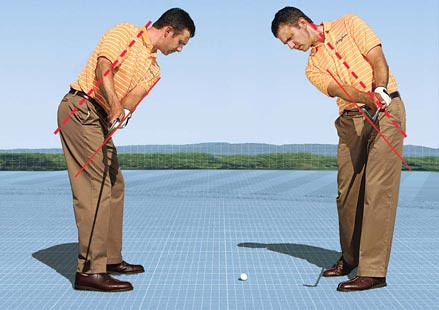
Lateral bend, although it seems simple, is really quite complicated. Simplistically, it is just a side bending like the picture above. But add in that this must be done at a while you're at the top of your backswing with shoulders turned, while in the absence of downswing shoulder rotation (if for a brief moment), while your spine is being bent to the right, your shoulder is pulled down behind you while increasing lumbar lordosis (explained later) and while the rotator cuff muscles are externally rotating the arm. Now this seems very complicated.So when does lateral bending occur? It should start during transition. 

Spine Engine Swing: Lateral Bend 
The key is in varying the amount of lumbar lordosis during the swing. Also we are combining the lateral bend with the lumbar lordosis to set the spine gears in place. Any disconnecting of the gears at any point prior to contact will produce an adverse swing reaction (most likely, a hip or shoulder stall) that will cause other problems to occur such as casting, flipping, lunging, jumping, etc. 

Second Magical Key to the Spine Engine: Lumbar Lordosis

Saturday, January 4, 2014

Torso Turn

You know...I've made several faux pas on this blog, and if you read through carefully, you'll no doubt find contradictions and errors (because golf instruction is full of contradictions and disagreements), and I've fallen prey to my fair share of fixes and tips, only to change my mind about them later. Remember, the ultimate purpose of this blog was to document my discoveries and breakthroughs, and some of those, unfortunately, turn out to be dead-ends (though some of them may not be dead-ends for you).

Torso Turn in Backswing
Torso Turn in the Backswing

But here's something I've stated a lot on this blog in numerous posts: "shoulder turn." What's the big deal? They turn, right? Well, yes. But we have to be careful, because each shoulder is capable of independent movement with respect to the torso (the rib cage and abdomen). The hips can also make a good deal of movement. The mid-spine (thoracic) and high-spine (cervical) have a wide range of rotation, while the lower spine (lumbar) is mostly limited to up-down movements. Yes, it's possible for you to FAKE a good turn by moving your arms, hips, and shoulder joints. This fake turn doesn't feature a lot of mid-torso movement, which is what we actually need. In other words, the mid-spine should turn the most, with the hips turning to complete the turn. The shoulders and arms MOSTLY go along for the ride.

Henceforth, when you read this blog and see the phrase "shoulder turn," please understand this is really synonymous--and actually more correctly descriptive--with an upper "torso turn." Is it a big deal? Yes. Because the shoulders will turn PASSIVELY when the chest and abdomen rotate back and through. Those muscles in the ribcage, back, and abdomen are the ones to focus on when conducting the takeaway, backswing, downswing, and finish. The shoulders, arms, wrists, and hands (and thus club) just go along for the ride MOSTLY (see gotchas below); there's no real need to consciously move them.

Actually, with just a torso turn, the arms are automatically brought to chest height during the takeaway. All that's necessary for the full arm motion from that point onward is a lift of the hands and club that amounts to about six inches of vertical movement above their address position! The torso turn provides the in, back, and up motion for the arms (i.e., depth), while a slight lift due to the right elbow bending provides the remaining up (i.e., width); no more is needed because of the posture (left shoulder low, right shoulder high). Yes, the arms lift, actually, very little in the backswing, and they DO NOT pull the body back at all! They merely lift up slightly. The hands should feel very wide and far away from your head and shoulders, but there should be no tension in getting there: Swing the hands away wide using your torso and let your arms stop moving when your torso stops turning!

I love to think of the torso as a large cylinder that juts out at an angle from a bulky bipod (legs). Using that analogy, it's much like a large reflecting telescope, pointing approximately 45-degrees into the sky (i.e., forward flexion or spine angle), sitting on a two-legged stand. Now for the backswing and downswing motion, just think of the telescope cylinder itself rotating IN-PLACE clockwise (back) and counter-clockwise (left) [something a real telescope would never do], while maintaining that 45-degree tilt!

If that’s difficult to envision, imagine a large dowel, rod, or pole that runs through the mid-back and through each latissimus dorsi muscle, about 3 inches below each armpit and extends out from the body about a foot on either side. The focus here is to first point the “lat dowel” at the ball and then “hit” the ball with the other end of the “lat dowel.” On the backswing, point the left side of the dowel down towards or even behind the ball for a big windup. Midway through the downswing, the dowel will be roughly parallel with the ground on both sides. Just after impact, the right side of the dowel will point down towards the ball, indicating that you have used lateral bend. At the finish, the right side of the dowel will point forward and to the right of the target, depending on your flexibility. At all times the imaginary “lat dowel” has rotated around on a tilted plane, which is ironically the visual analogy that is often used for the shoulder line. But remember that each shoulder has a generous range of independent movement in multiple directions, which makes it easy to fake a good torso turn by moving the shoulder joints. Moving the “lat dowel” eliminates the cheating. The "lat dowel” analogy is a very effective swing thought for the short game: chipping, pitching, greenside bunkers, and putting too.

A swath of golfing problems will disappear when you learn to maintain your posture or spine angle and simply turn the upper torso back and through (i.e., use the torso muscles to turn). Many of the aspects of the swing that are taught independently are suddenly addressed, automatically. I've found more power and consistency with increased lag, because the wrists are less likely to flip. I've found that my hips don't move as much in relation to my upper body. Posture or spine angle maintenance is reinforced, such that the shoulders rotate perpendicular to the forward flexion angle. The tension in the left lat muscle--the sign of a good backswing coil--suddenly shows up. Because the arms, wrists, and hands are passive, the angle of the club face stays in the correct position in the takeaway, mimicking the spine angle. I've found the same torso motion is used, more or less, in every golfing stroke, including chipping and putting.

As the shoulders turn in response to the torso turn, forget the "left shoulder to right foot" tenet; focus instead on the right shoulder and ensure that it gets as near as possible to the RIGHT foot (i.e., the sternum should be over the inside of the right foot), which automatically creates the necessary tilt behind the ball and prohibits reverse pivoting while preserving a proper coil. This thought is especially important for the driver, but a more centered pivot might be the ticket for irons, pitch shots, and chips.

The gotchas (at least for me): Ensure the arms are lifting at the same rate your mid-torso is turning to keep your arms in front of you. You should be able to--during rehearsals--look at the club head during the takeaway and notice that it's still well outside the hands and the club face angle matching the spinal posture. If you just let the arms go and focus only on turning the mid-torso, you may suck the club inside early and then lift the arms late; the left arm ends up too far behind you and pinned too much across the chest, when the hands and club should stay in front of the chest. This error can cause some plane shift problems (e.g., laid off) and waywards shots. Also, a subtle bump into the left leg (weight shift) should be sandwiched between the torso turn back and through to help ensure an inside-out swing. Be aware of the tendency for the arms to collapse at the top; the arms should stop moving when the torso turn is complete; the arms should be relatively straight and tension-free; and the hands should be well away from your head, signifying a wide swing arc with no possibility of a collapse.

The turn away and back to and through the ball is accomplished by turning your torso. It is so often referred to by teachers and players as a shoulder turn, that many people believe that is the part of the body that should turn. This is confusing for new players and causes both new and experienced players to make the wrong move.

When you consciously think of making a shoulder turn, instead of rotating your torso, your move will be to force your left shoulder back. When you do that, your left shoulder comes up or flattens in golf terminology.

Quit Calling it the Shoulder Turn!

Mistakes occur when the hands or wrists initiate the first movement. Start to bring the club back using your torso and shoulders, not your wrists and forearms.

3 Keys for a Smooth Takeaway

The arms can be the culprits [of posture loss] if they initiate the swing by pulling the turn of the torso. The torso starts the backswing by rotating to the right, maintaining the address spine angle and the arms following.

Pinewild Country Club of Pinehurst

The first move away from the ball is absolutely essential. The hands, arms, stomach and chest must all turn together, as a unit. If you can't manage that, well, good luck, you've got very little chance to hit a good shot. But if you do manage it, you then have only to hinge the wrists and turn the shoulders to complete a perfect backswing. It's as simple as that. I've eliminated the complexity. I sincerely believe that anyone who masters these three easy backswing steps will have a rock-solid golf swing for life.

The Backswing - Nick Faldo

To turn more, you need to turn your torso during the backswing. As you swing back, try to turn your bellybutton 45 degrees to the right.

Backswing Shoulder Turn: How to Turn More

What is the pivot? The pivot is a blend of weight shift and a circular turning of the body. Or said another way, the pivot is both a lateral and a rotational movement of the hips, and the rotational movement of the torso and shoulders.

The Pivot and a Flat Left Wrist

One of the most confusing terms in golf instruction is "shoulder turn". Instructors that talk about shoulder turn to describe the amount of body turn during the backswing are hurting their students. What this means is if you start your backswing by pulling the club away with your hands, you may be hurting your swing right at the start of the backswing.

Instead of pulling the club away with your hands, push the club away with the turning of your chest. It will maintain the arms/body geometry and increase your chances of an on-center strike.

A Golf Backswing Mistake to Avoid

Early arm lift to line the left arm up with the turn and keep the hands in front of the chest…GOOD!!!!!!

[L] ate arm lift because the left arm is across the chest and the hands and club are way behind the turn…BAD!!!!

The left arm must lift

Getting the right shoulder over the right foot (lefts for lefties) helps you keep tilt behind the ball, gets you into position to have a shallow AoA [angle of attack] and no room for your arms to over run your turn.

Guess what…lag city.

Monte Scheinblum's Blog

So, summing up, for the production of power, a golfer should have a neutral (comfortably straight) spine at address. During the backswing, the thorax should rotate a lot relative to the hips; and the shoulders should rotate perpendicular to the spine angle which was set up at address. During the downswing, the spine should remain in its forward flexion, at least until impact, and the left hip should rise at that stage.

Anatomy of the Golf Swing – The Trunk/Torso

"While the arms do swing up and down and the wrists hinge and set, these motions are secondary to torso rotation," Parees said. "That is what creates the majority of speed in the swing."

PGA Golf Instructors | Golf Tips To Improve Your Golf Game

From a physics standpoint, a longer coil has more power, so in the back swing you might try to turn back from the mid-section to lengthen your torso coil rather than thinking of turning with only the shoulders.

Hip Sway in Golf - How to Add Club Head Speed

The term "shoulder turn" is misleading. You can easily make what looks like a full turn by pushing your left shoulder under your chin and lifting your right shoulder behind your head. That’s a full shoulder turn, isn’t it? Maybe, but it’s far from what you need to make a great golf swing.

What you really need to do is to make a full chest turn, turning your whole upper torso a full 90 degrees so that your back faces the target, and your sternum faces directly away from the target. When done correctly, this will create a high degree of separation (the "X-factor") between your hips and your shoulders, stretching the large, powerful muscles of your core, generating lag and putting you in the correct position to execute a fantastic transition and downswing sequence.

Drill 302. Backswing: Making a Full Shoulder Turn

Core Rotation: A big part of Sam’s [Snead] power comes from the core rotation of his body and flows through his arms and hands, down the shaft and into the clubhead. Shoulder turn? Yes, it’s important. However, without core rotation you’ve only got about 50 – 60 percent of your normal power. Imagine throwing a baseball without turning your core. Not much power there. Look at how far Sam turns his core especially in his hips.

5 Swing Keys to Consider in Sam Snead’s Swing – and Yours!

One of the more frequent mistakes I see golfers make is to stand up or lose their body angles through impact – the "stand and deliver" move! The loss of body angles or posture causes the body to stop rotating and as a result the hands now assume the responsibility of squaring the clubface. Remember – if the body does not rotate to clubface square, then the hands will help out. This move is very difficult to time, especially under pressure, and often leads to the hands overworking or flipping through impact. If the hands rotate the clubface too early the shot misses left and if they’re a touch late, then the shot misses right.

Hands Flipping

As you stand to the ball with the wrists slightly up, there is a straight line practically from the club head up the shaft and along your arm to the left shoulder, and as your hands are already waist high it needs only the inclining of the shoulders as we turn (on the pivot) to bring them shoulder high, without having altered their relative positions at all.

They [the arms] have not been lifted. They have gone up in response to the shoulder movement. This accounts for the curtailment and the control of the modern swing.

The Controlled Golf Swing

Finishing the backswing with a turn of the body, instead of a lifting of the arms, makes it easier to match up the timing and peak speed sequence of the arm swing and body rotation throughout the downswing to impact.

Golf Swing Synchronization

If the elbows bend, we shorten our radius and are not consistent with the position and length of our arms/club. Makes it much more difficult to return back to impact in the same position that we started (the goal). Also, elbow bending lends to "arm lifting". Having the arms take over and lift on their own, is the worst move for the golf swing. No power or repeatability. Lifting is a very weak move and the shoulders will stop rotating.

Move Less … Get Good!

Sunday, December 22, 2013

Round Out the Swing Plane

Spine Angle and Face Angle

I recently posted on the so-called "twistaway" maneuver taught by Brian Manzella (and as it turns out, many others, going all the way back to Joe Dante's Magic Moves book in 1962). As a short review, this is an extreme way for teachers to get hackers and slicers to return to impact with a square to closing club face. It does work, but you can quickly discern that not too many professionals perform a takeaway exactly like that, though some do appear "closed" at the top and many before impact.

Whereas "twistaway" is extreme on purpose for the reasons stated above, there is a less-extreme--though related--school of thought that espouses swinging the club such that the leading edge of the club face stays parallel to the forward bend or "spine angle" throughout the swing. And you can find examples of many modern, professional golfers who swing this way, such as Hunter Mahan, Rickie Fowler, Luke Donald, Rory McIlroy, and Matt Kuchar to name but a few.

In the past, some would have called this "hooding" the club face or taking the club away "closed," but we've come to find out that the club face, when performing the takeaway like this, is actually square to the arc of the swing. The right palm can be thought of as a guide for how the club face is angled in the takeaway.

As an experiment, address the ball and perform your takeaway, stopping before the club shaft is parallel to the ground. Now stand up out of your posture and look at the leading edge of the face. If you performed the takeaway correctly (i.e., matching the face leading edge to your spine angle), the club face leading edge will be vertical when you stand erect. If you opened the face to get the toe of the club to vertical on your takeaway, you'll see that the toe, and thus the leading edge of the club face, is pointing right of vertical (assuming you're swinging right-handed). This means you opened the face going back. Now, many teach this conventionally and the club can be swung well this way, but it requires equal closure coming down to get the club face square again, which can introduce timing issues. Not good for the weekend golfer!

The reason I like this method of swinging the club is that I feel it actually helps keep me in the correct posture, both back and through. When I perform the takeaway and manuever the club face's leading edge to vertical, I tend to stand up out of my posture slightly. But when I keep the leading edge angled roughly 45-degrees to the ground on the takeaway, I have a mental marker for my spine angle. Therefore, I tend to get a slightly steeper shoulder turn (right shoulder pointing my downward), and thus my backswing is flatter (a flatter shoulder turn is usually associated with a more vertical swing plane).

After impact, the club face's leading edge is roughly angled 45-degrees to the sky (the right palm facing in the same direction), again matching the spine angle, when the club is parallel to the ground again (not completely toe-up as often taught), and my spine angle or forward bend again has a reference, so that I don't stand up too quickly out of my posture coming through. As a result, my right shoulder chases all the way through, my shoulders turn perpendicular to my spine angle (a'la Tom Watson's "secret"), and my finish--when performed this way--has my right shoulder pointing at the target and over my left foot! And I still have most of my forward posture, just like the pros. The chest has stayed covering the ball!

There's no need to consciously roll the club face closed through impact to square the face, because the club face is staying square to the arc all the way through; the club face is gradually closing all the way down and through impact. If you use too much hand action coming through (maybe left over from an old, conventional way of swinging), you'll pull or hook the crap out of the ball! Check your divots; a long, narrow toe divot means you're using too much hand action (either flipping or rolling the forearms too much or too soon).

Swinging this way flattens or rounds out the swing plane, without need to think much about it. I believe this is a more consistent way for weekend golfers to swing a club; it takes most of the timing out of the swing.

To check if your club face is square, take the club back until it’s about waist high, then pause your backswing and look at the club head. If the club face is square, it will match your spine angle.

How to Have a Good Takeaway in Golf

To improve your swing path and promote a square clubface at impact, practice making half swings so the club stops parallel to the ground on each side of your body. At these two positions, the leading edge of the clubface should be parallel to your spine. If it is, it means the clubface is rotating correctly and staying square to the swing path. Good path and a square face are the basic ingredients to straight, powerful shots.

Breaking 90: Match the leading edge to your spine angle

Test: Are You On Plane? One way to test your takeaway is by standing upright. If the toe of the club is vertical, your takeaway was on plane.

Shawn Humphries - Spine Angle

A narrow divot will mean the club has turned at impact; a hook or slice will be the probable result.

Golf Practice Drills: the perfect divot


Tuesday, March 12, 2013

Spine Angle Required

I've briefly touched on this in a few other posts but wanted to give some more time to discussing the topic of maintaining--throughout the swing--the spine angle that was established at address. The golfing world has bestowed several different clever phrases to discuss this subject. It's been called "covering the ball with your chest," "keeping the head down," "staying over the ball," "keeping the upper body still," "staying in your posture," and, of course, "maintaining the spine angle." The opposite of this--the mistake--also has many names, like "standing up," "coming out of the shot," "losing the spine angle," "early extension," "losing the posture," "raising the head," etc.
For the purpose of this post, I'm referring to the primary spine angle, which refers to the angle of the upper body to the legs when viewed down the line. The secondary spine angle refers to the axis tilt to the right when viewed from the front, primarily caused by the right hand being lower than the left hand on the grip.
The mysterious "spine angle" really isn't solely about the spine, as the S&T creators have eloquently argued, because the spine bends all over the place during a golf swing. It's not really about keeping the head down either, because you can still change the head position vertically from the neck while maintaining spine angle. I like "covering the ball" best as a description, because it drives home the point for me that the overall angle of the upper body established at address (i.e., posture created by bending over from the hips) should be maintained at least through impact; I would argue that amateur golfers should work to maintain it well after impact, as they risk coming up too early otherwise. This is that "head on a pillow" look in the followthrough and finish position, or looking at your initial ball flight through slanted eyes.
In other words, the "tush line" should be maintained through impact; if the pelvis begins to move forward (i.e., the upper body comes up)--even a little--at any point before or during impact, the radius required for the swing gets longer, making it harder to hold lag through impact when it's needed. As a matter of fact, losing the spine angle is a major factor in many mishits and bad results, to include inconsistent, short, fat, thin, pulled, and sliced shots. Most expert golfers may come up a little well after impact, but you'll notice that they are still bent over towards the target line, even in their finish positions. Some professional golfers have upper body positions that actually sink even lower than their address positions before impact!
An additional, related aspect of spine angle is shoulder plane. The left shoulder should point down towards the ground (in the direction of the ball) at the top of the backswing (right shoulder rotated up and behind the head), maintaining a perpendicular relationship to the spine angle. The left shoulder should be touching or very close to touching your chin at the top. On the downswing, the right shoulder should replace the left shoulder's previous position, and vice versa. Keeping the shoulder plane more "vertical" allows the arms to hang more from the shoulders as they should through the shot. The correct shoulder plane is actually a side bend; stand up and bend fully sideways to the left from the waist. Now simply rotate to the right (pointing in between both feet) and the shoulder plane should be in the correct position to maintain the backswing spine angle.
Believe it or not, the right knee can affect your spine angle. Notwithstanding Stack and Tilt, you should strive to keep a bend in your right knee at the top of your backswing.
Maintaining one's spine angle or covering the ball is important for EVERY shot in the book, to include putting, chipping, pitching, and bunker shots. It encourages movements that make drives long, powerful, and accurate. It encourages you to keep lag through the shot, because otherwise you will hit fat. It helps prevent fat shots due to an an early release or cast (usually a direct, autonomic, and unconscious manipulation as a result of "standing up"). "Standing up" and "casting" are directly related to each other. Staying over the ball frees you up to swing faster while still feeling in control; you can really pop the driver when covering the ball.
Actually, the only way you can really deliver lag to the ball is to maintain the spine angle. Now you'll have to learn how to lag the club by keeping the wrist angle late into the ball to keep from hitting fat. You will have to learn to keep the wrist cocked late and make contact with the ball with the right wrist still feeling bent back or dorsiflexed. If you lose the spine angle or stand up then you must cast or straighten the wrists to have any hope of contacting the ball; the result in this case is a powerless poot shot, duff shot, or skull across the ground!
Here's how to diagnose that "coming out of the shot" is a problem causing some of your mishits. First, take your address position (ground the club if you usually hover it), execute your takeaway, and stop when the club is parallel to the ground. Now, immediately rotate back to the front without bending from the hips and see if your club re-grounds itself in the same position behind the ball. If your club comes back above the ball then the distance from the club to the ball represents how much you stood up on the takeaway! In all cases, make sure your arms are fully extended and knee flex remains unchanged.
If the takeaway isn't your problem (or even if it is), do the same procedure above with the only exception being to stop at the top of your backswing. Again, any distance between the ball and club represents how much you came out of your spine angle. Now, slowly rotate to your usual impact position and do the same procedure. In each case, you will learn exactly how much your spine angle is changing throughout the swing. Do the same procedure again for takeaway, backswing, and downswing and pay attention to your pelvis; it's very easy to see when you're standing up when you pay attention to it. Video analysis also works, or you can have a friend touch a club to your head while you work through these exercises.
You may only be standing up in one part of the swing, or if you're like me you could be doing it some throughout the entire swing. It's possible to do well at first but start losing the spine angle late into a round as one begins to get tired. The tendency is always to stand up, because it requires strength and endurance in the core muscles to keep covering the ball as one must to execute good shots.
Now, it's important to drill the correct feeling, which is literally a feeling of covering the ball with your chest through impact. If you've been standing up, you'll notice a distinctly new feeling of the right should coming down and through the shot and replace the position of the left shoulder as the upper body rotates through.
The whole idea of keeping your spine angle consistent is that it will help you to keep the “shape” of your swing consistent. When the shape of your swing is consistent, it is much easier to deliver the club face in a square position at impact.
Newsletter: The 3rd Key To Consistency: Spine Angle | Target Centered Golf
There are two main ways to lose the spine angle. A dive and a loss of “tush line.” A dive is what Tiger does and to see if you have this problem, put your finger on the end of your nose on a video from behind and down the line. If your nose moves out or down toward the ball, that is not good. If it happens a little, it’s nothing to worry about, so don’t go out and ruin your swing by trying to keep you head still.
To see if you are losing the tush line, you need a vertical line (same camera angle as above) like an imaginary wall your behind is up against and your body pulls away from that line during the swing. This is also known as standing up or pulling out of it…not to be confused with keeping your head down.
Maintaining spine angle | Monte Scheinblum's Blog

One crucial element for good iron play is to maintain a constant spine angle throughout the swing. This enables you to hit down at impact, correctly taking a divot after the ball. Many amateurs tend to rise up as they swing the club down in a mistaken attempt to help lift the ball into the air. Lifting leads to poor contact such as fat or thin shots. To correct this tendency, swing to a finish position and then hold it for a moment. Then bring the club back down as if someone hit the rewind button. You should be able to get right back into your address position. That's maintaining your spine angle.
How to play consistent golf: Golf Digest

Friday, August 31, 2012

Make a Centered Pivot

Stay on the ball! This is another one that is often debated among teaching professionals (no shortage of such debates really), and slow-motion videos of touring pros are often used to emphasize the point that the head can and occasionally does move rearward in varying degrees during the backswings of many great players. (And yes, you can find videos of pros that illustrate a centered turn as well...far more these days than days of yore.)

But we've also heard the adage that we should "turn like you're standing in a barrel." While I think you'll find that there are no shortage of differences among professional golfing turns and pivots as they relate to the position of the head during the backswing and downswing, I believe that we amateurs benefit by staying as centered as possible. Why?

If you move off the ball during the backswing (i.e., your head shifts too far over towards your back foot), you've effectively moved the swing center backward from where you established it at address. In short, you've introduced unnecessary inconsistency into the swing. This means that the bottom of your swing arc has also moved backwards and will require timing to get it back to the right place consistently. Remember, pros can do all sorts of crazy things because of their talent--not necessarily because it's the right way. Also, you increase the chance that you'll sway (i.e., your weight will move to the outside of your back foot instead of staying on the inside where it should be).

Here's what you should try. Set up using the proper posture, grip, aim, and body alignment. With your shoulders properly squared to your knees and hips, your right shoulder should be noticeably lower than the left (assuming you play golf right-handed), and this will place your head slightly behind the ball using irons and wedges (the wider your stance and longer the club, the further your head will be behind the ball at setup).

Now, focus on the keeping the lower body stable and unmoving during the takeaway and backswing, as your shoulders turn and your weight turns into the inside of your back leg. The feeling you want is that the hips and knees stay parallel to your target line for as long as possible and only move in response to the shoulders turning back. Your head may move slightly to the right as a result, but it should stay relatively steady.

Achieving a centered pivot is possible when you recognize that the right hip does NOT move to the right at all during the takeaway: It moves straight back and even towards the body's center line in response to a proper shoulder turn, and the right leg stays angled towards the target (does not move towards a perpendicular-to-ground position). The right knee also stays bent. As a proper on-plane takeaway keeps the club head outside of the hands, the correct opposing move is for the right hip to move straight back. This thought should also keep you pivoting correctly.

Now simply unwind into your downswing and try to keep your head in the same place (or even moving slightly back) as your arms come through. One thing all pros do is to keep theirs heads behind the ball during the downswing. In some cases (especially with the longer clubs like driver), you will notice that the heads of professional players will sometimes even move further back (secondary spine tilt increases) as the arms come through. But that's only during the downswing and usually with longer clubs.

Slightly kicking in the right knee at address or at the beginning of the backswing will assist in stabilizing the body and help prevent a lateral sway off the ball.

Strive to stay centered on your backswing pivot and behind the ball on the downswing and you'll gain consistency.

The classic teacher from the 1930s Percy Boomer coined the phrase "Turn in a barrel." Boomer recognized that turning around your body, rather than sliding your hips sideways, results in more consistency. It's difficult to hit it solid when you move off the ball on the backswing, because you have to move back to the ball the exact same amount to hit it flush. That takes more talent than most golfers have and more practice than they can afford.

Jim Flick And Jack Nicklaus: Turn Don't Slide: Golf Digest

"Turning while keeping your chest in place not only eliminates swaying and the likelihood of fat contact, it improves the quality of your rotation, because if you sway you can't turn. Ditch the sway and your backswing becomes 100 percent rotation."

Hunter Mahan, Keep Your Chest Over the Ball, Hunter Mahan's Five Moves to Make Your Swing Great Photos | GOLF.com

The body needs to make a centered turn around your spine with limited up and down or side to side motion, thus creating an efficient coiling of the upper body and lower body.

Increase Swing Speed for More Distance | Instruction Feature | PGA.com


Saturday, February 4, 2012

A Changing Radius

The radius of a golf swing can change due to a number of swing flaws. But the bottom line is that it's usually a BAD thing when the radius lengthens or shortens in relation to the swing center that was established at address. After all, the club face is only a few inches high and the sweetspot is very small. If the radius lengthens, fat shots and/or deep divots can result. If it shortens, thin and topped shots can result. I've gone back and forth with first thin, then fat, and now thin again. Not fun, especially when that thin shot goes straight. Difficult lies can aggravate changing radius problems.

So what are the swing flaws that I've seen in myself?

I think the top one for me has been flipping the wrists at impact, such that the left wrist cups instead of bows. This is an unconscious reflex of the beginning golfer, who deduces that this motion will help the ball into the air. When the ball is caught flush, it will increase the loft of the club and make for a higher shot (basically turning a 7-iron into an 8 or 9-iron). Distance suffers as a result. But when the ball isn't caught flush, a thin or topped shot results. This, I believe, is what's currently causing me the most trouble. The cure is to work on the opposite, correct feel--a flat left wrist at impact. Think of turning the knuckles down at impact (or revving a motorcycle throttle). This delofts and closes the club face, turning a 7-iron into a 5-iron and resulting in a straighter, longer, lower trajectory ball flight. The right wrist, analogously, stays cupped or bent back more through impact, so one can also try bending the right wrist back more at impact to counter the instinct to flip the right wrist forward. Doing this also increases lag in the downswing. Hank Haney says that this needs to be a conscious swing thought for most golfers, though others feel it happens naturally. It makes sense, however, that if flipping is part of my muscle memory that I'll have to consciously work to make the correct move.

Maintaining the posture or "spine angle" is an oft-cited fundamental. Basically, losing one's posture changes the radius created at address. A basic example is losing the bend from the waist, which can occur in the backswing or the downswing. One of my bad habits is that I occasionally raise up slightly from the waist on the backswing. It's possible to compensate for this one by returning to the bend established at addressed…not easy, but possible.

The knees also play a role in a proper return to the ball. Many beginning golfers like me think the right leg should be straight on the backswing and the left leg straight at impact. Not true (unless you're after the S&T swing). I have a tendency to over straighten the right knee on the backswing , but I usually compensate by rebending the knee before impact. The left knee should also stay slightly bent in the downswing and only fully straighten into the followthrough.

Finally, the elbows. Chicken-winging can result for a variety of reasons and can occur on the backswing or downswing. I do this less now, but I need to work on extending more in the through swing and followthrough.