Showing posts with label hitting. Show all posts

Saturday, December 7, 2013

Do the Twist

As a former slicer, you may--through various compensations--have developed a hook that occasionally--or maybe usually--turns into a vicious hook. On a bad day, you pull-hook a lot, which is partly left over from your slicing days. And then suddenly one day, you'll go back to slicing the crap out of the ball. And you'll marvel to yourself and wonder why and set out trying to hook the ball again. That's golf. Fun huh? But wait! Maybe you've never broken the slicing curse and have resigned yourself to trying to make the slice work.
Magic Move
The Thumb Press

I've posted before about ways to square the club face and ingredients for various ball flights. If you start slicing the ball (i.e., curving left to right unintentionally), your club face is open to the path upon which the club head is moving; this is why you can hit a pull-slice (ball starting left of target usually with an outside-in path), straight-slice (ball starting at target usually with an in-out-in path), or push-slice (ball starting right of target usually with an inside-out path). So path has an effect, but you can see that slice basically means 'open club face' in all three situations. If you're hitting a push-slice (starts right and curves further right), you're almost there and just need the club face to close through impact! If you're hitting a pull-slice, you've got the most work to do, because you're likely over-the-top (OTT) with an open club face. But in all cases, the club face must be squared! That should be your first priority; then you can work on ingraining the correct plane and swing path. As the saying goes, you can go from slicing to hooking to good golf but can never go directly from slicing to good golf.

Many fine instructors, such as Brian Manzella, teach that OTT (and many other related golfing errors like flipping) is a symptom of an open club face, not the cause (though you'll find others that absolutely attribute a slice to an OTT path). Why is OTT a symptom instead of the cause, some say? Because in an effort to compensate for the open club face, you move OTT (and again, the open face could be causing other swing flaws) in an unconscious attempt to get the ball moving left, so that the ball might slice into the fairway instead of the right woods. So OTT may very well be a compensation for the open club face, not the cause. This means that the open club face is actually discouraging you from hitting inside-out, which is the correct path into the ball!

Assuming a netural to slightly strong left hand grip, you should use a dorsiflexed right wrist (DRW) to hit the golf ball, because you'll ensure a flat left wrist (FLW) at impact, and this may be one of the few universal fundamentals espoused by all great golfers and teachers. And I believe there are various places in the swing sequence where great golfers achieve this position. Some great golfers cup the left wrist at the top (e.g., Hogan, Couples, Watson, Clement, etc.) but dorsiflex the right wrist coming down (thereby flattening the left wrist). Others (e.g., Tiger Woods and Steve Stricker) achieve a FLW at the top, and thus, a DRW at the top before starting down. And some teachers espouse creating the DRW as you move off the ball in the takeaway (the point of this blog post). Most weekend and high-handicap golfers should only hinge or dorsiflex the right wrist in the backswing and forget the temptation to squeeze more power out of the conventionally taught upward vertical wrist cock (i.e., radial deviation or thumbs pointing more and more toward you); vertical wrist action feels powerful (and it may be marginally), but it will cup the left wrist and straighten the right wrist at the top, and that all has to be undone properly by impact to square the club face.
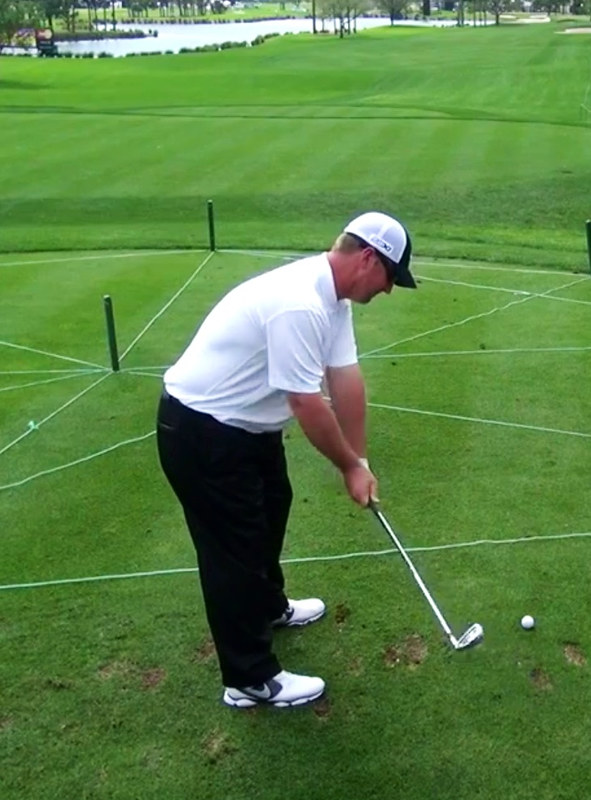
David Duval
Duval's Closed Takeaway

Grip strength plays a role on the left wrist. Stronger grips tend toward cupping at the top, while neutral to weak grips tend toward flattening or bowing at the top. Want to slice on purpose? Use a weak grip and then cup the left wrist at the top--instant banana ball without major compensations. That's actually a good combination to use in a greenside bunker; but I digress.

Why is a FLW at the top antithetical to left wrist radial deviation at the top? Because of biomechanics. It's easy to see how a FLW limits or restricts radial deviation (i.e., upward vertical wrist action); the more you cup or dorsiflex the left wrist, the more you can vertically cock the left wrist up and create what Shawn Clement calls 'snuff boxes.' With a FLW at the top, the left wrist is restricted and can't radially deviate more than 90 degrees, which is all that's needed--especially by weekend golfers. Likewise, the DRW can radially deviate slightly but is prevented from going too far because of the blocking action of the FLW.

Too much vertical wrist cock can contribute to collapsing at the top (in addition to opening the face), especially with weekend golfers. In Stricker's case, he uses very minimal vertical wrist action, and so he's very consistent and long enough to score well against the best professionals; he may have the best professional golf swing for amateurs to mimic because of its simplicity and minimal vertical wrist action; however, he uses plenty of right wrist dorsiflexion!

And now for the point of this post: Using one of Brian Manzella's teaching points (which other teachers such as Joe Dante and Tom Tomasello have also espoused in one form or another), try setting the club face in the correct position early--even as you take the club back, using only one conscious wrist motion. Manzella calls it "twisting" the club (i.e., "twistaway"), such that you dorsiflex your right wrist, palm down, without radial deviation, as you take the club away. The left wrist flattens immediately; it may even arch or bow slightly, and the back of the left hand faces slightly towards the ground. The club face is pointing more down at the ball, as you take it away, staying square to the arc (some detractors would argue "closed to the arc"). Then take it to the top (the club face pointing more skyward than a slicer is likely used to), keeping in mind that you must keep good width, good lower body pivot to start the downswing, and then return the DRW back to the inside part of the ball.

Some notes of caution about the downswing. You'll notice, when you "twistaway" like this on your takeaway, your right palm is roughly on top of the shaft, which means that your right arm is above your left arm. You should immediately discern that you can't come back down exactly the same way, or you'll be OTT, hit pulls, pull-hooks, tops, toe shots, and produce thin, toe-deep divots. During your downswing, you have to shift left (left hip bump over the left ankle) and your arms sort of reverse positions: The right arm feels as if it initially comes down UNDER the left arm (instead of on top of the left arm as it was in the takeaway). The right shoulder feels like it's moving down towards the right pants pocket. In a sense, you're opening the face up just slightly as you come down, because a strong lower body move to start down--in addition to adding tremendous power and great sequencing--has an opening effect on the club face that counteracts the closing affect of the palm-down DRW. This really puts you in a powerful impact alignment, pressuring the shaft, with the hands leading the club head down, with a FLW and DRW right wrist. You're making a bit of a loop--back steeper and closed, and down shallower and a bit more open, instead of trying to go back open and then close the face quickly on the way down (what's conventionally taught but is very tough to do consistently). In reality, your wrists aren't changing positions at all to create this more open club face position; your body and arms are changing to allow for the correct contact, so that your right palm comes back down a little more to the inside of the ball, as opposed to on top of the ball (which is how you executed the "twist" takeaway). Using the "twist" takeaway, get the feeling that the right arm and right hand are coming UNDER the left on the way down and you'll hit inside-out with a club face that's closed just enough--not too much, and with no extra, crazy squaring manipulations needed on the way through.

You no longer have to swing OTT, cast, or flip to keep the ball from going right; you've removed the cause. You no longer need to rotate the hands over in a flash to close the club face. You have to learn to trust that you can hit inside-out, start the ball to the right, and then draw it back to the left, because you've already ensured a square club face. No manipulation coming down is necessary, other than just starting down properly. Manzella teaches this in his "Never Slice Again" video, but he's also published parts of it on his web site and in Golf Magazine. Joe Dante's "Four Magic Moves" book is also an old classic that covers this precept. Many others teach very similar concepts, and just as many are opponents of this kind of thing (like many golf theories--lots of contradictory opinions, with everyone of them thinking their way is the "right" way).
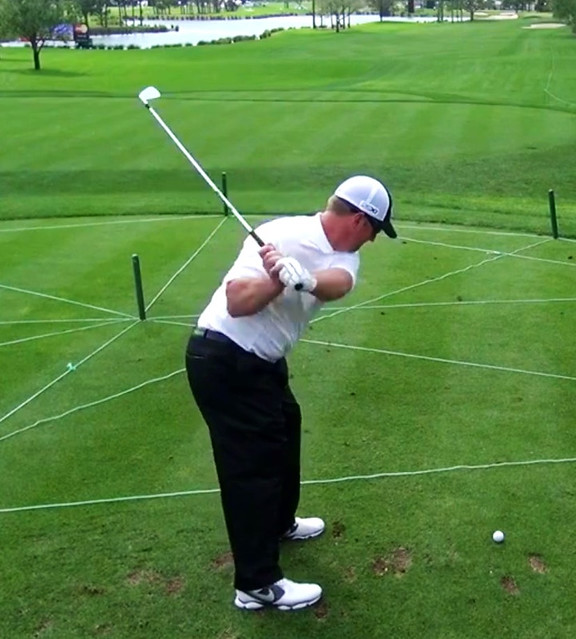
David Duval
Duval Closed at Top

Are there touring pros who are or have been shut or appear shut at the top? David Duval, Zach Johnson, Lee Trevino, Graeme McDowell, Greg Norman, Boo Weekly, Payne Stewart, Tom Lehman, Tom Weiskopf, and Dustin Johnson to name a few. But remember that this "shut face" position can be achieved at the beginning of the downswing or at any point before impact, and many pros, including Tiger Woods, do it this way (i.e., club face angled more toward the ground coming into impact due to the right palm rotating down toward the ground). Hogan went from cupped at the top to bowed left wrist at the bottom. Taking the club back already in this position and keeping it that way prevents the timing issues associated with achieving the position on the way down--very important for weekend golfers!

Why do you think you slice, because you come ‘over-the-top’? Reverse Pivot? Cut across the ball? ‘Hang back’ on your back foot, etc.? Nope. You may do one or all of the above, but these ‘flaws’ don’t cause the slice, you do them because you slice. You slice, because the clubface is too open. Period. Fix the clubface, and the slice goes bye-bye forever. The compensations will often also go away quickly when they are no longer needed.

Brian Manzella - Never Slice Again!

Once the hands move beyond the right thigh, the right wrist will start bending back which is classified as "dorsiflexion." This bending back of the right wrist creates the corresponding "flat left wrist" that is so well known in golf instruction.

As the backswing continues to progress beyond the right thigh area and the wrist bends back, the right elbow will start to fold. The right elbow actually does not travel very far in a good backswing. It simply folds and points toward the ground as the right palm faces the sky in the classic "waiters’ tray" position at the top.

The best way to describe the right arm on the downswing is that it should be "pushing down and out."

"Pushing down" allows the right arm to actively straighten while maintaining its bend in the right wrist.

"Out" is the second half of the equation as it directs the right arm to deliver the club head from the inside. Most players need to feel as if they are driving the right arm not only "down," but "out." I often times describe this feeling as if the right arm is being directed more towards right field.

TPC News and PGA TOUR Golf Events - TPC.com

The down cock of Hogan and Garcia has nothing to do with achieving distance. It is the maintaining of the cock [the hinge or DRW] in the right wrist until waist high in the down stroke that produces club head speed. The left wrist cock is unnecessary mechanical motion that must be recovered from. The left wrist cock[s] in a plane that is 90 degrees to the plane of the swing. Left wrist cock is one of the most unnecessary and hardest to recover from mechanical motions in golf.

"The Professor" Jack Kuykendall Answers Your Questions

When it is done, without moving the hands other wise, the right hand breaks backward at the wrist and the left hand breaks forward or inward, the hack of the left hand going under and facing, in a general way, toward the ground.

The Golf Backswing Part 3: The Thumb Press

Good wrist action is no wrist action. This is something I have been saying for years and years. It's one of my Surgisms. Yet, every so often I get a critic who is adamant that I actually cock my wrists. Well Surgites, today I'm going to let the video do the talking!

No Wrist Cock, PERIOD! | Swing Surgeon

A strong grip is by far the most common error I see with players who curve the ball too much from right to left. The right hand drifts to the right--away from the target--and moves underneath the club, as shown in the photograph below. With the right hand in this position, it will tend to turn over too much through impact. Because the position of the right palm roughly replicates the clubface, it's easy to see why this turning over of the right hand causes the clubface to close and the ball to curve left.

Hank Haney: Stop Losing Shots To The Left : Golf Digest

As you drive through the hitting zone, give the ball a slap with your right hand, changing your right wrist from bent back to bowed. Check the positions at left to see what it looks like.

Make a Power Release - GOLF.com

I have had tremendous success with this technique – primarily, I believe, because it taps into a [slicer's] instinct that screams – in order for my ball to not leak right I must swing as much to the left as possible. Essentially the drill gives the golfer a reason, something they’ve never had, to swing to the right.

  • Tilt the face down 30 degrees (1 hour)
  • Take normal grip
  • Adjust shoulders and arms to square the face at address
  • Swing out to right field

If you understand the above-described biomechanical maneuver, then you should realize that this "twistaway" maneuver is automatically/naturally used by a TGM hitter, who doesn't use a takeaway swivel action.

Backswing

At this stage [downswing, shaft parallel to the ground] the right wrist should still be bent back fully but the palm is now facing the ground not the sky. With the palm facing down this insures the clubface is also facing down or toward the ball and requires no scooping or manipulation to be squared up in time for the hit.

Golf Lag: Stop Casting, Lag like Tiger Woods

A clubface that points down was said to be a closed clubface. We now know that this is not true and in fact is a square clubface position. The clubface angle should match the angle formed by the back of your left hand on the takeaway. The more you have to manipulate the hands, the more clubface control you will lose. So next time you swing a club look at the toe position at your waist height. Is it open, square, or closed? [Toe-up means the club face is open.]

clubface position at waist height | Golfeneur

This golfer eliminated the shank very quickly when we got him to stop rotating the face open during the take-away. At the start, he was rolling his arms, right palm toward the sky, on the backswing, and he changed that to keeping the right palm facing down toward the ground for as long as he could throughout the backswing. Yes, it felt awkward as could be. The shanks disappeared instantly, but returned every time he failed to execute the new move. That’s good. There’s nothing like immediate feedback! But now his solidly struck shots went well left of the target. I explained that he no longer needed to try to flip the club closed through impact to correct the formerly wide-open face. He began to hit far better shots when he felt like he was keeping the face from closing through impact. His sensation was closed back, open down. It worked! Funny game.

The Case for the Face | John Dunigan Golf

The philosophy of the golf swing is that the position of the clubface throughout the entire golf swing is the single most important fundamental there is. It effects all other major fundamentals and is the glue that holds the golf swing together. When we swing the club with a square clubface, we naturally improve the path in which the club head comes into the ball, the angle that we approach the ball, our ability to get into a great impact position, our acceleration through the shot and our overall rhythm.

What is a Square Clubface?

[Tiger Wood's] right palm twists outwards as he starts the downswing. The motion is as if you are directing traffic to stop coming from your right side. There is a little straightening of the right arm along with the palm rotating to face away from you. This is the little secret that no says much about. Yet it happens in most good golf swings.

One of the biggest misunderstandings of the golf swing is that the hands have to rotate through impact. While this may be partly true, it directs the attention of the golfer to a point in the swing where all is lost already. This golfer has the same odds at getting the clubface squared at impact as me getting into a size 32 pants There’s too much error built into the swing and we already know what’s going to happen.

Secret to Squaring Your Clubface

Do you know why golfers don't change club path on the course? It is because they don't understand and cannot control the club face. When you have a club face that is open, the golfer will always correct this by swinging over the top, or left. Simple.

It's the Club Face Stupid! | Jim McClean

In addition to Dustin Johnson, many tour players have played successfully from a closed-face position, including Zach Johnson, Paul Azinger and Rory Sabbatini. The common denominator amongst them is they all rotate their body very aggressively through impact. This rotation neutralizes the clubface and prevents the ball from curving left. This technique can hold up very well under pressure because these players are not required to consciously close the clubface at any time through impact. Rather, the opposite is true: the harder they rotate and do nothing with the clubface, the straighter the ball will typically fly.

Video: Analyzing Dustin Johnson's Swing : Golf Digest

"David’s [Duval] clubface is amazingly square through impact," says David Leadbetter. "His clubface is closed at the top, the face pointing a bit toward the sky, which along with the strong grip would be a recipe for hooking for some players. But David works the club `under’ on the downswing, a bit like Lee Trevino, and that move can make a player incredibly accurate, especially with the irons."

David Duval’s Golf Swing | Golf Swing Gallery


Saturday, June 1, 2013

Back to Gripping: Unified Pressure Points

My previous two posts have been on the TGM concepts of grip pressure points. This is the last post of the grip pressure points series. I first talked about PP #1 and PP #3 often associated with the hitter style, and then I posted on PP #2, often used along with PP #4, in the swinger style.

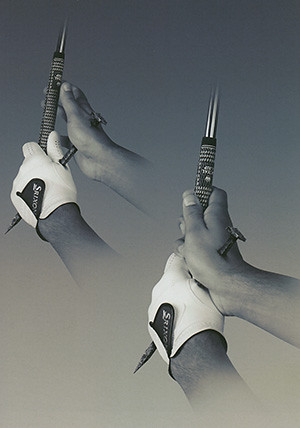
PP #2
PP #2

The references in the first post of this series alluded to the fact that there is no clear demarkation between a so-called hitter or swinger. In fact, most players have some elements of all of them to one degree or another. The pressure points are primarily about feel, but I now believe that awareness of them will help make a proper grip. Pop golf instruction often teaches grip fundamentals but leaves out the important points of where you should feel pressure in the grip, and it often confuses students with meaningless analogies about grip pressure.

PP #1
Proper use of PP #1

After experimenting with this for a few weeks now, I feel I have found the correct pressure points for my focus. First, awareness of PP #2--specifically the pinky and ring fingers of the left hand--is crucial. When I take my grip, I want to feel those two fingers gripping a touch tighter than the middle finger, and I want no pressure exerted by my left thumb and index finger.

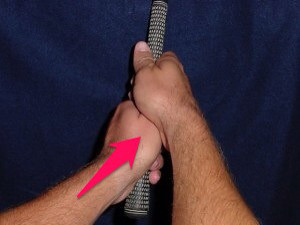
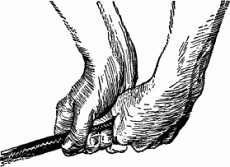
Next (and I think most important), you must feel PP #1! This is one that I absolutely was not using before. As a matter of fact, my two hands would often disconnect from each other at various points in the swing, even though I was covering my left thumb with my right palm. It's not merely enough--at least for me--to hide the left thumb in the lifeline of the right palm; it's an absolute necessity for me to apply pressure to the base of the left thumb using the crease in the base of my right palm! And it's important to keep it that way from setup to followthrough! This right hand palmer crease forms a semi-oval clamp that attaches firmly to the base of the left thumb.

PP #1
Nail illustration of PP #1

I'm not certain yet why PP #1 is so effective at increasing the quality of my contact (other than it unifies my hands so well), but I can post references below to what others say on the matter. And it's interesting that this is one part of the grip that is often glossed over or not mentioned at all.

As to PP #3, I believe it's better to sense it passively; I personally don't want to actively push with it. I do, however, think that PP #4 is a great power generator to use along with PP #1 and PP #2. So, yes...I've mixed a bit of hitter with both swinger qualities. Sue me.

He [Ernie Els] then wraps the right palm over the left thumb so that the lifeline palmar crease ("cup" of the right palm) rests over the right side of the left thumb and slightly over the top of the left thumb. This will cause part of the right thenar eminence to lie on top of the left thumb. Placing the right hand firmly over the left hand in this manner helps to interlink the hands, so that they can better function as a close-knit unit. Also, note that the right 3rd and 4th fingers are used to firmly grasp the club's grip, and that the grip is in the fingers and not the palm of the right hand.

Grip

You will find that the palm of the right comes up and faces directly to the left, and that the center of the base of the right hand fits snugly over the big knuckle at the base of the left thumb.

Golf Grip Part 4: Placing The Fingers

Grip check #2: Turn your hands to the right and check the underside of your grip. The lifeline on your right palm should fit snugly over your left thumb, again with downward pressure. If there's space between them, your swing will suffer.

How to check for a perfect grip - How to Check for a Perfect Grip - Photos - GOLF.com

The right hand "lifeline" (shown in red at left) smothers the left thumb at address and throughout the swing. The word "smother" is chosen carefully -- it implies constant, deliberate pressure, not just a hand position.

The role of the right hand is more subtle, and advice on the right hand is much harder to find.

The smothering pressure of the right hand lifeline promotes a wide arc on your backswing, because it tends to push the club away from your body. It also tends to prevent your left arm from bending too much at the top of your swing (although some bending is OK). It does this by simultaneously a) bracing your left elbow, and b) encouraging your left wrist to hinge rather than allowing your left elbow to bend once resistance develops at the top of your backswing. Think of your right arm almost like a splint for your left elbow during the backswing. Finally, the constant smothering pressure of your right lifeline tends to keep your two hands melded and joined together, almost "handcuffed", throughout the swing. This promotes a "one piece" takewaway and downswing that is driven from your big muscles of your lower body, not from your hands.

Golf Swing Tip: Use a Proper Right Hand Grip to Improve Your Swing Like Adam Scott

The three distinct grip pressure points are:

1. In the the last three fingers that trap the club underneath the heel pad of your left hand;

2. The two middle finger of your right hand, whether interlocking, overlapping or a two-fisted grip;

3. Where your right palm overlaps and exerts downward pressure on your left thumb.

Something for the Weekend: Why grip pressure is vital - Tips: General - GOLFmagic

Your right hand provides support and pressure. We like to say the left side pulls and the right side pushes or applies the punch. Where the palm of your right hand joins your left thumb is a pressure point. Also where the index finger or your right hand joins the club (grip) is a pressure point. These two points help put pressure down into the golf ball.

The big issue here is that with good strikers of the ball, the pressure points are applied with a bent right wrist. With poor ball strikers the right arm and wrist straighten out too soon (before impact) and those pressure points are lost as the club head flips past their hands and starts coming up and scooping the ball. Downward pressure into the golf ball is lost.

My Golf Instructor

The last three fingers of the left hand should always be firmly wrapped around the butt-end of the golf club grip. The task that they perform is to ensure that the left hand is kept securely in place.

You should also notice a little light pressure on your left thumb. This should be noticeable as you place the lifeline of your right palm firmly upon it. This should also trigger an awareness of the pressure applied from your right index finger as it pushes against the shaft perfectly sealing your grip on the golf club.

Don’t Lose Your Grip by Golfing Guru | Sportales

Push your right thumb pad against your left thumb with moderate pressure (Homer Kelly’s #1 Pressure Point). This helps you cock your wrist correctly and keep the club on plane. Continue to maintain the arm connections and the #1 Pressure Point until after impact.

The #1 Pressure Point is a “Mega Swing Thought” that we discussed in UST 2 (The fewer the concerns of a swing, the simpler it gets). It has the following benefits:

  • It keeps the club on plane during the backswing (prevents the clubhead from going too much inside).
  • It keeps your right arm connected and your right elbow in front of you. Try flying or sliding your right elbow behind you while applying the pressure. It’s much harder, isn’t it?
  • The pressure also extends the left arm straight. It creates width for your swing that promotes power and consistency.
  • It promotes a flat left wrist at the top which is what you want (unless you are fighting a big hook).
  • It encourages more shoulder turn.
  • It gives you lag in your swing. Try getting into your impact position and then apply the pressure. The clubhead will want to lag behind your hands and the haft leans forward. This lag promotes more solid impact and longer distance. It will also come in handy when you want to it a knock down shot into the wind since it de-lofts the club.

Simplified Base Swing

Another problem that results from a light right-hand grip is that the right hand often comes off the club somewhere in the backswing. This causes the left hand to increase its pressure, creating a number of downswing errors.

Proper Grip Pressure | Golf Channel

In the golf grip, the pressure in the left hand (for right handers) should be firmest in the last two fingers. On this, there is plenty of agreement. The problems start when the same advice is given for the right hand.

Golf Grip Tip - The Correct Golf Grip Depends On The Pressure Points

What should the grip pressure be as you hold onto the golf club throughout the entire golf swing? Most have heard "Hold it like your holding a baby bird or a tube of toothpaste without a lid and you don't want to squeeze any out." Your body will interpret those visuals as hold it very loose in the fingers throughout the swing. The effect of loose fingers is separation of the left hand from the club (at the top) during the transition of the backswing to the downswing which causes an early release and a change in the clubface.

Do you wear out the heel pad and thumb areas of your glove? If so, that is evidence of the movement which cause the friction that produced the hole. Understanding the physics of the golf swing would lead a person to promote secure (effort on firm) fingers around the club throughout the entire swing! This will promote a much improved release and a clubface that remains square throughout the swing.

The overall goal for grip pressure is for your hands to remain in constant contact with the club; if there is movement of the club, it's a huge problem. Recovering from a moving club is almost impossible to recover from on a consistent basis.

As long as the club remains still, it's ok to change finger pressure. You wouldn't want to be squeezing the daylights out of a wedge when you're pitching from just off the green.

The Grip and Grip Pressure - Golfer's Guide

Pressure point number one, the base of the left thumb, where the lifeline of the right hand comes in and connects down with these two middle fingers, feeling that pressure so that there is a connection there. Now watch what happens. A lot of people will swing up and lose that connection and separate right in here between the right hand and the club. When that happens the first move down they snap back on to it and they lose a lot of their clubhead load or their clubhead lag. What I would like to see you do now is this pressure point you can hinge of that position, keep it connected up to the top, and certainly keep that pressure point as you are driving down through impact. So pressure point number one, at the base of the left thumb. Where the right hand connects in. Pressure point number two, the last three fingers on the left hand. This is the one people do pretty well.

Video Golf Tip | Three Grip Pressure Points


Wednesday, May 15, 2013

Hitting Lag: More on Pressure Points #1 and #3

Lag Pressure
Lag Pressure.

I've posted before on the subject of lag and on various ways that have been cited to acquire it. To review for the uninitiated, the word lag is used in the full golf swing to describe how the club head SHOULD lag or trail the hands into the ball. All professional golfers have this lag to some extent, and it's responsible for powerful, compressed, penetrating shots that are associated--at least in the case of irons and wedges--with divots well ahead of the ball. This should not be confused with lagging long putts close to the hole.

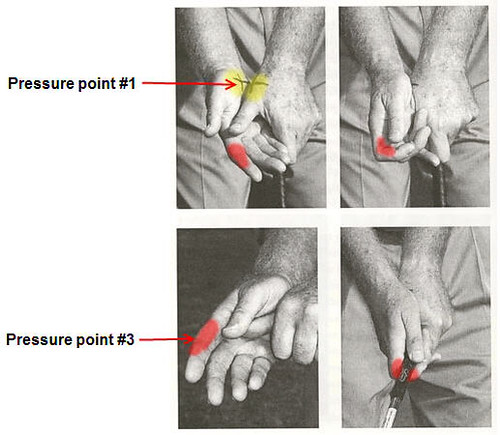
Lag isn't necessarily holding wrist angles, especially in the case of the left wrist (assuming a right-handed golfer). But in TGM circles, lag is strongly associated with feeling Pressure Point #3 (PP3), which is essentially located somewhere along the side of the first-finger base knuckle of the right hand (again, assuming a right-handed player). Pressure in this side area of that first right hand finger is applied--as a pushing force--to the shaft on the downswing along with a dorsiflexed right wrist, straight through impact and beyond. This pushing force is applied by the gradual straightening of the right arm through impact (called Power Accumulator #1 or PA #1 in TGM); the right wrist doesn't really do anything except stay bent back. This is also called lag pressure, and many golfers feel that keeping a "trigger finger" helps them to feel this. Doing so automatically flattens or even bows the lead left wrist and ensures that the hands lead the club head into the ball.

I have found it easier to focus on PP3 and the right wrist position rather than trying to produce a flattened or bowed left wrist, which may be a valid way for others to teach and learn this fundamental. I will not go deeply into the differences discussed in TGM between swingers and hitters in this post, but PP3 is more associated with the hitter style (though it can be felt more passively in the swinger style). There are also other Pressure Points and TGM concepts that I'm not really going to discuss in detail here; all you need to do is Google TGM or buy Homer Kelley's complex book and you'll have an endless supply of advanced golf theory to consume.

PP1 and PP3
PP1 and PP3

But there's an equally--if not more--important pressure point associated with the right side or hitting style (PA #1): Pressure Point #1 or PP1. The is where the lifeline of the right hand encloses the left thumb on top of the grip. The left thumb should NOT be visible to you when you apply this pressure point correctly (you should use a "short thumb"). And the kicker is, you should feel downward pressure applied to the base of the left thumb, which means the right hand may be rotated over to the left more than you may think or may have been told, even if you have a strong left hand grip. This helps secure the two hands together, helps prevent the club from moving around in the hands, and helps prevent independent movement. PP1 helps to produce lag pressure felt in PP3. You should feel PP1 through impact, as if the heel of the right hand is pushing the base of the left thumb through the ball (again, use a "short thumb" with your left hand). This pressure flattens or bows the left wrist through impact automatically, keeping the club head behind the hands where it must be. This assumes that your left wrist is kept very relaxed to allow the push force of the right hand heel to flatten or bow the left wrist.

Lag is also known by other synonyms, such forward shaft lean, delofting the club, hitting down on the ball, pinching the ball off the turf, trapping the ball against the turf, etc. Pinching, trapping, and hitting down are descriptions of feel, and many golfers get caught up the verbatim trap of trying to achieve these feels in reality. Forward shaft lean and delofting are the best synonyms of these when attempting to describe reality--what actually occurs when the hands lead the club head into impact.

The opposite of good lag into the ball is a cast or club head throwaway right from the top, followed by a flip at the bottom, where the right wrist flips forward early and the left wrist breaks down and dorsiflexes, the left-hand knuckles rising both skyward and targetward. Even a small amount of cupping through impact has a detrimental effect. This is a classic high-handicap, hacker error that adds loft to the club (e.g., turns a 7-iron into a 9-iron, depending on the degree of flip). In a sense, this mistake has the two wrists in antithetical positions at impact compared with their correct positions; in a flip, the right wrist straightens and the left wrist bends backwards in a conscious or unconscious attempt to lift the ball into the air, causing weak, uncompressed, high shots that don't fly very far and many other potential mishits like fat, thin, and sliced shots.

Since exploring and researching this topic more thoroughly, I wanted to post additional references to material on the internet that I've found helpful, especially since this seems to be a subject that isn't taught much or taught in a manner that's easy to understand. The mop drill demonstrated by many professionals goes a long way towards getting the amateur golfer familiar with the sensation of using PP1 and PP3, but I sometimes wonder if this tidbit isn't kept purposefully vague among golf teaching professionals much the way magicians are sworn never to reveal their secrets; yes, I think this fundamental of golf is that important to improving beyond the hacker stage, at least with respect to feel in the hands and arms.

Another drill that golfers may find helpful is the aiming point drill, where a point ahead of the ball becomes a target for the hands. In other words, the hands must get to that point before the club head, and where that point is will vary by the club length and the player (body type, swing speed, etc). With longer clubs the driver and woods, the aiming point moves closer to the ball or possibly even behind it.

I like Tom Watson's description of using PP3); he likes to keep everything loose on the backswing. But on the transition and downswing, he wants to feel that pressure in PP3 increase dramatically and feel that the right wrist dorsiflexes even more than it was at address. This down-cocks the wrist and produces tremendous lag without creating any tension at address or during the backswing; this creates more of a swinger style with some elements of a hitter style. It should be noted that some teachers want their students to create pressure at PP1 and PP3 right at address and carry that pressure all the way through; in other words, the grip pressure should be constant from address to finish. In this same vein, Mr. Watson also states that that a golfer should hit the ball hard with their right hand at the bottom, provided they start down from the ground up. As Mr. Watson says, "Hit it hard!" Also why Ben Hogan stated he wished he had three right hands!

You should still feel PP1 and PP3 when driving the ball. They key is to keep the ball well forward in your stance with the shaft leaning away from the target slightly at address. Even though we've been told to play the ball more back in the stance to hit a draw, using PP3 for your driver can cause you to hit down on the ball unintentionally, causing pop-ups that go nowhere. Keeping the ball more forward, especially if you don't sway off the ball, allows the club to release. In a sense (just as with the aiming point drill), you're allowing yourself time to let the right wrist straighten a bit more, square up the club face, and hit the ball more on the upswing.

And now, caution. Feeling PP1 and PP3 and pushing against the shaft with that right hand knuckle feels very powerful, but pushing too much with the right arm (without enough lower body's initiating movement) can also send the shaft outside too early, causing an over-the-top move (and thus a pull or slice). The way to counteract this potential error is to keep the butt-end of the club pointing down towards the ball for as long as possible in the downswing, while maintaining the feeling in PP1 and PP3. The end of the handle should first point out to the right of the target line (inside the ball) when coming down from the top, gradually reaching a point where it points towards the target, and then finally pointing behind the golfer's left hip when the fully rotated into the ball. If the end of the club points directly at the golfer during the downswing, that golfer is probably over the top.

Using PP3 can also be thought of as using a "trigger finger." The pressure in the right index finger can also be felt in the crook that wraps around the shaft, especially if that finger is well separated from the others. Using the finger this way increases swing awareness of not only where the clubhead is in relation to the hands (i.e., lagging or releasing) but also where the clubface is pointing at all points in the swing. During the release, the right arm and shaft should form a straight line pointing into the ground, and that trigger finger should be rotated over.

I vacillate between concentrating on PA#4/PP#4 (swinger style of pulling the club through) and PA#1/PP#3 (hitter style described in this post), but I sometimes believe that the swinger style (while still feeling PP#1 and PP#3) is more efficient and passive. For me, I need to make sure that I press that right hand knuckle into the right-side-top of the grip at address, which ironically also seats PP#1 better; then I'm free to swing using PP#4 and can forget about PP#3 and active hitting with the right hand. In other words, a solid connection with the right hand and the club is essential, regardless of the swing style. My tendency is to hold the club with no connection or a loose connection of the right hand pressure points. Now, keep in mind that you can vary the pressure with which you press this right hand knuckle into the shaft; experiment with different pressures--lighter pressures are most likely to yield right-to-left shot shapes, while tighter pressures are better suited for fades. Whatever PA/PP combination used, it's important to keep the end of the club handle pointing down-target for as long as possible to ensure an inside approach. Swingers may very well feel PP#3 but it should be passive and not active as it is for hitters.

How can this be fixed? Well, there needs to be an understanding that the clubhead will always follow whatever the other end of the club does. So, the grip actually should lead or direct the club towards the ball. Once the golf club reaches the "set" position at the top of the backswing (a right angle between the left hand and the shaft of the club) that position should stay the same until the hands and the grip of the club are about even with the golf ball. At that point the hands will begin to unhinge and release down into the golf ball.

Casting Recall: Stop the Power Loss

PP#1- Right heel pad of hand against left thumb

PP#2- Last three Fingers of left hand

PP#3- Right index finger against shaft

PP#4- Left arm against chest

Golfers use different combinations of these pressure points. A golfer who is referred to as a “swinger” because they’re left side is pulling the golf club primarily use pressure points #2 and #4. Golfers referred to as a “hitter” because they’re right side is pushing the club primarily use pressure points #1 and #3.

Positions, Pressure Points, And Power Accumulators | Matt DeJohn Golf

The problem most golfers have is that they have no concept of pressure points and lag pressure and they almost inevitably maximize their lag pressure in the startdown. And because you lose lag pressure immediately after you maximize it, the golfer has lost the lag pressure once they arrive to impact. And remember, once you start to lose the lag pressure, you cannot regain it in that swing.

What usually happens when the golfer loses that lag pressure at impact is that their hands stop or slow down greatly in the downswing and they wind up using their wrists (flipping) to move the clubhead towards the golf ball. One of the main things I try to emphasize in the FLW (flat left wrist) at impact is that in order to obtain it, the golfer should avoid trying to actually keep the left wrist flat at impact. Instead, use lag pressure properly and that will get your FLW at impact.

3Jack Golf Blog: Lag Pressure, Key Concept in the Golf Swing

Probably the biggest question I get in regards to TGM is about 'swingers' and 'hitters.' Before I go on explaining the difference between the two styles, I will note that according to physicist Dr. Aaron Zick, who was brought to the latest TGM Teaching Summit, there is no such thing as a 'pure hitter' or a 'pure swinger' on full golf swing shots. Instead, everybody does a little of both.

3Jack Golf Blog: Understanding the Basics of TGM -- Part III

During the past two years, my thinking has become more refined and I have moved beyond the limitations of TGM thinking, which believes that the swing styles of swinging (drag-loading) and hitting (drive-loading) are mutually exclusive swing styles. I now believe that it is perfectly acceptable to mix swinging elements with hitting elements in the same swing if a golfer can successfully manage to synergistically mix the two elements in a time-coordinated and synergistically synchronous manner.

Power mechanics of swinging

One of the most overlooked fundamentals of the golf swing is the point of pressure created by the club resting against and across the middle joint of the right-hand forefinger. This pressure point transforms that finger into the "trigger finger," meaning it plays a major role in the loading of the club on the backswing and the lagging of it on the downswing.

Where the grip falls across that finger is where we feel the lag of the club. To use this effectively, lay the handle diagonally across the middle joint of the trigger finger. During the swing, you want to feel the club's weight in that spot the entire time.

Breaking 80: Bobby Clampett: Golf Digest

You know that the Lag is felt during the downstroke as a steady pressure in the index finger of your right hand (aka Pressure Point #3 (PP#3)). Done properly the hands and the clubhead combine as Clubhead Lag feel that can be directed, or aimed at a target.

Consequently, the Aiming Point is a target on the delivery line where you fire the pressure in your index finger (PP#3) to. The Aiming Point is very rarely at the ball. Therefore you must not consider the ball as your target. Instead, the Aiming Point replaces the ball and becomes your new target.

The Aiming Point Concept from the Golfing Machine | Golf Lag Tips

2. BOTTOM HAND FOREFINGER PRESSURE

HERE’S AN IMPORTANT POINT: Nearly every bad shot in golf results from the shaft coming off the bottom hand forefinger before impact. When this occurs, it’s all but impossible to control the clubhead. As you address the ball, you should feel very little pressure on your bottom hand forefinger. However, as you start your swing, the weight of the club puts pressure onto your forefinger. This pressure must be sustained throughout the downswing, with the forefinger staying in front of the clubhead. To help maintain this pressure through impact, when taking your grip extend the forefinger down the shaft.

3. BENT BOTTOM HAND WRIST

AT IMPACT, THE FORWARD leaning shaft and clubhead exert force into the ball. When the bottom wrist is bent back, pressure is applied to the lead arm and shaft as the clubhead approaches impact. If the clubhead weight passes the hands prematurely, the bottom hand wrist straightens, slowing down the clubhead. To ingrain the correct feeling of the bent bottom hand wrist, sprinkle some grass on your left thumb and take your grip. Make some short pitching-length swings. If the right wrist stays bent, force is sustained during the downswing and the grass will remain in place.

For maximum distance here are four little known..but key points

When a ball is struck with "Lag" it explodes off the clubface! Without this "lag" the sound turns into one of mush, a soft Impact instead of a driving Impact.

So we have a Clubhead Lag Pressure Point (Pressure Point #3) which is the Right Forefinger and this is always directing the club to where, the inside back quadrant of the ball.

Golf Swing | The Secret of Golf

The right hand “V” will point straight up toward the chin, and the secret is accenting the forefinger position so it looks like a “trigger finger.” Going further, be sure the first joint segment of the finger is pressing into the side of the club in a manner that slightly puts the first knuckle on top of the handle as pictured here. The trigger finger will maintain side pressure on the handle from start all the way to impact.

Right Wrist Action for the Perfect Golf Swing | Herman Williams Golf Instruction

A trigger finger can help you better engage your golf swing. What’s a trigger finger? John Daly, for instance, as well as several other top players use some separation between their index finger and the rest of their grip as a “trigger” to help sustain proper grip pressure and assist in better hand rotation and in preventing the club from slipping too far into the palms of the hands. Give it a try and see what a trigger finger can do for your feel and overall swing.

Master Your Iron Play | GolfTipsMag.com

If you are holding the club with the last three fingers of your left hand and the middle two fingers of your right hand, and if your left thumb is cradled firmly in that little pocket of your right hand, with the part of the right hand below the thumb keeping a steady pressure, then you've got it.

You may have trouble keeping the pressure on with your right hand below the thumb. But believe me, this is the right way to hold the club. Master it and you are more than halfway home as a golfer.

The Swing is Simple - Arnold Palmer - SI Vault

Power is applied to the left hand, not the club itself, using the base of the right wristbone pressing against the top of the left thumb, to help the left hand move along its arc around the shoulder fulcrum.

The Wrong and Right Way to Apply Force

When your right palm exerts this slight pressure against the left thumb extending the grip away from your left shoulder, you will not need to have any tension in your left arm to help it remain straight and your left arm will have the same radius around your left shoulder from start up, through your back swing, down swing, and through impact. [This] pressure point has another function as well, it monitors the cocking and uncocking of the right elbow and sends this information to the motor cortex. It only feels this hinging motion and should never add or contribute to the actual cocking or uncocking of the right elbow.

TGM 101 - The GOLFING MACHINE

Again, the palm of the right hand presses hard against the thumb of the left.

Cure A Golf Slice - Harry Vardon


Sunday, November 11, 2012

Compression: Role of the Right Arm

Hang around online long enough and you'll discover a plethora of golf teachers with varied opinions on the role of the right arm in the golf swing. Some teach that the left arm should be dominant (players sometimes called "swingers" who pull with the left arm), some argue the right arm (players called "hitters"), and some both ("switters" or "swing-hitters"). Some say that both arms should be passive, neither pulling or pushing, and merely responding to gravity and body movement.

And you'll find examples of successful touring pros who use each one. In The Golfing Machine (TGM) parlance, the active straightening of the right arm (primarily driven by the right tricep) is described as using Power Accumulator (PA) #1 and is heavily associated with the "hitter" swing style.

Regardless of what is taught, used, or believed, there seems to be one universal truth, at least visually, with regard to the right arm in the full golf swing when we examine the swings of great players: The right arm folds in two places--the elbow and wrist--in the backswing, and the right arm gradually unfolds in the downswing, reaching it's fully extended, released position (right wrist and elbow straight) a foot or so past impact. The left wrist never breaks down or bends backwards (i.e., flips). The right arm straightening can be passive for swingers or active for hitters.

The first element of properly using PA #1 involves keeping the elbow and wrist of the right arm bent for as long as possible coming down. Ernie Els describes this as "keeping the box." The right elbow should still be slightly bent at impact, reaching a fully extended, released position only a foot or so past impact, with the right wrist still bent backwards (even just after impact). Doing both automatically extends the left arm fully and keeps the left wrist flat through impact. Pressure should be felt in the first phalanx or base knuckle of the right index finger from the top and through impact. In a sense, that phalanx or inside base knuckle of the right index finger can and should serve as a guide to the club face position throughout the swing. The right hand thumb and index finger should be completely loose around the club handle; you can even take them off! Only that phalanx or base knuckle is important.

If the right wrist straightens in a way that causes the left wrist to bend backward at impact, this creates a "flipping" motion and the club head will pass the hands (lag is lost and the effective loft of the club is increased). Instead of "flipping" or swatting at the ball with the right wrist (behaving as if it was merely a door closing along its vertical axis), the right wrist should only straighten WELL AFTER impact with the right palm rotated slightly downward through impact.

This reflects the TGM description of hitting down on the ball with the right palm and actively straightening the right elbow, feeling pressure in the base joint of the first finger of the right hand (Pressure Point #3) and pressure on top of the left thumb (Pressure Point #1) due to pushing on the left hand with the right. This creates a feeling of pushing down and out on the shaft with the right palm, and results in a flexed shaft due to the compression against the ground; a divot is taken well in front of the ball. The ball is often described as being powerfully "pinched" off the ground or "compressed against the ground."

Use this one swing thought: Aim to fully, dynamically straighten the right elbow a foot or so past the ball with your irons. Straighten it down, forward, and out. You can use this method to hit the driver; simply use less downward extension. Instead, extend so that the right forearm is more level with the ground coming into the ball. Straighten it out to the right slightly for a draw and out to the left slightly for a fade.

The best way to describe [Kenny Perry's] right arm on the downswing is that it is "pushing down and out." Pushing down allows the right arm to actively straighten while maintaining the bend in the right wrist. This feeling is no different than if you were to try to push something into the ground with your right arm.

Maintaining the bend in the right wrist is a fundamental you see in a good swing. It allows the clubshaft to return forward at impact, resulting in a clubhead that is descending and accelerating through the impact zone.

PGATOUR.COM - Instruction blog: Right arm the key to Perry's swing

"In essence, bending and straightening the Right Elbow will raise and lower the left arm and/or cock and uncock the left wrist without bending, flattening, or cocking the right wrist. Right elbow action either powers and/or controls all three elements of the Three Dimensional Impact, (downward, outward, and forward)." ~ Homer Kelley

www.chuckevansgolf.com

In a golf swing (whether one is a hitter or a swinger), the right wrist is always bent back and the right wrist never bends forward (palmar flexes) at any time point during the downswing - because it would cause the left wrist to bend forward (flip).

Whether one is a hitter or a swinger, the clubhead should never flip past the hands while the clubhead is moving through the pre-impact zone. The clubhead should always be lagging behind the hands during the entire downswing, which means that the right wrist is always bent back.

[A] hitter applies an active push-force at pressure point #3 by actively extending the right elbow during the downswing - as the right elbow actively straightens it applies an active push-force via the bent right wrist to pressure point #3.

PA#1 is only actively released in a hitter's swing action - when the right triceps muscle actively contracts with a large amount of isotonic force, thereby straightening the right arm in a straight line thrust action that thrusts the right forearm downplane and drives PP#1 [the left thumb]/PP#3 towards the ball (or towards a desired aiming point in the vicinity of the ball).

The release of PA#1 is due to a very active triceps muscle contraction that actively straightens the right elbow in a forceful thrust action that pushes the right forearm and bent right wrist towards their impact fix position.

How to Power the Golf Swing

Throw the club through the ball with your right hand. As Jack Nicklaus said, you can hit as hard as you want with the right hand as long as the lower body is leading.

Tom Watson: My power key never gets old: Golf Digest

That right hand does not stay as loose as it does on your backswing. You take it back loose, your hands are nice and flexible. But when you hit that ball, you’re adding power to it and you’re increasing your pressure all the way through impact.

Tom Watson Interview