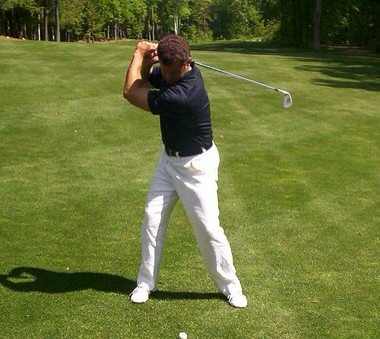
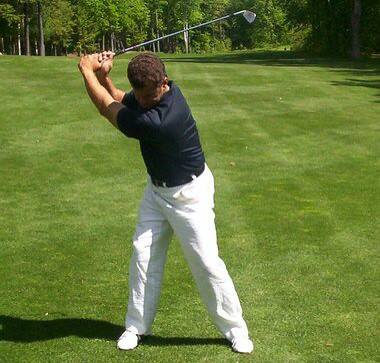
Saturday, January 4, 2014

Torso Turn

You know...I've made several faux pas on this blog, and if you read through carefully, you'll no doubt find contradictions and errors (because golf instruction is full of contradictions and disagreements), and I've fallen prey to my fair share of fixes and tips, only to change my mind about them later. Remember, the ultimate purpose of this blog was to document my discoveries and breakthroughs, and some of those, unfortunately, turn out to be dead-ends (though some of them may not be dead-ends for you).
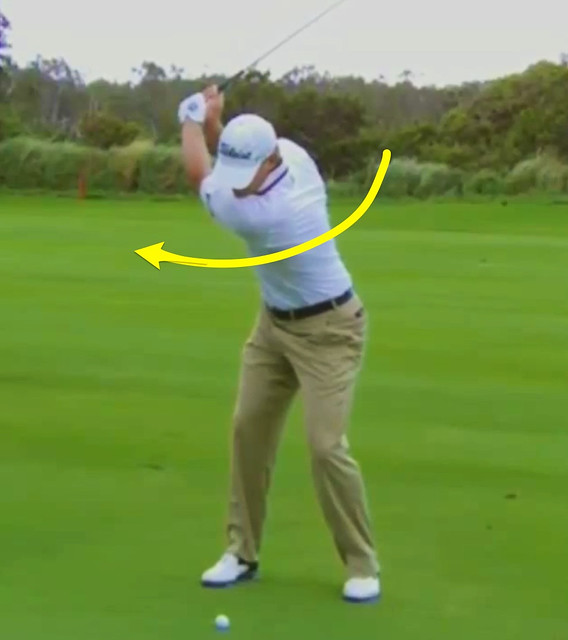
Torso Turn in Backswing
Torso Turn in the Backswing

But here's something I've stated a lot on this blog in numerous posts: "shoulder turn." What's the big deal? They turn, right? Well, yes. But we have to be careful, because each shoulder is capable of independent movement with respect to the torso (the rib cage and abdomen). The hips can also make a good deal of movement. The mid-spine (thoracic) and high-spine (cervical) have a wide range of rotation, while the lower spine (lumbar) is mostly limited to up-down movements. Yes, it's possible for you to FAKE a good turn by moving your arms, hips, and shoulder joints. This fake turn doesn't feature a lot of mid-torso movement, which is what we actually need. In other words, the mid-spine should turn the most, with the hips turning to complete the turn. The shoulders and arms MOSTLY go along for the ride.

Henceforth, when you read this blog and see the phrase "shoulder turn," please understand this is really synonymous--and actually more correctly descriptive--with an upper "torso turn." Is it a big deal? Yes. Because the shoulders will turn PASSIVELY when the chest and abdomen rotate back and through. Those muscles in the ribcage, back, and abdomen are the ones to focus on when conducting the takeaway, backswing, downswing, and finish. The shoulders, arms, wrists, and hands (and thus club) just go along for the ride MOSTLY (see gotchas below); there's no real need to consciously move them.

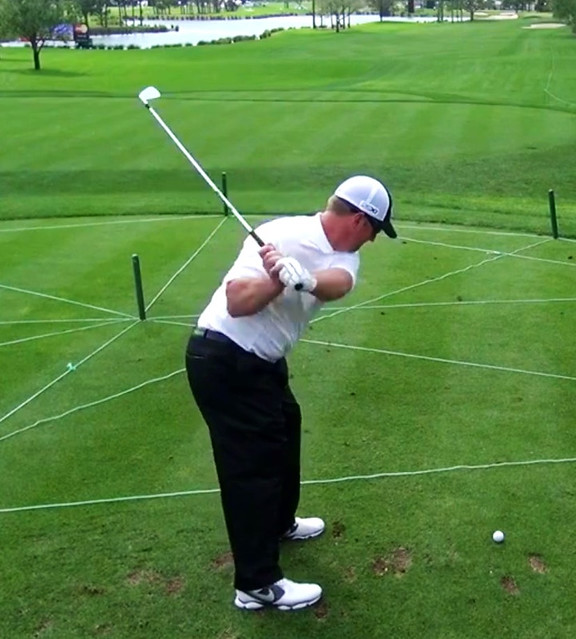
Actually, with just a torso turn, the arms are automatically brought to chest height during the takeaway. All that's necessary for the full arm motion from that point onward is a lift of the hands and club that amounts to about six inches of vertical movement above their address position! The torso turn provides the in, back, and up motion for the arms (i.e., depth), while a slight lift due to the right elbow bending provides the remaining up (i.e., width); no more is needed because of the posture (left shoulder low, right shoulder high). Yes, the arms lift, actually, very little in the backswing, and they DO NOT pull the body back at all! They merely lift up slightly. The hands should feel very wide and far away from your head and shoulders, but there should be no tension in getting there: Swing the hands away wide using your torso and let your arms stop moving when your torso stops turning!

I love to think of the torso as a large cylinder that juts out at an angle from a bulky bipod (legs). Using that analogy, it's much like a large reflecting telescope, pointing approximately 45-degrees into the sky (i.e., forward flexion or spine angle), sitting on a two-legged stand. Now for the backswing and downswing motion, just think of the telescope cylinder itself rotating IN-PLACE clockwise (back) and counter-clockwise (left) [something a real telescope would never do], while maintaining that 45-degree tilt!

If that’s difficult to envision, imagine a large dowel, rod, or pole that runs through the mid-back and through each latissimus dorsi muscle, about 3 inches below each armpit and extends out from the body about a foot on either side. The focus here is to first point the “lat dowel” at the ball and then “hit” the ball with the other end of the “lat dowel.” On the backswing, point the left side of the dowel down towards or even behind the ball for a big windup. Midway through the downswing, the dowel will be roughly parallel with the ground on both sides. Just after impact, the right side of the dowel will point down towards the ball, indicating that you have used lateral bend. At the finish, the right side of the dowel will point forward and to the right of the target, depending on your flexibility. At all times the imaginary “lat dowel” has rotated around on a tilted plane, which is ironically the visual analogy that is often used for the shoulder line. But remember that each shoulder has a generous range of independent movement in multiple directions, which makes it easy to fake a good torso turn by moving the shoulder joints. Moving the “lat dowel” eliminates the cheating. The "lat dowel” analogy is a very effective swing thought for the short game: chipping, pitching, greenside bunkers, and putting too.

A swath of golfing problems will disappear when you learn to maintain your posture or spine angle and simply turn the upper torso back and through (i.e., use the torso muscles to turn). Many of the aspects of the swing that are taught independently are suddenly addressed, automatically. I've found more power and consistency with increased lag, because the wrists are less likely to flip. I've found that my hips don't move as much in relation to my upper body. Posture or spine angle maintenance is reinforced, such that the shoulders rotate perpendicular to the forward flexion angle. The tension in the left lat muscle--the sign of a good backswing coil--suddenly shows up. Because the arms, wrists, and hands are passive, the angle of the club face stays in the correct position in the takeaway, mimicking the spine angle. I've found the same torso motion is used, more or less, in every golfing stroke, including chipping and putting.

As the shoulders turn in response to the torso turn, forget the "left shoulder to right foot" tenet; focus instead on the right shoulder and ensure that it gets as near as possible to the RIGHT foot (i.e., the sternum should be over the inside of the right foot), which automatically creates the necessary tilt behind the ball and prohibits reverse pivoting while preserving a proper coil. This thought is especially important for the driver, but a more centered pivot might be the ticket for irons, pitch shots, and chips.

The gotchas (at least for me): Ensure the arms are lifting at the same rate your mid-torso is turning to keep your arms in front of you. You should be able to--during rehearsals--look at the club head during the takeaway and notice that it's still well outside the hands and the club face angle matching the spinal posture. If you just let the arms go and focus only on turning the mid-torso, you may suck the club inside early and then lift the arms late; the left arm ends up too far behind you and pinned too much across the chest, when the hands and club should stay in front of the chest. This error can cause some plane shift problems (e.g., laid off) and waywards shots. Also, a subtle bump into the left leg (weight shift) should be sandwiched between the torso turn back and through to help ensure an inside-out swing. Be aware of the tendency for the arms to collapse at the top; the arms should stop moving when the torso turn is complete; the arms should be relatively straight and tension-free; and the hands should be well away from your head, signifying a wide swing arc with no possibility of a collapse.

The turn away and back to and through the ball is accomplished by turning your torso. It is so often referred to by teachers and players as a shoulder turn, that many people believe that is the part of the body that should turn. This is confusing for new players and causes both new and experienced players to make the wrong move.

When you consciously think of making a shoulder turn, instead of rotating your torso, your move will be to force your left shoulder back. When you do that, your left shoulder comes up or flattens in golf terminology.

Quit Calling it the Shoulder Turn!

Mistakes occur when the hands or wrists initiate the first movement. Start to bring the club back using your torso and shoulders, not your wrists and forearms.

3 Keys for a Smooth Takeaway

The arms can be the culprits [of posture loss] if they initiate the swing by pulling the turn of the torso. The torso starts the backswing by rotating to the right, maintaining the address spine angle and the arms following.

Pinewild Country Club of Pinehurst

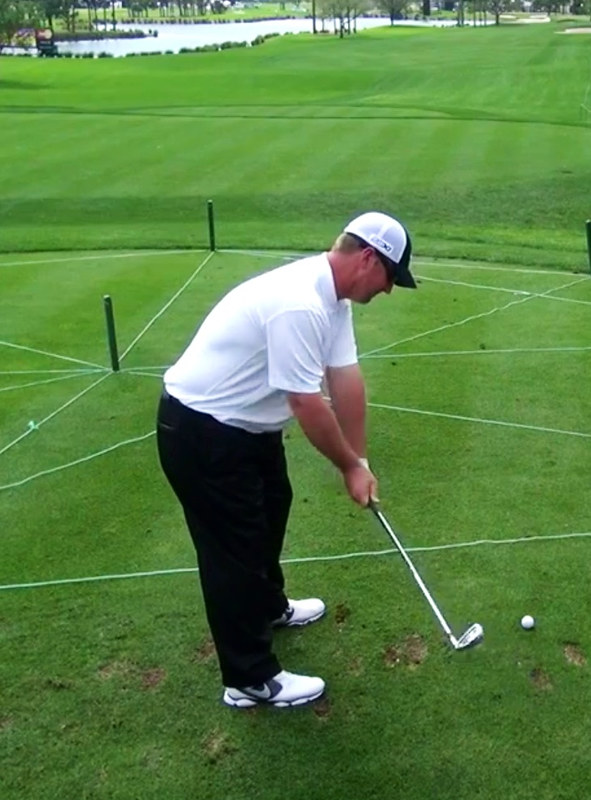
The first move away from the ball is absolutely essential. The hands, arms, stomach and chest must all turn together, as a unit. If you can't manage that, well, good luck, you've got very little chance to hit a good shot. But if you do manage it, you then have only to hinge the wrists and turn the shoulders to complete a perfect backswing. It's as simple as that. I've eliminated the complexity. I sincerely believe that anyone who masters these three easy backswing steps will have a rock-solid golf swing for life.

The Backswing - Nick Faldo

To turn more, you need to turn your torso during the backswing. As you swing back, try to turn your bellybutton 45 degrees to the right.

Backswing Shoulder Turn: How to Turn More

What is the pivot? The pivot is a blend of weight shift and a circular turning of the body. Or said another way, the pivot is both a lateral and a rotational movement of the hips, and the rotational movement of the torso and shoulders.

The Pivot and a Flat Left Wrist

One of the most confusing terms in golf instruction is "shoulder turn". Instructors that talk about shoulder turn to describe the amount of body turn during the backswing are hurting their students. What this means is if you start your backswing by pulling the club away with your hands, you may be hurting your swing right at the start of the backswing.

Instead of pulling the club away with your hands, push the club away with the turning of your chest. It will maintain the arms/body geometry and increase your chances of an on-center strike.

A Golf Backswing Mistake to Avoid

Early arm lift to line the left arm up with the turn and keep the hands in front of the chest…GOOD!!!!!!

[L] ate arm lift because the left arm is across the chest and the hands and club are way behind the turn…BAD!!!!

The left arm must lift

Getting the right shoulder over the right foot (lefts for lefties) helps you keep tilt behind the ball, gets you into position to have a shallow AoA [angle of attack] and no room for your arms to over run your turn.

Guess what…lag city.

Monte Scheinblum's Blog

So, summing up, for the production of power, a golfer should have a neutral (comfortably straight) spine at address. During the backswing, the thorax should rotate a lot relative to the hips; and the shoulders should rotate perpendicular to the spine angle which was set up at address. During the downswing, the spine should remain in its forward flexion, at least until impact, and the left hip should rise at that stage.

Anatomy of the Golf Swing – The Trunk/Torso

"While the arms do swing up and down and the wrists hinge and set, these motions are secondary to torso rotation," Parees said. "That is what creates the majority of speed in the swing."

PGA Golf Instructors | Golf Tips To Improve Your Golf Game

From a physics standpoint, a longer coil has more power, so in the back swing you might try to turn back from the mid-section to lengthen your torso coil rather than thinking of turning with only the shoulders.

Hip Sway in Golf - How to Add Club Head Speed

The term "shoulder turn" is misleading. You can easily make what looks like a full turn by pushing your left shoulder under your chin and lifting your right shoulder behind your head. That’s a full shoulder turn, isn’t it? Maybe, but it’s far from what you need to make a great golf swing.

What you really need to do is to make a full chest turn, turning your whole upper torso a full 90 degrees so that your back faces the target, and your sternum faces directly away from the target. When done correctly, this will create a high degree of separation (the "X-factor") between your hips and your shoulders, stretching the large, powerful muscles of your core, generating lag and putting you in the correct position to execute a fantastic transition and downswing sequence.

Drill 302. Backswing: Making a Full Shoulder Turn

Core Rotation: A big part of Sam’s [Snead] power comes from the core rotation of his body and flows through his arms and hands, down the shaft and into the clubhead. Shoulder turn? Yes, it’s important. However, without core rotation you’ve only got about 50 – 60 percent of your normal power. Imagine throwing a baseball without turning your core. Not much power there. Look at how far Sam turns his core especially in his hips.

5 Swing Keys to Consider in Sam Snead’s Swing – and Yours!

One of the more frequent mistakes I see golfers make is to stand up or lose their body angles through impact – the "stand and deliver" move! The loss of body angles or posture causes the body to stop rotating and as a result the hands now assume the responsibility of squaring the clubface. Remember – if the body does not rotate to clubface square, then the hands will help out. This move is very difficult to time, especially under pressure, and often leads to the hands overworking or flipping through impact. If the hands rotate the clubface too early the shot misses left and if they’re a touch late, then the shot misses right.

Hands Flipping

As you stand to the ball with the wrists slightly up, there is a straight line practically from the club head up the shaft and along your arm to the left shoulder, and as your hands are already waist high it needs only the inclining of the shoulders as we turn (on the pivot) to bring them shoulder high, without having altered their relative positions at all.

They [the arms] have not been lifted. They have gone up in response to the shoulder movement. This accounts for the curtailment and the control of the modern swing.

The Controlled Golf Swing

Finishing the backswing with a turn of the body, instead of a lifting of the arms, makes it easier to match up the timing and peak speed sequence of the arm swing and body rotation throughout the downswing to impact.

Golf Swing Synchronization

If the elbows bend, we shorten our radius and are not consistent with the position and length of our arms/club. Makes it much more difficult to return back to impact in the same position that we started (the goal). Also, elbow bending lends to "arm lifting". Having the arms take over and lift on their own, is the worst move for the golf swing. No power or repeatability. Lifting is a very weak move and the shoulders will stop rotating.

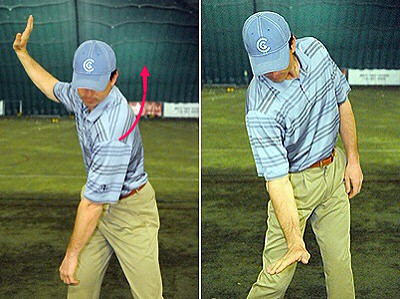
Move Less … Get Good!

Left Shoulder Lag Secret

Flipping. Casting. Club head throwaway. The opposites of lag. Not fun. Flipping ruins a good backswing and adds loft to clubs when we don't want to add loft; thus, we lose distance. The pros don't flip or cast; some of them look like they're barely swinging and hit a 7-iron 170 yards or more (think of languid, slow-rhythmed Freddy Couples and his Boom-Boom distance). They achieve this through physics...not strength or necessarily through some exclusive ability. The lagging club head is the key to effortless power. How does one stop the club head from catching up with the hands too early? For us amateur golfers, a little lag can go a long way, especially when we haven't had any.

The club head naturally wants to extend out to the furthest point from where it's being swung--the left shoulder. Yes, some instructors (e.g., Shawn Clement) argue that the swing center is the notch above the sternum, but when you're coming into impact, the right arm is still bent while the left is straight, so the club wants to seek an alignment with the left arm and left shoulder (i.e., the fulcrum of the club is actually the right wrist). For most hacker golfers like myself, this occurs too early--way behind the ball. We come through with the club head passing the hands to one extent or another (the more the flip, the worse the shot). So, we have been taught any number of silly things to counteract this--hold the lag, drag the mop, aiming point, etc.

Torso in the Downswing

For an industry that's struggling to grow, the Jedi Masters of the game need to stop holding back information, if they are, in fact, doing that on purpose. If hackers could learn the correct movements, they would all start lagging the club and handicaps would drop. But so would the number of lessons taken. It's not in a teaching professional's interest to give it all away early; one wonders if they don't have a need to keep things esoteric, vague, and mysterious--slowly giving up the real game-changing information, once a regular student has forked over enough dough. But I digress...forgive my conspiracy theorizing.

When the club head reaches the point where it is aligned with the left arm and left shoulder, the club head is moving its fastest; from that point onward, the club head is slowing down, no matter how hard you push with the right hand. For the flip to occur, something else must be slowing down too much. And I believe that's the left shoulder for most (i.e., the torso rotation is slowing or pausing). If the left shoulder keeps turning up and back before and after impact, and forward flexion over the ball is maintained, the club head CANNOT pass the hands early. Or, it's, at least, a lot harder to achieve.

Still images of pro swings fool us a bit; we usually only see these great swings from two views: DTL (down-the-line) or FO (face-on). We rarely see them from the target's perspective, and usually never from above, back-on, or from other angles. And swing sequences in magazines often omit images between "positions" that relay useful information, simply because they don't have the print space to show it all. There's a lot of missing information from which the careful observer could learn. At impact, we see a still image of shoulders that appear square to the target line, but that's just a brief moment located within the space of a second; the camera captures that moment, but we don't see that the shoulders (actually, the torso turning the shoulders), which began rotating briefly after the hips in the downswing, continue turning all the way through and past impact. They shouldn't tilt backwards. They shouldn't stop or slow down to stay parallel to the target line, forcing the arms out "to right field."

Slow motion video has, fortunately, removed some of the mystery, for those who observe closely. You will notice that the left shoulder keeps turning up and back, without pausing, though impact, when looking at the swing of a touring or good teaching professional. As the torso continues turning, there is a moment after impact when both shoulders are perpendicular to the target line, with the right shoulder lower than the left. Continuing the rotation into the finish position, the entire left side of the body is facing away from the target, with the left shoulder back towards the right foot, and the right shoulder is pointing target-ward and over the left foot. And the great player maintains their posture (forward flexion or "spine angle") over the ball into the finish--torso flexed towards the target line; they don't stand up out of their swing (i.e., sometimes distastefully called "goat humping").

Lightbulb! This is where you've heard the vague advice to move the left shoulder away from the chin as quickly as possible. It's one of those little tidbits that gets a brief mention but is never expounded upon very much. Sometimes it's those little tips or advice that are glossed over that have the biggest impact on changing your golf swing for the better.

This is also useful for chipping, as a chip is a smaller version of a pitch, which is a smaller version of the full swing; even the putting stroke has a minute bit of this movement. To keep the club head from passing the hands (i.e., flipping), the torso must continue turning while staying in forward flexion. Many chunked and thinned chips are caused by swinging the arms at the ball, overusing the wrists and elbows, and trying to keep the shoulders parallel to the target line through impact, which is what intuition tells you to do. Intuition and instinct in golf are usually wrong!

Now there's an inverse to this, obviously, since we're bilateral human beings. Just as the left shoulder continuously rotates counter-clockwise and up during the downswing, the right shoulder continuously rotates counter-clockwise and down--the reverse of the torso's backswing movement. After all, the torso is actually doing the turning, with the shoulders merely following. This is what teachers refer to as "firing the right side through," which is the antithesis of "clearing the left side."

Whether you think of it as continuously "clearing the left side" or continuously "firing the right side through," you must be shifted first into your left leg, left knee aligned over the left ankle. And you MUST maintain your posture (i.e., forward flexion) throughout--no standing up! See which swing thought gets you through the most and practice that one; you should immediately notice a more piercing ball flight, and your finish will have your shoulder line roughly parallel with the target line but mostly facing away from the target line!

The "feeling" of extending the left side of the body and elevating the left shoulder has been described by Brian Manzella (New Orleans golf instructor) as a "throwing a drunk off one's back" maneuver. Imagine being at a party and having a drunk partygoer draping himself over your left shoulder, and imagine the "feeling" of "throwing the drunk off one's back" by abruptly elevating the left shoulder in a sudden left shoulder shrug maneuver. If that left shoulder shrug maneuver is incorporated in a smooth manner into one's swing action, then it can produce smooth parametric acceleration of the hands/club without any need to "jump-up" after impact, and without any need to elevate the upper swing center.

Learning to perfect the i) timing of left shoulder socket elevation and ii) also the exact amount of upward movement of the left shoulder socket during the late downswing is an absolute requirement if a golfer wants to consistently strike the ball solidly with the sweetspot of the clubface.

Downswing

A golfer should ingrain the "feel" that the right shoulder is moving [down plane] at the same speed as the right elbow/RFFW (right forearm flying wedge) in the early downswing.

How to maximize wrist lag

The sustained rotation of the left shoulder is critical to squaring off the clubface at impact. [T]he beauty is you don’t have to think about pulling the grip up through impact. Swinging to a properly architected and balanced finish is the most simple and best means to keep the left shoulder ["to" removed] moving upward and rearward.

[In a balanced finish,] [t]he left shoulder should compress back towards the right heel and settle directly over the right heel.

WaddenGolf - Why the Finish to the Golf Swing is so Important

Here’s a secret golf tip Ernie El’s gives about the shoulders in the golf swing. At the start of your downswing, get the left shoulder moving away from your chin as soon as possible.

Perfect Golf Impact Position


Sunday, December 22, 2013

Round Out the Swing Plane

Spine Angle and Face Angle

I recently posted on the so-called "twistaway" maneuver taught by Brian Manzella (and as it turns out, many others, going all the way back to Joe Dante's Magic Moves book in 1962). As a short review, this is an extreme way for teachers to get hackers and slicers to return to impact with a square to closing club face. It does work, but you can quickly discern that not too many professionals perform a takeaway exactly like that, though some do appear "closed" at the top and many before impact.

Whereas "twistaway" is extreme on purpose for the reasons stated above, there is a less-extreme--though related--school of thought that espouses swinging the club such that the leading edge of the club face stays parallel to the forward bend or "spine angle" throughout the swing. And you can find examples of many modern, professional golfers who swing this way, such as Hunter Mahan, Rickie Fowler, Luke Donald, Rory McIlroy, and Matt Kuchar to name but a few.

In the past, some would have called this "hooding" the club face or taking the club away "closed," but we've come to find out that the club face, when performing the takeaway like this, is actually square to the arc of the swing. The right palm can be thought of as a guide for how the club face is angled in the takeaway.

As an experiment, address the ball and perform your takeaway, stopping before the club shaft is parallel to the ground. Now stand up out of your posture and look at the leading edge of the face. If you performed the takeaway correctly (i.e., matching the face leading edge to your spine angle), the club face leading edge will be vertical when you stand erect. If you opened the face to get the toe of the club to vertical on your takeaway, you'll see that the toe, and thus the leading edge of the club face, is pointing right of vertical (assuming you're swinging right-handed). This means you opened the face going back. Now, many teach this conventionally and the club can be swung well this way, but it requires equal closure coming down to get the club face square again, which can introduce timing issues. Not good for the weekend golfer!

The reason I like this method of swinging the club is that I feel it actually helps keep me in the correct posture, both back and through. When I perform the takeaway and manuever the club face's leading edge to vertical, I tend to stand up out of my posture slightly. But when I keep the leading edge angled roughly 45-degrees to the ground on the takeaway, I have a mental marker for my spine angle. Therefore, I tend to get a slightly steeper shoulder turn (right shoulder pointing my downward), and thus my backswing is flatter (a flatter shoulder turn is usually associated with a more vertical swing plane).

After impact, the club face's leading edge is roughly angled 45-degrees to the sky (the right palm facing in the same direction), again matching the spine angle, when the club is parallel to the ground again (not completely toe-up as often taught), and my spine angle or forward bend again has a reference, so that I don't stand up too quickly out of my posture coming through. As a result, my right shoulder chases all the way through, my shoulders turn perpendicular to my spine angle (a'la Tom Watson's "secret"), and my finish--when performed this way--has my right shoulder pointing at the target and over my left foot! And I still have most of my forward posture, just like the pros. The chest has stayed covering the ball!

There's no need to consciously roll the club face closed through impact to square the face, because the club face is staying square to the arc all the way through; the club face is gradually closing all the way down and through impact. If you use too much hand action coming through (maybe left over from an old, conventional way of swinging), you'll pull or hook the crap out of the ball! Check your divots; a long, narrow toe divot means you're using too much hand action (either flipping or rolling the forearms too much or too soon).

Swinging this way flattens or rounds out the swing plane, without need to think much about it. I believe this is a more consistent way for weekend golfers to swing a club; it takes most of the timing out of the swing.

To check if your club face is square, take the club back until it’s about waist high, then pause your backswing and look at the club head. If the club face is square, it will match your spine angle.

How to Have a Good Takeaway in Golf

To improve your swing path and promote a square clubface at impact, practice making half swings so the club stops parallel to the ground on each side of your body. At these two positions, the leading edge of the clubface should be parallel to your spine. If it is, it means the clubface is rotating correctly and staying square to the swing path. Good path and a square face are the basic ingredients to straight, powerful shots.

Breaking 90: Match the leading edge to your spine angle

Test: Are You On Plane? One way to test your takeaway is by standing upright. If the toe of the club is vertical, your takeaway was on plane.

Shawn Humphries - Spine Angle

A narrow divot will mean the club has turned at impact; a hook or slice will be the probable result.

Golf Practice Drills: the perfect divot


Saturday, December 7, 2013

Do the Twist

As a former slicer, you may--through various compensations--have developed a hook that occasionally--or maybe usually--turns into a vicious hook. On a bad day, you pull-hook a lot, which is partly left over from your slicing days. And then suddenly one day, you'll go back to slicing the crap out of the ball. And you'll marvel to yourself and wonder why and set out trying to hook the ball again. That's golf. Fun huh? But wait! Maybe you've never broken the slicing curse and have resigned yourself to trying to make the slice work.

Magic Move
The Thumb Press

I've posted before about ways to square the club face and ingredients for various ball flights. If you start slicing the ball (i.e., curving left to right unintentionally), your club face is open to the path upon which the club head is moving; this is why you can hit a pull-slice (ball starting left of target usually with an outside-in path), straight-slice (ball starting at target usually with an in-out-in path), or push-slice (ball starting right of target usually with an inside-out path). So path has an effect, but you can see that slice basically means 'open club face' in all three situations. If you're hitting a push-slice (starts right and curves further right), you're almost there and just need the club face to close through impact! If you're hitting a pull-slice, you've got the most work to do, because you're likely over-the-top (OTT) with an open club face. But in all cases, the club face must be squared! That should be your first priority; then you can work on ingraining the correct plane and swing path. As the saying goes, you can go from slicing to hooking to good golf but can never go directly from slicing to good golf.

Many fine instructors, such as Brian Manzella, teach that OTT (and many other related golfing errors like flipping) is a symptom of an open club face, not the cause (though you'll find others that absolutely attribute a slice to an OTT path). Why is OTT a symptom instead of the cause, some say? Because in an effort to compensate for the open club face, you move OTT (and again, the open face could be causing other swing flaws) in an unconscious attempt to get the ball moving left, so that the ball might slice into the fairway instead of the right woods. So OTT may very well be a compensation for the open club face, not the cause. This means that the open club face is actually discouraging you from hitting inside-out, which is the correct path into the ball!

Assuming a netural to slightly strong left hand grip, you should use a dorsiflexed right wrist (DRW) to hit the golf ball, because you'll ensure a flat left wrist (FLW) at impact, and this may be one of the few universal fundamentals espoused by all great golfers and teachers. And I believe there are various places in the swing sequence where great golfers achieve this position. Some great golfers cup the left wrist at the top (e.g., Hogan, Couples, Watson, Clement, etc.) but dorsiflex the right wrist coming down (thereby flattening the left wrist). Others (e.g., Tiger Woods and Steve Stricker) achieve a FLW at the top, and thus, a DRW at the top before starting down. And some teachers espouse creating the DRW as you move off the ball in the takeaway (the point of this blog post). Most weekend and high-handicap golfers should only hinge or dorsiflex the right wrist in the backswing and forget the temptation to squeeze more power out of the conventionally taught upward vertical wrist cock (i.e., radial deviation or thumbs pointing more and more toward you); vertical wrist action feels powerful (and it may be marginally), but it will cup the left wrist and straighten the right wrist at the top, and that all has to be undone properly by impact to square the club face.

David Duval
Duval's Closed Takeaway

Grip strength plays a role on the left wrist. Stronger grips tend toward cupping at the top, while neutral to weak grips tend toward flattening or bowing at the top. Want to slice on purpose? Use a weak grip and then cup the left wrist at the top--instant banana ball without major compensations. That's actually a good combination to use in a greenside bunker; but I digress.

Why is a FLW at the top antithetical to left wrist radial deviation at the top? Because of biomechanics. It's easy to see how a FLW limits or restricts radial deviation (i.e., upward vertical wrist action); the more you cup or dorsiflex the left wrist, the more you can vertically cock the left wrist up and create what Shawn Clement calls 'snuff boxes.' With a FLW at the top, the left wrist is restricted and can't radially deviate more than 90 degrees, which is all that's needed--especially by weekend golfers. Likewise, the DRW can radially deviate slightly but is prevented from going too far because of the blocking action of the FLW.

Too much vertical wrist cock can contribute to collapsing at the top (in addition to opening the face), especially with weekend golfers. In Stricker's case, he uses very minimal vertical wrist action, and so he's very consistent and long enough to score well against the best professionals; he may have the best professional golf swing for amateurs to mimic because of its simplicity and minimal vertical wrist action; however, he uses plenty of right wrist dorsiflexion!

And now for the point of this post: Using one of Brian Manzella's teaching points (which other teachers such as Joe Dante and Tom Tomasello have also espoused in one form or another), try setting the club face in the correct position early--even as you take the club back, using only one conscious wrist motion. Manzella calls it "twisting" the club (i.e., "twistaway"), such that you dorsiflex your right wrist, palm down, without radial deviation, as you take the club away. The left wrist flattens immediately; it may even arch or bow slightly, and the back of the left hand faces slightly towards the ground. The club face is pointing more down at the ball, as you take it away, staying square to the arc (some detractors would argue "closed to the arc"). Then take it to the top (the club face pointing more skyward than a slicer is likely used to), keeping in mind that you must keep good width, good lower body pivot to start the downswing, and then return the DRW back to the inside part of the ball.

Some notes of caution about the downswing. You'll notice, when you "twistaway" like this on your takeaway, your right palm is roughly on top of the shaft, which means that your right arm is above your left arm. You should immediately discern that you can't come back down exactly the same way, or you'll be OTT, hit pulls, pull-hooks, tops, toe shots, and produce thin, toe-deep divots. During your downswing, you have to shift left (left hip bump over the left ankle) and your arms sort of reverse positions: The right arm feels as if it initially comes down UNDER the left arm (instead of on top of the left arm as it was in the takeaway). The right shoulder feels like it's moving down towards the right pants pocket. In a sense, you're opening the face up just slightly as you come down, because a strong lower body move to start down--in addition to adding tremendous power and great sequencing--has an opening effect on the club face that counteracts the closing affect of the palm-down DRW. This really puts you in a powerful impact alignment, pressuring the shaft, with the hands leading the club head down, with a FLW and DRW right wrist. You're making a bit of a loop--back steeper and closed, and down shallower and a bit more open, instead of trying to go back open and then close the face quickly on the way down (what's conventionally taught but is very tough to do consistently). In reality, your wrists aren't changing positions at all to create this more open club face position; your body and arms are changing to allow for the correct contact, so that your right palm comes back down a little more to the inside of the ball, as opposed to on top of the ball (which is how you executed the "twist" takeaway). Using the "twist" takeaway, get the feeling that the right arm and right hand are coming UNDER the left on the way down and you'll hit inside-out with a club face that's closed just enough--not too much, and with no extra, crazy squaring manipulations needed on the way through.

You no longer have to swing OTT, cast, or flip to keep the ball from going right; you've removed the cause. You no longer need to rotate the hands over in a flash to close the club face. You have to learn to trust that you can hit inside-out, start the ball to the right, and then draw it back to the left, because you've already ensured a square club face. No manipulation coming down is necessary, other than just starting down properly. Manzella teaches this in his "Never Slice Again" video, but he's also published parts of it on his web site and in Golf Magazine. Joe Dante's "Four Magic Moves" book is also an old classic that covers this precept. Many others teach very similar concepts, and just as many are opponents of this kind of thing (like many golf theories--lots of contradictory opinions, with everyone of them thinking their way is the "right" way).

David Duval
Duval Closed at Top

Are there touring pros who are or have been shut or appear shut at the top? David Duval, Zach Johnson, Lee Trevino, Graeme McDowell, Greg Norman, Boo Weekly, Payne Stewart, Tom Lehman, Tom Weiskopf, and Dustin Johnson to name a few. But remember that this "shut face" position can be achieved at the beginning of the downswing or at any point before impact, and many pros, including Tiger Woods, do it this way (i.e., club face angled more toward the ground coming into impact due to the right palm rotating down toward the ground). Hogan went from cupped at the top to bowed left wrist at the bottom. Taking the club back already in this position and keeping it that way prevents the timing issues associated with achieving the position on the way down--very important for weekend golfers!

Why do you think you slice, because you come ‘over-the-top’? Reverse Pivot? Cut across the ball? ‘Hang back’ on your back foot, etc.? Nope. You may do one or all of the above, but these ‘flaws’ don’t cause the slice, you do them because you slice. You slice, because the clubface is too open. Period. Fix the clubface, and the slice goes bye-bye forever. The compensations will often also go away quickly when they are no longer needed.

Brian Manzella - Never Slice Again!

Once the hands move beyond the right thigh, the right wrist will start bending back which is classified as "dorsiflexion." This bending back of the right wrist creates the corresponding "flat left wrist" that is so well known in golf instruction.

As the backswing continues to progress beyond the right thigh area and the wrist bends back, the right elbow will start to fold. The right elbow actually does not travel very far in a good backswing. It simply folds and points toward the ground as the right palm faces the sky in the classic "waiters’ tray" position at the top.

The best way to describe the right arm on the downswing is that it should be "pushing down and out."

"Pushing down" allows the right arm to actively straighten while maintaining its bend in the right wrist.

"Out" is the second half of the equation as it directs the right arm to deliver the club head from the inside. Most players need to feel as if they are driving the right arm not only "down," but "out." I often times describe this feeling as if the right arm is being directed more towards right field.

TPC News and PGA TOUR Golf Events - TPC.com

The down cock of Hogan and Garcia has nothing to do with achieving distance. It is the maintaining of the cock [the hinge or DRW] in the right wrist until waist high in the down stroke that produces club head speed. The left wrist cock is unnecessary mechanical motion that must be recovered from. The left wrist cock[s] in a plane that is 90 degrees to the plane of the swing. Left wrist cock is one of the most unnecessary and hardest to recover from mechanical motions in golf.

"The Professor" Jack Kuykendall Answers Your Questions

When it is done, without moving the hands other wise, the right hand breaks backward at the wrist and the left hand breaks forward or inward, the hack of the left hand going under and facing, in a general way, toward the ground.

The Golf Backswing Part 3: The Thumb Press

Good wrist action is no wrist action. This is something I have been saying for years and years. It's one of my Surgisms. Yet, every so often I get a critic who is adamant that I actually cock my wrists. Well Surgites, today I'm going to let the video do the talking!

No Wrist Cock, PERIOD! | Swing Surgeon

A strong grip is by far the most common error I see with players who curve the ball too much from right to left. The right hand drifts to the right--away from the target--and moves underneath the club, as shown in the photograph below. With the right hand in this position, it will tend to turn over too much through impact. Because the position of the right palm roughly replicates the clubface, it's easy to see why this turning over of the right hand causes the clubface to close and the ball to curve left.

Hank Haney: Stop Losing Shots To The Left : Golf Digest

As you drive through the hitting zone, give the ball a slap with your right hand, changing your right wrist from bent back to bowed. Check the positions at left to see what it looks like.

Make a Power Release - GOLF.com

I have had tremendous success with this technique – primarily, I believe, because it taps into a [slicer's] instinct that screams – in order for my ball to not leak right I must swing as much to the left as possible. Essentially the drill gives the golfer a reason, something they’ve never had, to swing to the right.

  • Tilt the face down 30 degrees (1 hour)
  • Take normal grip
  • Adjust shoulders and arms to square the face at address
  • Swing out to right field

If you understand the above-described biomechanical maneuver, then you should realize that this "twistaway" maneuver is automatically/naturally used by a TGM hitter, who doesn't use a takeaway swivel action.

Backswing

At this stage [downswing, shaft parallel to the ground] the right wrist should still be bent back fully but the palm is now facing the ground not the sky. With the palm facing down this insures the clubface is also facing down or toward the ball and requires no scooping or manipulation to be squared up in time for the hit.

Golf Lag: Stop Casting, Lag like Tiger Woods

A clubface that points down was said to be a closed clubface. We now know that this is not true and in fact is a square clubface position. The clubface angle should match the angle formed by the back of your left hand on the takeaway. The more you have to manipulate the hands, the more clubface control you will lose. So next time you swing a club look at the toe position at your waist height. Is it open, square, or closed? [Toe-up means the club face is open.]

clubface position at waist height | Golfeneur

This golfer eliminated the shank very quickly when we got him to stop rotating the face open during the take-away. At the start, he was rolling his arms, right palm toward the sky, on the backswing, and he changed that to keeping the right palm facing down toward the ground for as long as he could throughout the backswing. Yes, it felt awkward as could be. The shanks disappeared instantly, but returned every time he failed to execute the new move. That’s good. There’s nothing like immediate feedback! But now his solidly struck shots went well left of the target. I explained that he no longer needed to try to flip the club closed through impact to correct the formerly wide-open face. He began to hit far better shots when he felt like he was keeping the face from closing through impact. His sensation was closed back, open down. It worked! Funny game.

The Case for the Face | John Dunigan Golf

The philosophy of the golf swing is that the position of the clubface throughout the entire golf swing is the single most important fundamental there is. It effects all other major fundamentals and is the glue that holds the golf swing together. When we swing the club with a square clubface, we naturally improve the path in which the club head comes into the ball, the angle that we approach the ball, our ability to get into a great impact position, our acceleration through the shot and our overall rhythm.

What is a Square Clubface?

[Tiger Wood's] right palm twists outwards as he starts the downswing. The motion is as if you are directing traffic to stop coming from your right side. There is a little straightening of the right arm along with the palm rotating to face away from you. This is the little secret that no says much about. Yet it happens in most good golf swings.

One of the biggest misunderstandings of the golf swing is that the hands have to rotate through impact. While this may be partly true, it directs the attention of the golfer to a point in the swing where all is lost already. This golfer has the same odds at getting the clubface squared at impact as me getting into a size 32 pants There’s too much error built into the swing and we already know what’s going to happen.

Secret to Squaring Your Clubface

Do you know why golfers don't change club path on the course? It is because they don't understand and cannot control the club face. When you have a club face that is open, the golfer will always correct this by swinging over the top, or left. Simple.

It's the Club Face Stupid! | Jim McClean

In addition to Dustin Johnson, many tour players have played successfully from a closed-face position, including Zach Johnson, Paul Azinger and Rory Sabbatini. The common denominator amongst them is they all rotate their body very aggressively through impact. This rotation neutralizes the clubface and prevents the ball from curving left. This technique can hold up very well under pressure because these players are not required to consciously close the clubface at any time through impact. Rather, the opposite is true: the harder they rotate and do nothing with the clubface, the straighter the ball will typically fly.

Video: Analyzing Dustin Johnson's Swing : Golf Digest

"David’s [Duval] clubface is amazingly square through impact," says David Leadbetter. "His clubface is closed at the top, the face pointing a bit toward the sky, which along with the strong grip would be a recipe for hooking for some players. But David works the club `under’ on the downswing, a bit like Lee Trevino, and that move can make a player incredibly accurate, especially with the irons."

David Duval’s Golf Swing | Golf Swing Gallery


Tuesday, November 19, 2013

Right Arm Width: The Anti-Collapse

Collapsing
Arms Collapsing

One of my biggest golfing faux pas is collapsing at the top of my backswing. My right elbow has a tendency to pull the club back inside too quickly (too flat). Then at the top, in probably some unconscious effort to manufacture a longer swing and get the club parallel to the ground, my right elbow sucks in close to my right side--past 90 degrees--and my left arm collapses. As a result, I would get to parallel, but not like the pros do (through flexibility and athleticism); when I got to parallel, the club shaft appeared to be an inch or so from my right shoulder! It didn't feel this way during my swing, but it looked absolutely horrible in pictures and on video: My left elbow was almost at 90 degrees!!!

Proper width
Correct Width

My downswing then exhibited an over-the-top move and a flip at the bottom.

My teaching pro had me work on correcting the collapse by using a partially deflated rubber ball between my elbows as a drill to show me the correct feel for keeping my arms extended, wide, and in front of my chest during the takeaway and backswing. He told me that my elbows should maintain the same distance relationship (or near to it) at the top of my backswing as they did at address; the right elbow and arm should not be pulled behind oneself--an optical illusion we all think we see in the pros. The ball drill felt very strange indeed; it felt "wrong" to me. I had never really tried the correct feel, which feels shorter, compact, more linear, and vertical (and it really is because it's not as flat on purpose).

Something amazing happened when I watched video of me hitting a ball using the ball drill, besides the fact that I wasn't so collapsed at the top anymore; I had a flat left wrist at impact! A consequence of having a flying right elbow on the backswing, and sucking the club inside so far, was that my right elbow would crash into my right side on the way down--I was trapped! And the only way I could save the shot was to flip the club using my wrists! This made it clear to me--especially for an amateur hacker--that what you do on the takeaway and backswing CAN have a dramatic effect on what follows! (NOTE: Listen to your golf teaching pro!!!)

Many fine golf instructors have noted the importance of an extended left arm to create width in the backswing for power and consistency, and I believe the answer isn't the left arm itself: It's the right arm! The right arm should stay as extended as possible and push the club handle away from one's body, keeping the left arm straight passively. Pressure should be felt on top of the left thumb, and the right palm should face roughly up and to the rear at the top of the swing (as if the right palm is pushing the handle away from the target). The right arm should bend slightly (up to 90 degrees at maximum), but it shouldn't go below 90 degrees the way I was doing before, sucking the arms in close to the body and collapsing the left arm in the process. The hands can go as high as head level but shouldn't really go any higher, or the arms will disconnect from the body; also, the extension should only go as far as the left arm will allow while maintaining a slight bend in the right arm (again, ensuring no loss of connection). The club DOES NOT need to reach parallel to hit a powerful shot; don't worry about the pros who can reach parallel--they're pros and you're not!

This brings me to another point when it comes to addressing your swing problems: Don't be afraid to exaggerate a swing change, even if you might be overdoing it at first. You've got to give your body a new feel, and many great teachers such as Martin Hall, Hank Haney, and Butch Harmon advocate for exaggeration to ingrain a change in your game. As Martin Hall often says, "If you keep on doing what you've been doing, you'll keep on getting what you've been getting."

Coupled with maintaining a stable lower body (i.e., another of my errors was rotating my hips freely with my upper body) through torso rotation, I can consistently hit the middle of the club face this way. An overacting lower body can also contribute to sucking the club too far inside and its follow-on recovery moves of going OTT and flipping.

Another way to think of this: Try to keep your hands as far from your chest at the top as they were at address.

The second thing to consider is does the leading arm really bend on it's own? The answer is "no". It is the rear arm that pulls in. When your back arm collapses or pulls into your body, your front arm will naturally collapse. For this reason, our focus must be on the width that our rear arm is creating and maintaining.

Keep Your Left Arm Straight

If the arms travel across the body in the back swing, as is seen in many players, the club will be too far behind the body and it will take excessive hand rotation in the down swing to square the clubface. Conversely, if the arms move away from the body in the back swing the club will be above plane and the club will be returned on an outside to in path through the ball.
To learn to correct role of the arms, place a soccer ball between your arms in your address position and take some practice swings. Make a back swing keeping the ball between your arms and in front of your chest. This will ensure that the arms stay connected to your body coil and they remain in front of your chest with good width. All the ingredients you will require to generate good club head speed.

Golf in Japan

One of the staple tips we’ve heard over the years is “Keep your left arm straight.” By trying to do this, you could be preventing rotation and stalling your arm speed so why don’t we take the water skiing example and think of the lead arm like a rope where the roll of the right arm is to keep it tight – for the whole swing. There are a lot benefits to this including maintaining width in the arms, sequencing the arms with the chest, preventing the clubface from rolling open on the backswing, and creating just the right amount of lag on the downswing. Amateur golfers dream of lagging the golf club and in doing so create angles that are too much to control and ultimately can’t control them leading to the exact opposite at impact. Try going for an inch of lag instead of a foot.

The Backswing

At the top of the backswing, many amatuer golfers collapse their arms here as well. This is a crucial point in the swing where you want to make sure you have good extension and width. The right arm and elbow naturally folds as you swing to the top and your wrists are set and firm. The hands should also be a good distance away from your head or body. Collasping your arms will cause your hands to get too close to your head and you'll lose your golf swing width.


To increase width, you need to increase the spacing between your right hand and right shoulder (right-handed golfers) during your backswing.

Practice taking a backswing holding the golf club with just your right hand. Keep your right hand as far away from your body as possible during these practice swings. During this drill, reach your right hand toward the sky at the top of the backswing.

Golf tip: Remember, in your backswing, width equals power

When Nick came to me, his hands were too active on the backswing, which made his swing arc narrow--a big killer of distance. The club got too far to the inside, so he would shift his weight away from the target on the downswing to get the club back in position to hit the ball.

I wanted Nick to feel his arms staying in front of his body as he turned back. We worked hard on building a backswing where his right arm and hand were as far away from his head at the top as possible. This gave Nick, who is 6-feet-2, tremendous width in his swing arc.

One of the biggest problems that many golfers have is an inability to generate and maintain sufficient width in their backswings.

That problem could be related to flexibility but it’s also possible that it’s just a swing flaw relating to issues such as a narrow swing arc, a takeaway that’s too flat or laid off, or just a complete collapse of the arms at the top of the swing.


Because a swing change involves either a totally different motion or a wholesale change in your grip or setup, there's no way it should feel comfortable.

The best way to make a radical change like that is to take slow-motion swings, sometimes exaggerating the movement. Then you repeat it over and over.