Thursday, April 25, 2013

Standing Too Close to the Ball?

Standing too close
Standing too close.

Most professional golfers would tell you that the biggest and most likely error seen among amateurs in terms of stance distance to the ball is standing too far away--in a sense, reaching for the ball. However, Tom Watson and others' opinions aside, I'm telling you that you CAN stand too close to the ball, because I did it for a while.

What are some symptoms of standing too close? Over-the-top/outside-in swing, pulls, slices, shanks, divots pointing left, fat shots, steep swing plane, standing up through impact, etc. True that these mishits and characteristics can originate from other swing problems, but I believe it's true that many--if not most--errors can be traced to the setup (GASP - grip, alignment/aim, stance, and posture/position).

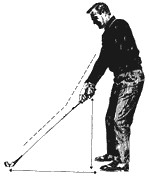
You will find numerous methods online and in books to explain how you can judge the correct distance to the ball, and you'll notice that it's not an exact science. And two additional factors probably account for this inexact advice: One's body type and equipment (and whether that equipment is fitted to one's body type). For example, maybe you're 6 feet tall and skinny but your arms are short for your height. Or maybe you're 6 feet fall with a long, thick torso but you have short arms and legs. No matter, all of these characteristics can affect how far away you should stand from the ball to get an ideal swing plane. To me, the best advice is to just allow your arm-triangle to hang straight down from the shoulders, such that there's some open space between the arms and body; a down-the-line view would give the arm-triangle plane a perpendicular-to-the-ground appearance (though the arms may reach out towards the ball a bit more with the driver). I like to think of this triangular arm plane as floating on top of the chest and swinging around the neck and NOT underneath the chest; this should help you to visualize how to assume the proper distance to the ball with a given club.

I had experimented with a taller posture, which can cause one to stand closer to the ball, especially if one is not a tall player. Anything in golf can be taken too far, and what was a good thing, in retrospect, had gone too far for my body type. Standing closer to the ball, with a narrower stance and a taller posture, can lead to a swing plane that's too vertical, especially troublesome for shorter players. I had pulled my arms in closer to my chest, such that my elbows were REALLY close to my stomach. My arms were no longer just hanging from my shoulder sockets as they should be; I had been using unconscious tension to pull my arms inward, with my hands too close to my thighs at address. I had become that version of golfer that Tom Watson said didn't really exist: I was standing TOO close to the ball. My arm-triangle plane was angled inward; it no longer hung straight down. I had become TOO connected, meaning my entire upper arm was pressed against my torso, when only the top part of the upper arms should be pressed against or connected to the chest.

To correct my mistake, I had to let the triangle formed by my arms at address hang a little more freely from my shoulders, and because of this, I had to back away from the golf ball a few inches and bend over more. The club shaft automatically lowered into a flatter position at address, and I could focus a bit more on the inside of the ball instead of the top of it. It felt like I was much further away from the ball, and my posture was more bent over, covering the ball more. If you're 5-9 like me, chances are your posture should be more bent over, and your swing plane more flat. Getting further away from the ball (still only far enough so that one's arms hang freely) automatically shallows the swing plane and makes it easier to hit from the inside-out. It's also easier to stay in one's correct posture, covering the ball through impact, because the arms have space to move through without crashing into the body.

I finally started seeing a push again, which was a welcome sight after lining up on the left side of tee box, hoping to hit a push-draw, and instead, ending up with a pull-hook into the left rough or trees. If you do this and start pushing the ball, you will only need to close the club face more to get the ball drawing. If it starts hooking too much, you'll need to work on closing the club face less. This works hand-in-hand with a correct takeaway; be sure to keep the club outside the hands in the takeaway and avoid jerking the club inside, which will just cause another pull situation due to rerouting the club on the downswing.

Standing too close to the ball causes golfers to stand too upright, losing the forward upper body tilt. The arms won’t have enough room to hang and swing freely, causing the club to be lifted by the hands in the backswing, forced down on the downswing, and lifted again to the finish position. Since the hands are overly active, the body will remain relatively inactive resulting in poor club contact with the ball and very weak shots.

How's Your Distance to the Ball at Address? ~ Create Golfers

Your posture determines your swing plane to a large degree. It seems that golfers who stand very tall and close to the ball have very upright swings and golfers who bend over a lot and are farther from the ball tend to have flatter swings. I would encourage the average golfer to bend forward more in order to make it easier to make a flatter (more rounded) swing as this will help him hook the ball and also help him take a divot after the ball is struck.

Jim Suttie: How far is too far and how close is too close? » Naples Daily News

Heck, if we can stand too far where we're reaching or stretching for the ball that takes us out of dynamic balance. It should be obvious that the exact opposite could be true. We can stand too close to the ball and be out of dynamic balance. In fact, being way too close to the ball, we're in trouble when we swing down with our hands and arms and club to impact the ball. We could very likely start bumping our arms into our body or into our hips or into our legs and have to spin out of the shot too fast to make room. So yes, we can definitely stand too close.

The Proper Distance to Stand from the Ball at Address | Swing Surgeon

Interestingly enough, Martin Kaymer just brought this up last night on the Fix. He said when hitting a draw, he sets up a bit further away from the ball. This results in 2 key things for shaping a draw: I allows him to come more from the inside without getting stuck, and it flattens out his swing plane a bit more.

OTT pull swingers may be standing too close

Standing with your body too close to the golf ball so you don’t give yourself enough room, then you try and lean back to create room, there’s another big cause of the fat shots.

Causes and Cures: Fat Shots, Golf Video

If you stand too close to the ball the club gets too steep in the back swing and if you are too far away, the club becomes too flat. You need to get a feel for this and ensure that your weight is in the center of your feet. If you are too far away from the ball, you will feel like you are too much on the balls of your feet. If you are too close you will be on your heels.

Golf Ball Position In Stance, Golf Stance Tips, Lesson, Ideas


Tuesday, April 23, 2013

Preset Open Hips

Open hips
Open hips/open stance.

If you're struggling with solid contact, it's always best to try something different in your setup. The swing itself is best when the setup, posture, grip, and alignment (GASP) create a somewhat automatic backswing and downswing. Trying to control small muscles in the arms in an attempt to provide power and club face control (i.e., steering) is a recipe for disaster. A good setup should help you "automatize" the swing.

Here's something I've found that really helps me create consistent, solid contact. Please note that, depending on your body type and swing mistakes, trying this may cause you more problems than it solves. Try it as a drill (at the very least) before you determine whether this is of any help. Of course, I can only theorize why it's helpful, and I will get to that shortly.

First, let's get to the heart of it: Setup like you normally would with feet, knees, hips, and shoulders aligned square to the target line, as the fundamentals tell us to do. You can even setup with slightly closed feet, and the correct shoulder position should feel somewhat closed, although in reality it's square (shoulders pointing left is a major no-no). Now, before swinging back, preset your hips into a slightly open position. Yes, you can do this even though your feet are square/closed and the shoulders are square, due to the mobility available in the hips (assuming you have no restrictions in the movement of your hips). In essence, you're starting from a correct preset impact position, and your hips are "out of alignment" with the target line compared to your shoulders.

Starting my swing from this position created very powerful near-center-face hits on all clubs, so I decided to analyze potential reasons why this apparent break from the fundamentals is helpful to me, especially given that open hips are supposed to contribute to slices and pulls.

First, I think simulating the impact position before starting the swing pre-programs the brain on what the impact position should be for a particular club and lie. You're giving your brain a "pass-through" point in the swing; instead of trapping the ball between backswing and followthrough, you've added a middle waypoint to connect those dots.

Next, you'll notice that opening the hips while keeping everything else square automatically puts a little more weight on the front leg and positions the remaining weight into the right instep where it should be. In reality, your knees will move slightly to the left when opening the hips, so you should let them (don't think about moving the knees consciously); the right knee will automatically tick inward a bit, which is a solid setup tip unto itself.

Next, when you swing back and rotate your shoulders to 90 degrees, you'll notice now that your hip turn is VERY restricted and that it's difficult to stay in a fully rotated position. The shoulders instantly want to release the tension, which means more power for your downswing. You're basically presetting a greater "X-Factor" or differential between the shoulder line and hip line at the top, which is what the X-Factor calls for. This tension is a good thing because it's going to provide automatic unwinding power from your body down to your arms and club.

You'll also notice that your weight automatically concentrates into your right instep where it should be at the the top of the backswing and thus you can't really sway to the right off the ball with the hips or shoulders.

The hands and end of the club handle also move fractionally more forward of the ball, which is where they should be at impact.

Finally, when you let that automated unwinding happen, your weight gets instantly back to your left leg as it was at address, because there was no sway off the ball. You're moving left well before impact without even thinking about it.

There may be other reasons, but I believe these are probably the main reasons why presetting open hips assists me in making reliable, solid contact.

I believe that there are other versions of this same line of thinking out there. Opening the left foot while keeping the right foot perpendicular to the target line (espoused by Hogan) or using a slightly open stance with closed shoulders (like Trevino or Couples) are really designed to do the same thing. It's important to note that all of these golfers favored a fade, and open body lines at impact are associated with a left-to-right ball flight. However, you can still hit a draw using this technique; experiment with different grips, ball position, turning the club, swinging more right, concentrate on hitting the inside of the ball, etc. Trevino stated that he used the same setup for draws and fades; he pictured a row of four balls, and for fades he would try to hit all four in a row, while he would only pick off the first ball without hititng the others for a draw.

You can preset open hips for all shots, especially including the short game and even for putting (it locks the knees into place and prevents swaying), and for full shots, you may choose to use it merely as a drill.

Speaking of Hogan, I believe DTL views of his swing show that he also preset his hips slightly open, because you will notice his right knee ticked in slightly and his left foot flared out with the right foot perpendicular.

Last but not least, all three main horizontal planes, i.e. feet, hips and shoulders should never be parallel to one another. Hence the idea of increasing the diagonality of the stance in three planes - hips open in relation to feet, shoulders closed in relation to hips. Of course shoulders are used for visual aiming while feet seeks for ultimate balance and ultimate benefitting from ground forces.

Biokinetic Golf Swing Theory: Setting the Swing Motion

Pre-Set Drill: A great drill to properly train the feel of Key #2: Weight Forward is to pre-set your impact position before making a golf swing. Here's how:

1. Set up over the ball as you normally would.

2. Move your left knee and hip towards the target and open them slightly. Let your hands shift towards your left thigh as you do this. You'll feel more weight on your forward leg.

3. Make a half to three-quarter backswing leaving your left knee and hip forward.

4. From there, bump the hips even farther forward, hit the ball, and swing to an abbreviated finish.

Doing this drill properly will set you on the path to achieving Tour-quality impact.

5 Keys | GolfTipsMag.com

A common error of golfers of all levels is lining up too far to the right of the target. This forces you to come over the top on the downswing to reroute the club on line, then release the hands quickly to prevent a slice and send the ball toward the target. These corrections put too much pressure on the small muscles of the hands to release the club at precisely the right time. You may be powerful, but you'll find yourself missing the target in every direction.

If you're going to make mistakes in alignment, make them to the left of the target. An open stance presets your hips in a cleared position, as they begin slightly rotated toward the target. You don't need a quick release of the hands; instead, you can square the club with the big muscles of the shoulders and back and approach the ball from an inside path. Keep your stance square to slightly open to develop a repeating swing. Don't let yourself drift to the right.

Set up for straight shots | Golf Features | IntoTheRough.co.uk

For pitch shots and chip shots, there is a much less aggressive turning of the body through impact. This is especially true for chip shots, as the chipping motion more closely mirrors a putting stroke. To overcome the less aggressive hip turning through impact, ideally we want to set up with an open stance to the target line with our body lines. This ensures open hips through impact, and the result is our arms can swing freely without manipulation to the follow-through position.

Believe it or not, this also comes into play with putting. Although it is common for teachers to tell students that their entire body alignment should be parallel to the target line, most tour professionals set up with open feet, knees, and hips (with the shoulders remaining square to allow a proper putter path). Again, this open alignment of the lower body allows the arms to swing down the target line in a free manner.

Golf Teaching Pros: Why the Open Stance?

If that sounds familiar, here's a drill to help you start the club back straighter and shallow out your downswing. Set up in a dramatically open stance, with your feet aimed 30 or 40 degrees left of the target. Then swing back along your stance line. This will prevent you from pulling the club to the inside and will create a wider arc. You'll get into a lower, flatter position at the top (below).

Jim McLean: Open Up To Fix Your Slice: Golf Digest

Sunday, March 24, 2013

Hover Craft

I think Jack Nicklaus' preference to hover his club at address could help many players, and I have found it helpful to me with all the clubs--even the putter. Why? It definitely smooths the takeaway and backswing because the club can't catch on the ground and be jerked off plane. It prevents unnecessary tension from forming in the arms and hands which can happen when "snatching" the club off the ground to execute the takeaway; in other words, it helps keep the arms passive in the swing, as it should be. Hovering the club or "underreaching" provides for the feeling of the arms and club hanging freely from the shoulders, so there's an enhanced sense of the club head weight. Fat and thin shots are greatly reduced, because the wrists are allowed to extend more fully at address instead of starting less extended and then extending more in the downswing.

In the case of the driver, it can preprogram your driver head to help find the sweet spot on the downswing. But it's important to hover it properly to promote this: Tee the ball so that you can hover the club to position the ball just a hair above and right of dead center, which is the sweet spot of modern drivers. Therefore, the club is just barely off the ground. Don't hover the bottom of the club even with the bottom of the ball.

With fairway woods I position the club on the barely touching the ground because I like to think of the ground as my tee; with fairway woods, I'm trying sweep the ball like a driver.

With the putter and irons, it's the same: just barely above the ground.

Provided the arm tension and posture remain constant, hovering the club should ensure clean contact. The key is to use your posture with fully extended arms (not locked) to hover the club; don't fall into the trap of lifting the club up with your arms.

...The problem is teeing up higher and placing the driver on the ground at address. For example, let's say that you tee the ball up so that 2/3 of the ball is above the driver head. If you return the driver head to its address position, you will hit a pop-up. So you will have to raise the driver head off the ground at impact. But if you do this, the driver head moves further away from your body and cause heel hits.To fix this and hit it in the middle of your clubface with higher tee height, hover the driver head (off the ground) just behind the ball. I think you will be able to fix your heel hits with this adjustment.

Can't Hit The Driver - Golf Samurai

When I watch a PGA Tour event, Champions Tour event or LPGA Tour event, I'm often struck by how many players hover the club at address. They do not rest it on the ground before starting their takeaway. To name a few players: Bubba Watson (click on the link here), Dustin Johnson, Jason Day, Matt Kuchar, Steve Stricker, Davis Love III, Jay Haas, Greg Norman, Yani Tseng, Cristie Kerr. Get the picture? Yet, I rarely see average golfers do this. These tour players all hover the club when the ball is teed, but a number also use the same technique on pitches and even putts. You should try it, too, especially if you feel you have difficulty bringing the club back, or would like to smooth out your takeaway, or have trouble making solid contact on pitches from tight lies.

Weekend Tip: Don't sole the club at address: The Instruction Blog: Golf Digest

JIM FLICK: I'm reminded of what the legendary player and teacher Paul Runyan described as "measuring out" or "underreaching" at address. Paul contended that if you didn't sole the club but held it just above the ground, and then kept your grip tension and spine angle constant throughout your swing, you would always hit the ball cleanly.

This principle is especially true for pitch shots, but it also holds for irons, fairway woods and, yes, the driver. And with today's fairways mowed so tightly, it really helps you make perfect contact. You want the club to return to the ball in a precise manner every time.

Jim Flick And Jack Nicklaus: Hover The Club At Address: Golf Digest

Another simple way to stay loose over the ball is to hover the clubhead just off the ground (above, right). Hovering the club promotes a free-flowing movement away from the ball and sets the stage for a smooth, rhythmic backswing. In many instances, when players rest the clubhead on the ground for any length of time, they freeze over the ball, which encourages muscle tension to creep in.

By hovering the clubhead you'll begin to feel the weight of the head. This will help you to start back at a nice, controlled pace.

David Leadbetter: Hover To Beat Tension: Golf Digest

The biggest problem amateur golfers like me and you have when it comes to the short game is chunked shots. To help prevent fat chips, try the under-reach technique. Begin by assuming your address position, with your arms hanging to their natural length. Choke down on the club about an inch (I go even shorter, about two inches), and hover the club just off the ground as you get ready to execute the shot. The combination of choking the grip and hovering the club will help you guard against hitting the shot fat. When you finally make a swing, simply concentrate on contacting the bottom half of the ball.

Golf Short Game Swing Tips at GolfGist.com


Tuesday, March 12, 2013

Spine Angle Required

I've briefly touched on this in a few other posts but wanted to give some more time to discussing the topic of maintaining--throughout the swing--the spine angle that was established at address. The golfing world has bestowed several different clever phrases to discuss this subject. It's been called "covering the ball with your chest," "keeping the head down," "staying over the ball," "keeping the upper body still," "staying in your posture," and, of course, "maintaining the spine angle." The opposite of this--the mistake--also has many names, like "standing up," "coming out of the shot," "losing the spine angle," "early extension," "losing the posture," "raising the head," etc.
For the purpose of this post, I'm referring to the primary spine angle, which refers to the angle of the upper body to the legs when viewed down the line. The secondary spine angle refers to the axis tilt to the right when viewed from the front, primarily caused by the right hand being lower than the left hand on the grip.
The mysterious "spine angle" really isn't solely about the spine, as the S&T creators have eloquently argued, because the spine bends all over the place during a golf swing. It's not really about keeping the head down either, because you can still change the head position vertically from the neck while maintaining spine angle. I like "covering the ball" best as a description, because it drives home the point for me that the overall angle of the upper body established at address (i.e., posture created by bending over from the hips) should be maintained at least through impact; I would argue that amateur golfers should work to maintain it well after impact, as they risk coming up too early otherwise. This is that "head on a pillow" look in the followthrough and finish position, or looking at your initial ball flight through slanted eyes.
In other words, the "tush line" should be maintained through impact; if the pelvis begins to move forward (i.e., the upper body comes up)--even a little--at any point before or during impact, the radius required for the swing gets longer, making it harder to hold lag through impact when it's needed. As a matter of fact, losing the spine angle is a major factor in many mishits and bad results, to include inconsistent, short, fat, thin, pulled, and sliced shots. Most expert golfers may come up a little well after impact, but you'll notice that they are still bent over towards the target line, even in their finish positions. Some professional golfers have upper body positions that actually sink even lower than their address positions before impact!
An additional, related aspect of spine angle is shoulder plane. The left shoulder should point down towards the ground (in the direction of the ball) at the top of the backswing (right shoulder rotated up and behind the head), maintaining a perpendicular relationship to the spine angle. The left shoulder should be touching or very close to touching your chin at the top. On the downswing, the right shoulder should replace the left shoulder's previous position, and vice versa. Keeping the shoulder plane more "vertical" allows the arms to hang more from the shoulders as they should through the shot. The correct shoulder plane is actually a side bend; stand up and bend fully sideways to the left from the waist. Now simply rotate to the right (pointing in between both feet) and the shoulder plane should be in the correct position to maintain the backswing spine angle.
Believe it or not, the right knee can affect your spine angle. Notwithstanding Stack and Tilt, you should strive to keep a bend in your right knee at the top of your backswing.
Maintaining one's spine angle or covering the ball is important for EVERY shot in the book, to include putting, chipping, pitching, and bunker shots. It encourages movements that make drives long, powerful, and accurate. It encourages you to keep lag through the shot, because otherwise you will hit fat. It helps prevent fat shots due to an an early release or cast (usually a direct, autonomic, and unconscious manipulation as a result of "standing up"). "Standing up" and "casting" are directly related to each other. Staying over the ball frees you up to swing faster while still feeling in control; you can really pop the driver when covering the ball.
Actually, the only way you can really deliver lag to the ball is to maintain the spine angle. Now you'll have to learn how to lag the club by keeping the wrist angle late into the ball to keep from hitting fat. You will have to learn to keep the wrist cocked late and make contact with the ball with the right wrist still feeling bent back or dorsiflexed. If you lose the spine angle or stand up then you must cast or straighten the wrists to have any hope of contacting the ball; the result in this case is a powerless poot shot, duff shot, or skull across the ground!
Here's how to diagnose that "coming out of the shot" is a problem causing some of your mishits. First, take your address position (ground the club if you usually hover it), execute your takeaway, and stop when the club is parallel to the ground. Now, immediately rotate back to the front without bending from the hips and see if your club re-grounds itself in the same position behind the ball. If your club comes back above the ball then the distance from the club to the ball represents how much you stood up on the takeaway! In all cases, make sure your arms are fully extended and knee flex remains unchanged.
If the takeaway isn't your problem (or even if it is), do the same procedure above with the only exception being to stop at the top of your backswing. Again, any distance between the ball and club represents how much you came out of your spine angle. Now, slowly rotate to your usual impact position and do the same procedure. In each case, you will learn exactly how much your spine angle is changing throughout the swing. Do the same procedure again for takeaway, backswing, and downswing and pay attention to your pelvis; it's very easy to see when you're standing up when you pay attention to it. Video analysis also works, or you can have a friend touch a club to your head while you work through these exercises.
You may only be standing up in one part of the swing, or if you're like me you could be doing it some throughout the entire swing. It's possible to do well at first but start losing the spine angle late into a round as one begins to get tired. The tendency is always to stand up, because it requires strength and endurance in the core muscles to keep covering the ball as one must to execute good shots.
Now, it's important to drill the correct feeling, which is literally a feeling of covering the ball with your chest through impact. If you've been standing up, you'll notice a distinctly new feeling of the right should coming down and through the shot and replace the position of the left shoulder as the upper body rotates through.
The whole idea of keeping your spine angle consistent is that it will help you to keep the “shape” of your swing consistent. When the shape of your swing is consistent, it is much easier to deliver the club face in a square position at impact.
Newsletter: The 3rd Key To Consistency: Spine Angle | Target Centered Golf
There are two main ways to lose the spine angle. A dive and a loss of “tush line.” A dive is what Tiger does and to see if you have this problem, put your finger on the end of your nose on a video from behind and down the line. If your nose moves out or down toward the ball, that is not good. If it happens a little, it’s nothing to worry about, so don’t go out and ruin your swing by trying to keep you head still.
To see if you are losing the tush line, you need a vertical line (same camera angle as above) like an imaginary wall your behind is up against and your body pulls away from that line during the swing. This is also known as standing up or pulling out of it…not to be confused with keeping your head down.
Maintaining spine angle | Monte Scheinblum's Blog

One crucial element for good iron play is to maintain a constant spine angle throughout the swing. This enables you to hit down at impact, correctly taking a divot after the ball. Many amateurs tend to rise up as they swing the club down in a mistaken attempt to help lift the ball into the air. Lifting leads to poor contact such as fat or thin shots. To correct this tendency, swing to a finish position and then hold it for a moment. Then bring the club back down as if someone hit the rewind button. You should be able to get right back into your address position. That's maintaining your spine angle.
How to play consistent golf: Golf Digest

Friday, February 22, 2013

Avoiding the Inside Takeaway

Yes, we amateur golfers hear over and over again that we should swing inside-out and not over-the-top (OTT). In an unconscious effort to achieve this, we often roll the wrists and bring the hands and club inside too quickly, often well below the waist, during the takeaway. This often leads to the very thing we're trying to avoid--an OTT move that is unconsciously utilized to get the club back on line and hit the ball. The result is often pulls and pull-hooks for better players who can close the club face well; for others who can't, it produces a slice. Another symptom of this condition is a very narrow swing arc going back, with the right elbow bending too early and getting too close to the right side. The right elbow will drop into the right side coming down; it's no help to you there early.

Pulling club inside
Incorrect: club too inside

One should always ensure that the clubhead stays outside of the hands for as long as possible, when viewing the takeaway down the line. In other words, the clubhead should only move inside somewhere in the upper trunk area--around the right shoulder. If it moves inside at waist level or even below, the club is being jerked inside by the hands and/or the right elbow is bending too early. The right elbow should ONLY FULLY bend late in the backswing. The hands stay in front of the body and only move inside due to the correct shoulder rotation. Actually, the correct shoulder turn in the takeaway and backswing SHOULD prevent you from doing this, provided you're not using the small muscles in your arms and hands to move the club.

Watch slow motion video of professional golfers (down-the-line view) and pay attention to the takeaway; specifically, look at their hands in relation to the club face, and pay attention to the bending action of their right elbow. You'll see that the right elbow bends late (and only reaches a full bend REALLY late in the backswing), and you'll notice that the clubhead stays outside of their hands (when viewed down the line) for a long time. The club head only comes inside (passes their mid-body line) somewhere around their right shoulder, not down near the waist like us inside-early schmucks. Their hands remain in front until waist high or even slightly above the waist; in other words, it's as if the hands move backwards in a straight line during the takeaway. And when the club head does finally move inside, it's due only to the motion of the shoulders turning; the arms and hands have nothing to do with it!

If you're guilty of this huge golfing transgression, you will feel like you're taking the club OUTSIDE the line when you first start doing the correct motion. But you're not going outside as long as you move everything--shoulders, arms, and hands--back together. You're on your way to achieving WIDTH in your backswing, which will help in numerous ways.

Club correct
Correct: Club outside hands

Coming down, the right elbow will drop in close to the right side around the right hip, as you fire through. In essence, the swing is going from wide to narrow to wide again in the through swing. In other words, the swing flattens some coming down, and if you traced the club head all the way through, you would see that the club head actually loops up and then under a bit, giving your swing an inside-out path naturally. The OTT swing has the opposite loop: up and over.

Another key point: When you move the arms and club back in this way with the club head staying outside your hands, you'll be prone to swaying your hips to the right, especially if that's already one of your problems. To counter this, imagine that your right hip moves straight back and towards the target in the takeaway to counter the weight of the club head staying outside the hands. In a sense, you want to think of them moving in opposite directions. Sounds silly, I know, but if you look at DTL video of pro swings, you'll notice that their right hip moves backwards slightly during the takeaway. This will get you swinging the club back on the right plane without your swing center moving off the ball.

With any "fundamental" in golf there come the gotchas. For this aspect of the takeaway, remember that the arms and hands should simply move up during the takeaway in relations to the chest, while the club head stays outside the hands! In reality, the hands also move inside (inside or back, and up simultaneously), but the inside part of the equation happens only because the shoulders are turning. The hands and arms should not roll the club open, pull the club inside, nor should they move out away from you; if your hands move out away from your body and not inside and up during the takeaway, you're setting up for an OTT swing even if the club head stays outside the hands.

This is an especially good thought for the open-clubface-at-impact slicer. Most of these slicers create their open clubface because they roll the club wide-open during the first three feet of the swing. As a result, the club usually gets way behind them at the top, and from that position, it is very difficult to square it up. There must be some wild, compensating move made coming down. If you think "hands inside, club head outside", this will keep your clubface square at waist high, and will also help put you in the proper shape at the top of your swing. It will definitely prevent that clockwise, rolling-open action of your forearms and club, which has led to many disastrous shots over the years. So remember, "your hands are in, the club head is out...as a result, you will be square throughout".

Golf Tips - Hands Inside the Club Head During The Swing

Take the club straight back low to the ground and allow the turning of your shoulder to bring the club inside on the back swing. Do not pull the club to the inside with your hands and wrists but also guard against reaching too far back. Reaching will cause you to sway off the ball. Prevent reaching by keeping your weight on the inside of your right foot.

golf long drive take away and back swing

Another great practice drill requires the use of two alignment clubs. First, place a club above the ball, parallel to the target line. Then place a second club eight to 10 inches inside this line. You’ll notice the two clubs form a path, which should be your track on which to swing the club. At first, it will probably feel like the club is moving to the outside of the target line, but after a number of repetitions, the proper swing path will begin to feel normal. Practicing this drill will help keep your shoulders, hips and feet in alignment, and promote a more on-plane backswing.

Staying On-Plane | GolfTipsMag.com

My point in that article, and in this tip, is, if you will make a conscious effort to take the club back straight for as long as possible, you'll give yourself the optimum chance for a powerful, square-faced return of the clubface to the ball.

Instruction Tip #39 - The Takeaway

The most influential component of swing arc is the position of the right arm throughout the backswing. A player with a narrow swing arc tends to fold the right arm too early or keep it unnaturally pinned to the right side all the way to the top. Both flaws pull the club in too close to the body. The player with this flaw will feel the need to free the club by throwing it way over the top and away from the body.

Stop Coming Over The Top | GolfTipsMag.com

The best way to fix an inside golf swing takeaway is to work on your wrists and the role they play. The first initial movement should be the hinging of the wrists vertically instead of horizontally. You need to ensure your left wrist does not flatten out too early which pulls the golf club on the inside. Next you need to move the golf club across your chest as you hinge your golf club vertically.

How Your Golf Swing Takeaway Is Destroying Your Golf & How To Fix It In Just 5 Minutes

What is the one flaw in the golf swing that leads to inconsistent golf shots time and time again? If you hook, slice, hit fat or thin shots and can’t figure out the cause, you may be bringing the golf club back too far to the inside. If you want to master the takeaway, then you must keep the golf club outside of your hands in the backswing. In this article, we are you to cover a few simple golf tips that you can use to stop taking the club back too far to the inside.

Stop Taking the Club Back to the Inside: Fix Your Takeaway Today!

To determine if your hands and clubhead are properly positioned, assume your normal golf stance with a full-length mirror to your right (left, if you’re left-handed). Watch your takeaway and note where the shaft points when your hands have reached the right pocket. If it points in front of you, good – the clubhead is outside your hands. If it’s already parallel to the target line or pointing behind you, your takeaway is too far inside.

A simple way to instill a “clubhead outside the hands” takeaway is to keep the butt of the club pointing at the right hip as it passes by. If the butt points left of this spot, you’ve got too much wrist action and/or an inside path.

Be mindful of the rotation of your forearms on the takeaway. If you pull the club straight back without the arms and hands rolling naturally, the clubface will become closed. Check the toe’s position at the parallel point as described above; if it points well in front of you, it’s closed.

Think “Clubhead Outside the Hands” for Solid Takeaway

A good takeaway sets the pace for a good swing. Unfortunately, many amateurs get off to a shaky start: They lift the club and roll their hands away from their body, which draws the clubhead inside and opens the face. As a result, they make erratic contact.

Perfect your takeaway - Golf.com - GOLF.com

Tuesday, February 19, 2013

Address Procedure, Shaft Angles, and Taller Posture

I recently discovered a simple error I was making at address that affected the consistency of my contact in the full swing, especially with the driver. This unlikely culprit was also causing me to bend over too much from the hips with too deep a knee bend at address. What was this error? The angle of the club shaft to my arms was not large enough. In other words, I had preset too much radial deviation and not enough ulner deviation at address; my wrists were preset with too much wrist cock (too close to 90 degrees), which meant I had to bend over more from the hips, bend the knees more, and widen my stance in order to address the ball!

Taller posture
Taller posture, larger wrist angle

The result was inconsistent contact on the club face, and the club was also bottoming out behind the ball (fat) or hitting the top of the ball (thin and skulls). I would get a lot of pop-ups and skulled shots with my driver. The wrist angle naturally increases in the downswing as the wrists uncock, which means the difference between my address shaft angle and impact shaft angle was too great; the impact shaft angle is usually always more upright than at address, but too much can cause the errors I was experiencing.

I should note that the two work in tandem: a taller posture should cause one to address the ball with a more upright shaft and, thus, a straighter wrist angle (shaft-arm angle). And the opposite is true. Therefore, as the angle of posture (legs to trunk) decreases (moves away from 180 degrees towards 90 degrees), the shaft-arm angle also decreases (i.e., the hands get closer to the ground). And vice versa.

Other variables play a role. One's body type and equipment (length of shafts and lie angles) have an impact in this equation. You should experiment to find what's best for you to make solid contact in the center of your clubs. I wrote before about having the grip point at the belt buckle at address, but the truth is that this may be too flat for some players: it should point somewhere between the belt buckle and the belly button.

Every golfer needs a good procedure for helping to ensure a proper setup or address posture with respect to stance width and distance from the ball. It's easy to overlook the importance of a good address procedure as a fundamental, but when done consistently the same way with all clubs, it helps eliminate inconsistency introduced into the swing BEFORE the first move off the ball in the takeaway.

I've written before on how a wider stance helps promote a hook and higher ball flight, while a more narrow stance helps promote a slice (a wider stance presets the upper body further behind the ball and theoretically produces a flatter swing). What set me off on my quest was learning that I tended to bend over too far from the hips (also using too much knee bend) when addressing the ball, especially with the driver; this meant that my posture was not upright or tall enough. Increasing or straightening the wrist-club angle at address automatically induces a taller posture and reduces the amount of the downward wrist uncocking (ulner deviation) that occurs during the downswing! It's important not to go too far and completely straighten the angle, but getting closer to straight will help reduce the vertical variance in club movement through the ball when the wrists uncock. In reality, it also reduces the amount of horizontal variance, helping to return the ball to the center of the club face at impact, because you're presetting both downward and outward movement of the club head.

Using chalk on the club face, I noticed that my contact with the driver face was consistenly too high. Most of my misses were no longer left and right (horizontal) but up and down (vertical) with respect to impact on the club face. I could compensate slightly by hovering the club completely above the ball at address, but this was ridiculous as no golf professional does this, and the contact was still too high on the face. So, on a whim, I addressed the ball as usual and then raised my posture a few inches. Doing so caused the angle between the club shaft and arms to increase as my wrists had to increase in ulner deviation to keep the club aligned with the ball. Standing taller can also cause the stance width to decrease slightly, but what's more important is to recognize the relationship between the angle of the address wrist cock and the amount of upper body bend (or posture) over the ball at address. Subsequent drills using chalk as an indicator produced many more impacts located in or nearer to the center of the club face, which is essential for distance with any club but especially for the driver.

So I asked myself if there might be a more failsafe method of addressing the ball to achieve a taller posture, better stance width, larger arm-shaft angle, and correct distance from the ball, and I remembered something that I had poo-pooed away before but that most professionals do some form of when addressing the ball.

After ascertaining the proper aim behind the ball, one should first place the club behind the ball on the intended starting or target line (aligned to a close target a foot or so in front of the ball on the intended starting line). This should be done, initially, with both feet together with the ball located on a line running between both feet and perpendicular to the target or starting line. Most important is that the wrist angle at address is extended or closer to a fuller down-cocked position. The knees, hips, and shoulders should be on lines parallel to the target or starting line. The head should be located slightly behind the ball. At this point, one should assume the correct upper body posture by bending over from the hips with the arms hanging to get the correct distance from the ball; if you've suffered from too much wrist cock at address, your posture should feel much taller.

Address procedure
Address procedure

Now, all that's left to do is to move both feet to a stance comfortably wide enough, with a very slight knee bend, to maintain that upper body posture relative to the ball established when both feet were together! Your head and upper body should not move vertically when you take your stance. In other words, the posture stays taller. With the driver, only the right leg need move, as the ball position should be more forward. The shoulder, hip, and knee lines shouldn't move from their original positions; if they do, then the stance assumed has been too wide. If one wants to hover the club (to improve impact or smooth out the takeaway) then one should hover it when going through this procedure; otherwise, the upper body's posture will change when raising or grounding the club.

Notice that tour players look “big” compared to their clubs. Even with a longer iron, say a 4-iron, they seem to be standing “on top” of the ball, meaning the ball is not too far from their feet. Their spines are generally bent forward a fair amount, and the shaft of the club points at the belt-line, and often higher.

Are Your Golf Clubs Too Long? | Golf Things Considered

The clubshaft should be pointing to the belt buckle or slightly above it…

10 Checkpoints For Proper Setup Position ~ Create Golfers

In establishing the correct shaft angle, we also resolve the question of the correct position of the hands at address. Far too many players hold their hands too low at address - few hold them too high. Holding the hands low at address is a major cause of excessive wrist action in the swing. A vice to be avoided at all costs!

Here once again, is the routine:

1 Evaluate the shot.

2. Take up your grip and square the club face to it.

3. Ground the club correctly behind the ball.

4. Now place the feet into position.

Note that the positioning of the feet came LAST.

The average golfer often reverses the procedure, placing his feet first, then vaguely grounding the club he juggles with his grip in an attempt to get the club-face square. There is no logical sequence in his method and his last minute grip adjustments account for the fact that his grip is never the same one shot from the next.

Golf Lessons - Lesson 4 from Golf Today

In an athletic address position the arms hang comfortably from the shoulders with a slight cocking of the wrists as you grip the club. The toe of the club should be off the ground slightly, with the club resting more on the heel of the club. From this set up position it is easier for the wrists to cock correctly, starting the club on plane and setting the club at the top of the back swing.

Club lie angle at address and impact are not the same | Derek Hooper Golf


Monday, February 4, 2013

Driver Downswing: See the Ball at Eye Level

One feel I use to shallow out the driver is to feel that my eyes are behind and level with the back of the ball up to the point of impact. Impossible, I know, but we're talking about a feeling here, not reality.

Ernie Els - Head Back!
The head and chest are behind the club shaft, the head is actually behind its original position.

Another way to put this is that--of all the clubs--it's most important with the driver to exaggerate staying behind the ball! It's true that the longer the club the more behind the ball you should be at impact, but it's an absolute necessity to hit good, penetrating drives with the driver.

Look at slow motion video of most professional golfers and you'll notice that, up to the point of impact, their heads are located over their right leg when swinging the driver. In many cases, their heads move FURTHER right from the initial address position, which was already behind the ball! (You'll still notice that their heads are behind the ball with other clubs too--just not that far back.) Thus my feel of trying to get my eyes behind and level with the back of the ball. The continuing motion of the arms and club will pull you fully over into the left leg and into your balanced finish.

A wider stance and increased rightward tilt at address will help with staying behind the ball at impact, but it also encourages a hook. Remember that a wide stance is a hook condition, meaning that it inhibits lower body movement and encourages more arm movement through impact. If you find yourself hooking the ball wildly, you may need to go with a more narrow driver stance to help straighten out your drive; a narrow stance is a fade or slice condition, because the body can get ahead of the arms; as the stance widens, the swing plane becomes flatter, and the plane becomes more vertical with a more narrow stance. There are many such characteristics associated with different ball flights that you can use to encourage a shot shape you desire, but remember that you still must be able to get behind the ball and stay there up to impact.

Swinging this way also allows you to tee the ball up higher to encourage a high draw without the fear of sliding the club UNDER the ball and hitting pop-ups, which is common with golfers who swing the driver too steeply.

Staying back like this with the driver helps to shallow out the downswing and produces a flatter swing plane, causing the golfer to catch the ball on the upswing and impart an upward angle of attack, which reduces backspin, helps ensure an inside-out motion (often resulting in a nice draw), and thus, increases distance. Some instructors teach setting up with an exaggerated spine tilt to the right, but this doesn't help if the golfer immediately begins moving back over the ball (as if hitting an iron). As a matter of fact, it might be best to set up with a rightward tilt with the understanding that this right tilt will, initially, increase when the downswing begins.

Some golfers try to keep their head still or over the top of the golf ball. To make a full turn on a swing with your driver your head might move a little towards your back foot. That’s fine if not desired. You need to be well behind the golf ball at impact. One should have a straight line from the front shoulder to the ball at impact.

Golf Tips with Bobby Lopez: Why Is It More Difficult To Hit Your Driver Than Any Other Club?

David Leadbetter in 100% Golf, 2004, states: "the head and upper body stay behind the ball as you unswing and accelerate into impact." Try to maintain your spine angle from the set up all the way to the moment of impact and don't worry if your head has a little lateral movement. Your head and spine are behind the ball at impact.

Keep Your Head Back and Behind the Ball Through Impact! Six Top Golf Pros Agree

The key to solid driving is that you first get fully behind the ball as you wind up your backswing. Only then can your truly stay behind the ball as you unwind on the way back down. With the driver, one of the problems that I see a lot of amateurs struggle with is they get too far ahead of themselves on the way down, which results in the swing being too steep coming in to the ball.

Remember, you have to get back to the left side to strike the irons properly, which involves making sure that your body weight is centred more on top of the left foot as you hit the ball. With a driver, if you can first get behind it and then stay behind it, you will enjoy flighting your tee-shots with a good powerful trajectory.

The BIG Feeling - Denis Pugh

Anchor the head at the beginning of the downswing. There is no need to shift the weight forward the same as on an iron shot where you have to hit down onto the ball. Keep the head back to hit the ball on the upswing.

Driving the Golf Ball - Golf Swing Driver Tips

In the swing you will need to feel that you are staying behind the ball with your upper body as you aggressively drive the hips and weight over onto the front foot. This is where the “uphill” sense comes from – as the hips drive the head stays back you create the body motion that allows for the clubhead to move up into the hit. I like to refer to this as body curve.

Driver Set Up | Andrew Rice Golf